Explore Churchill’s Leadership and Challenges During WWII
Churchill’s wartime leadership from 1940 to 1945 combined inspirational resolve and decisive action with moments of strategic misjudgement, creating a legacy that was both heroic and at times flawed.
Britain 1940
Wartime politics – the fall of Neville Chamberlain and the rise of Winston Churchill
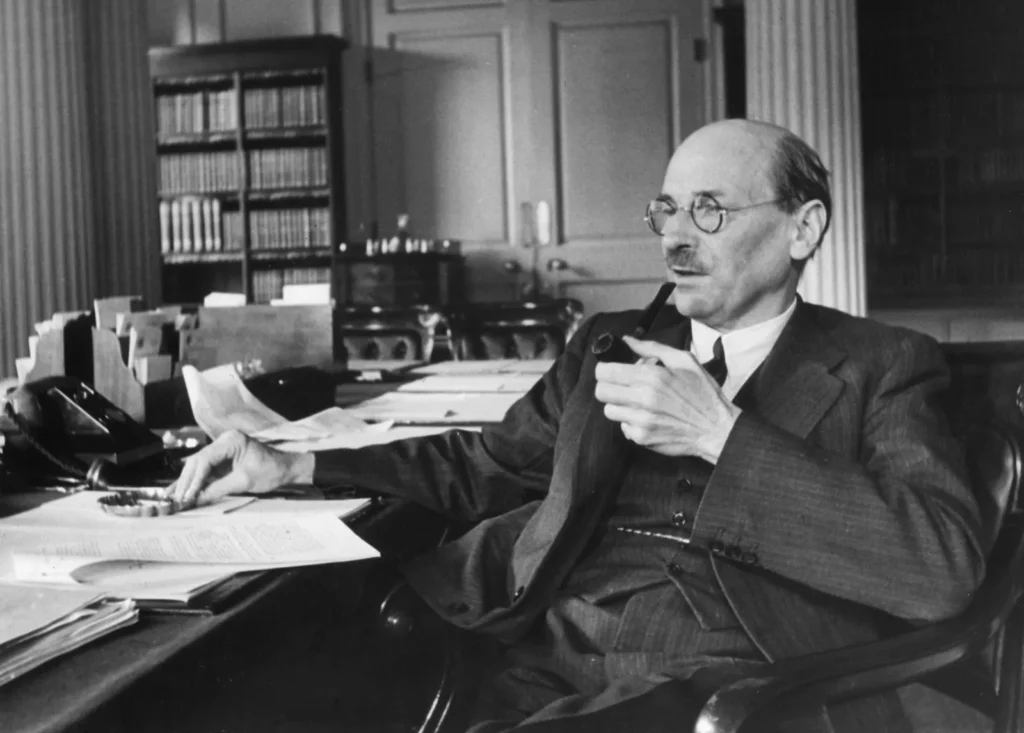
The outbreak of war had little effect on the political situation in Great Britain. A political truce was immediately agreed upon by the three major political parties. The composition of the Chamberlain government changed little. The Prime Minister was prepared to make some gestures towards his political opponents to encourage national unity. However, the Labour Party, owing to its personal hatred of Chamberlain – “he always treated us like dirt”, said Attlee, years later – refused to serve, a decision which was not unwelcome to the Prime Minister. Chamberlain was therefore forced to strengthen his team by the inclusion of leading Tory dissidents like Winston Churchill who was assigned to the Admiralty and also became a member of the new War Cabinet, and Anthony Eden. The appointment of Churchill was particularly significant. Although an ardent anti-appeaser, he remained loyal to the Prime Minister to the end, but his energy, confidence and growing popularity meant that he was, in effect, an alternative Prime Minister.
Neville Chamberlain was not cut out to be an effective war leader. An outstanding administrator and party manager in peacetime, and a lucid but uninspiring speaker, he lacked the energy, vision and popular appeal that would enable him to offer the leadership and inspiration that the nation now needed. Chamberlain seemed to recognise this himself, writing to his sister, “How I loathe this war. I was never meant to be a War Minister”.
When the scale of the military crisis became clear in April 1940, Neville Chamberlain began to face increasing criticism from groups within his own party, from most of the Labour Party, and from the press. There were various reasons for this. His policy of appeasement had been popular at first but public opinion began to turn against it after Hitler annexed Czechoslovakia in March 1939 and even more so when Germany invaded Poland in September 1939. Chamberlain was also criticised for failing to procure an alliance with Soviet Russia to deter Hitler; and for underestimating Hitler’s aggressive intentions. In April 1940, Chamberlain boasted that “Hitler had missed the bus” – a few days later the Germans invaded Denmark and Norway. This undermined faith in his leadership.
Chamberlain was also heavily criticised for not organising the economy for war with enough urgency. Some important and indispensible measures were carried out by the government in the early months to place the country on a war footing. Over 1 million children were evacuated from the great cities to the countryside after the 1st September; gas masks had been distributed and a black-out was imposed; new ministries were created; the call-up of young men into the armed forces was begun; food subsidies and rent controls were introduced and food rationing was begun in January 1940. Even so, the transition from a peacetime to wartime economy was slow and unco-ordinated and often accompanied by muddle and confusion. As late as the spring of 1940 there were still more than a million unemployed. As historian, A.J.P Taylor has commented, “the government were still moving into the war backwards with their eyes tightly closed”. Moreover, as far as the wider purpose of the war was concerned, namely, to attack and defeat Germany, the attitude of the Allied governments was cautious and defensive. In the period of the “Phoney war”, no military activity took place in western Europe. Instead the RAF dropped propaganda leaflets over Germany and the British navy performed its traditional functions of patrol and blockade. Indeed, Neville Chamberlain and other ministers had virtually convinced themselves that naval blockade alone could win the war by depriving Germany of essential raw materials and foodstuffs.
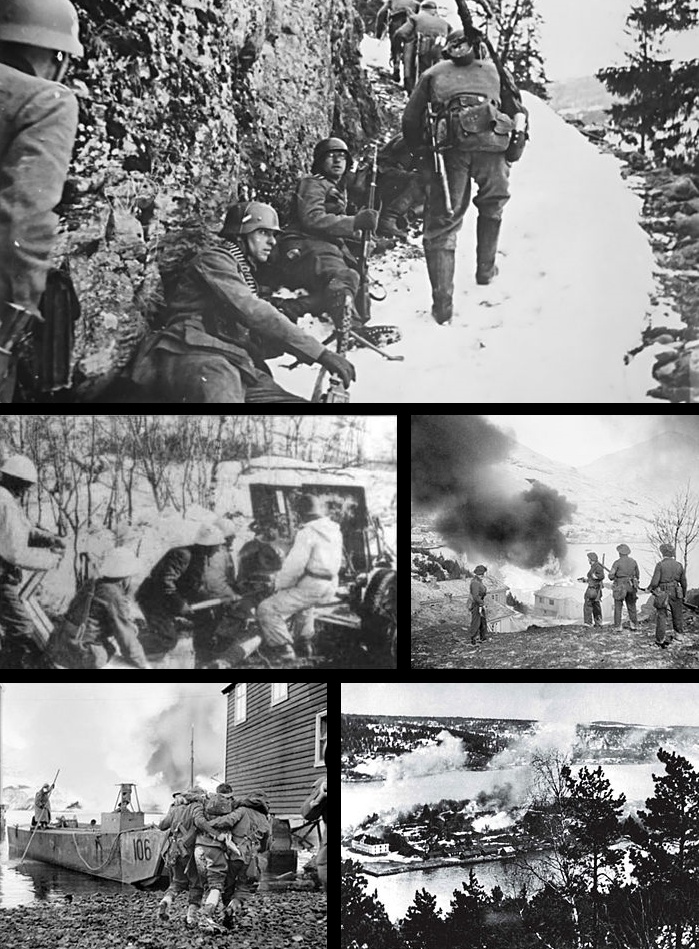
There was growing unease and bewilderment among the public at the military stalemate. In parliament members of all parties were increasingly critical of the government’s record. Their fears were soon justified. Early in April 1940 German troops invaded and occupied Denmark and then moved against Norway. The British government responded to the Norwegian appeals for help. However, due to poor planning, lack of co-ordination between navy and army, and no real air cover, British troops were forced to withdraw. It was this debacle which brought to a head the mounting criticism of Neville Chamberlain’s leadership. It led directly to a two-day debate in the House of Commons on 7-8 May, instigated by the Labour Party. It was one of the most enthralling and momentous occasions in British parliamentary history. Though there was a half-hearted defence of the government’s recent record by the Prime Minister and a more vigorous one from Churchill, the tone of the debate was set by the speech of the Tory anti-appeaser, Leo Amery, who attacked Chamberlain personally and called for him to stand down as Prime Minister. When the Prime Minister appealed for support from his friends in the House, Lloyd George replied, “there is nothing that can contribute more to victory in this war than that he should sacrifice the seals of office”. Conservative backbenchers refused to support Chamberlain and it was clear he had lost the support of a large section of his party. On the following day, 9th May, the Prime Minister reluctantly accepted that a coalition government was inevitable. However, it was also made clear that the parties would not accept Chamberlain as leader of the coalition – a new Prime Minister was needed.
“You have sat too long here for any good you have been doing. Depart, I say, and let us have done with you. In the name of God, go.” Leo Amery
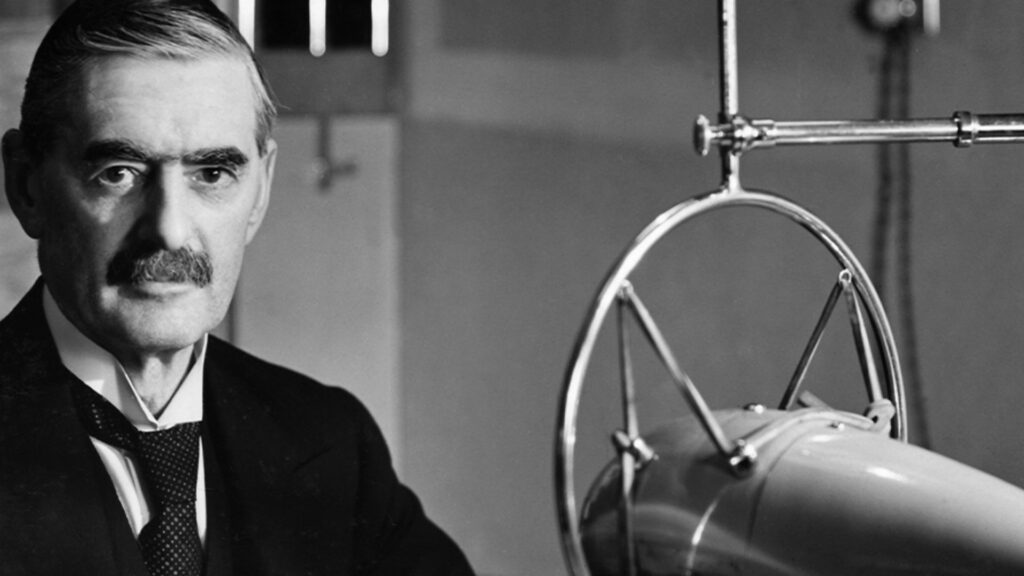
Winston Churchill’s first wartime broadcast – 1 October 1939
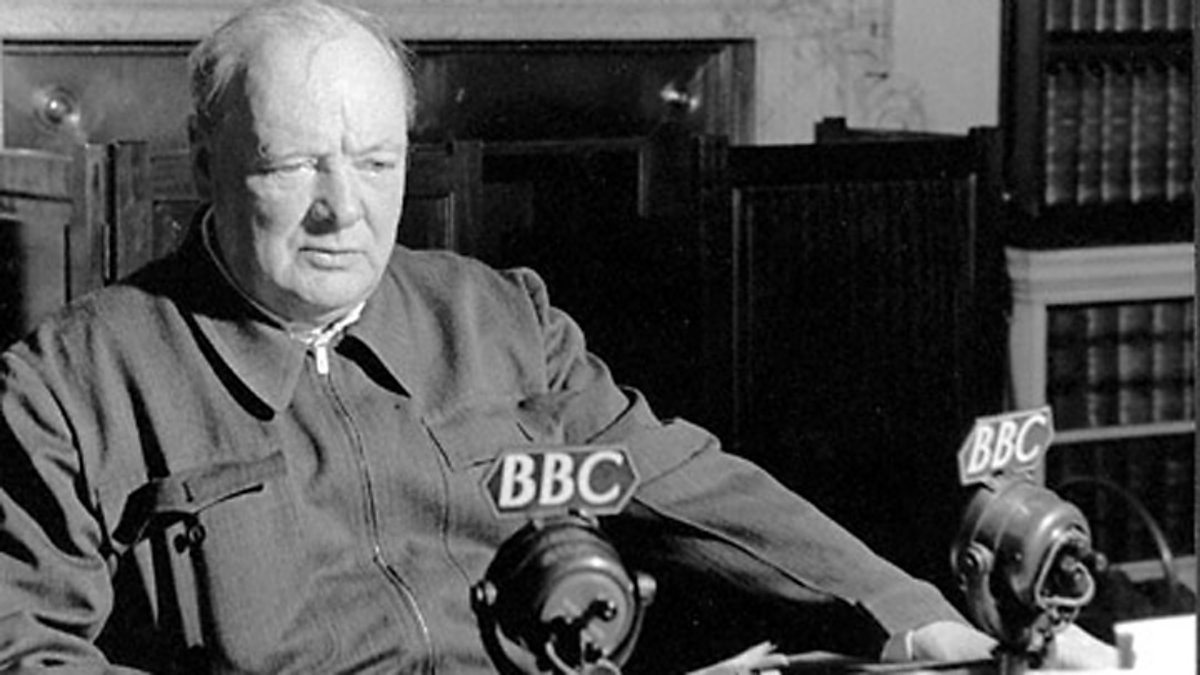

“At eleven o’clock I was again summoned to Downing Street by Mr Chamberlain, the Prime Minister. Mr Chamberlain had received a reply from the Labour leaders that they would not serve under him. The question, therefore, was whom he should advise the king to send for after his own resignation had been accepted …. He looked at us both across the table. I have had many important interviews in my public life, and this was certainly the most important. Usually I talk a great deal, but on this occasion I was silent. As I remained silent a very long pause ensued … Then at length Halifax spoke. He said he felt that his position as a Peer, in the Lords and not in the House of Commons, would make it very difficult for him to discharge the duties of a prime minister and especially in wartime. He spoke for some minutes in this sense, and by the time he had finished it was clear that the duty would fall upon me – had in fact fallen upon me. “
From Churchill’s, “The Gathering Storm”, 1948
“As I went to bed at about 3 am I was conscious of a profound sense of relief. At last I had the ability to give directions over the whole scene. I felt as if I were walking with destiny, and that all my past life had been but a preparation for this hour and for this trial.“
Churchill recalling his feelings on the night of his appointment as Prime Minister in his book “The Gathering Storm”, 1946
What was Churchill’s stance towards the war in 1940?
Churchill felt that he was destined to lead Britain; he had first-hand experience of war and confidence in the ability of Britain and its considerable empire to wage war successfully.
By the 13th May, the situation was dangerous but the British army was intact; the French had large forces; Italy had not joined Germany; the British were fighting on only one front and Churchill had put together a Cabinet with some of his own supporters. He was highly determined to wage war energetically, but his past record was not especially encouraging. The Norway campaign had not been a success; he did not have a good record in the First World War; there was little enthusiasm from US President Roosevelt for his appointment; and both the House of Commons and the government contained many who liked and admired Chamberlain.
The war moved quickly, and on 14th May the Germans broke the French defences. The prospect of a rapid defeat of France was suddenly a reality. By 28th May 1940, Churchill was facing a profound challenge:
Germany had bombed Poland and the Low Countries. There was considerable fear of large scale bombing of Britain and very heavy casualties were expected.
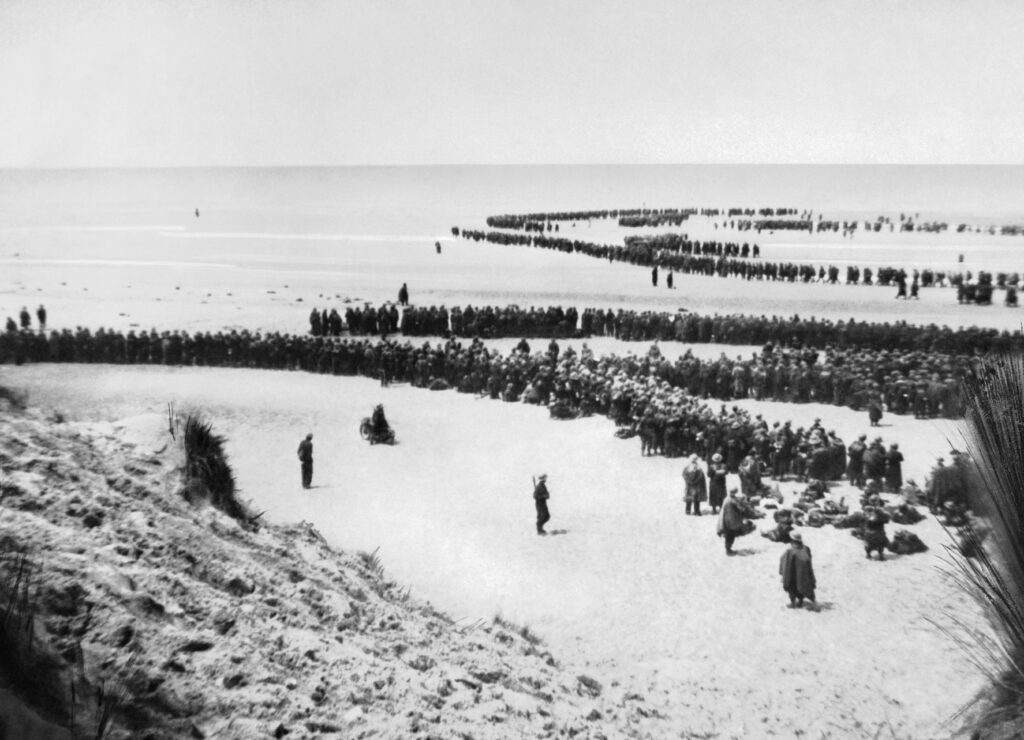
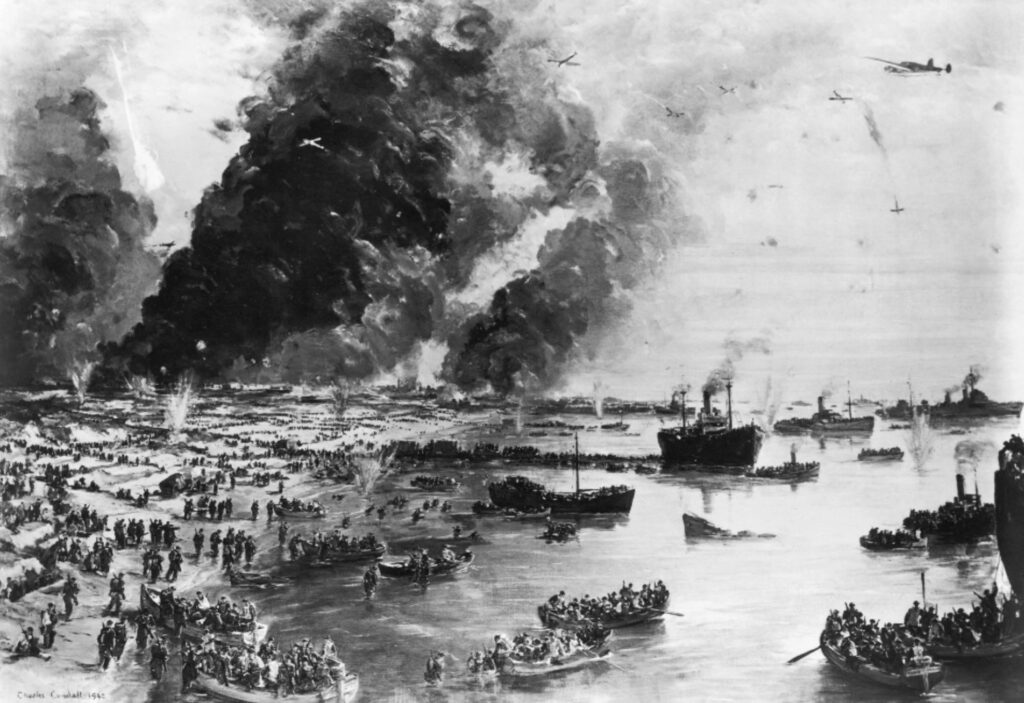
The British army had been cut off from the French forces and had fallen back on Dunkirk, hoping to be evacuated. The chances of rescuing 300,000 troops seemed low given German air superiority.
There was danger of Italian entry into the war, which would threaten Egypt and the Suez Canal. This would cut off Britain’s quickest sea route to India, and its colonies in the Far East and make them more difficult to defend against Japan.
Gold reserves were running out and it was not clear whether Britain could afford to go on fighting.
Britain’s options
Lord Halifax, appointed Foreign Secretary in Churchill’s first war cabinet, had been a major supporter of appeasement and had begun making discreet approaches to discover what the Germans would require from Britain to enter into peace talks. On 28th May the Cabinet discussed a French proposal to approach Mussolini to find out what peace terms Hitler might accept. As foreign secretary, Halifax needed to know what Britain’s options were, but it would have been dangerous to suggest by approaching Italy that Britain was considering a negotiated peace, as this would have shown Hitler that Britain was weakening her resolve to carry on in the war.
Halifax had argued that it might be better to consider terms with the Germans before France was defeated and before German bombing destroyed Britain’s aircraft factories. The Australian High Commissioner pleaded for an appeal to Roosevelt for a peace conference but his memorandum was firmly rejected by Churchill with the word “rot”.
The situation had improved by 4th June with the evacuation of 224,318 British troops and 111,172 of their allies from Dunkirk. The cabinet had resisted French demands for more aircraft and an air defence of Britain was possible. Belgium had surrendered and relations with France were very poor. The cabinet members who favoured any negotiation had been silenced and Churchill made his most famous speech to the Commons.
He made a direct appeal to the USA when, after saying the Empire would continue the fight if Britain was invaded, he went on to say until “the New World, with all its power and might, steps forth to the rescue and the liberation of the old”. This speech was broadcast on the radio, but with actor Norman Shelley impersonating Churchill, who was too busy to speak on the radio himself. Churchill later re-recorded the speech in his own voice. Events continued to move quickly, and next came the French surrender. Once again, there was talk of attempting peace talks with the Germans, but by now, these were not considered a serious possibility. The remarkable achievement of Churchill was to maintain a war with no allies against what was perceived to be one of the greatest military powers the world had ever seen. On 3rd July 1940, a massive gesture of defiance was made by the attack on the French fleet to prevent it falling into German hands. The RAF had been bombing Germany since its invasion of the Low Countries and continued to do so, despite inevitable German reprisals. A very bold decision was taken to send British armoured forces to Egypt even when there was a real threat of German invasion of Britain. This decision paid off as Britain achieved rapid victories against Italy, Hitler’s ally, which had colonies in North Africa adjacent to Egypt.
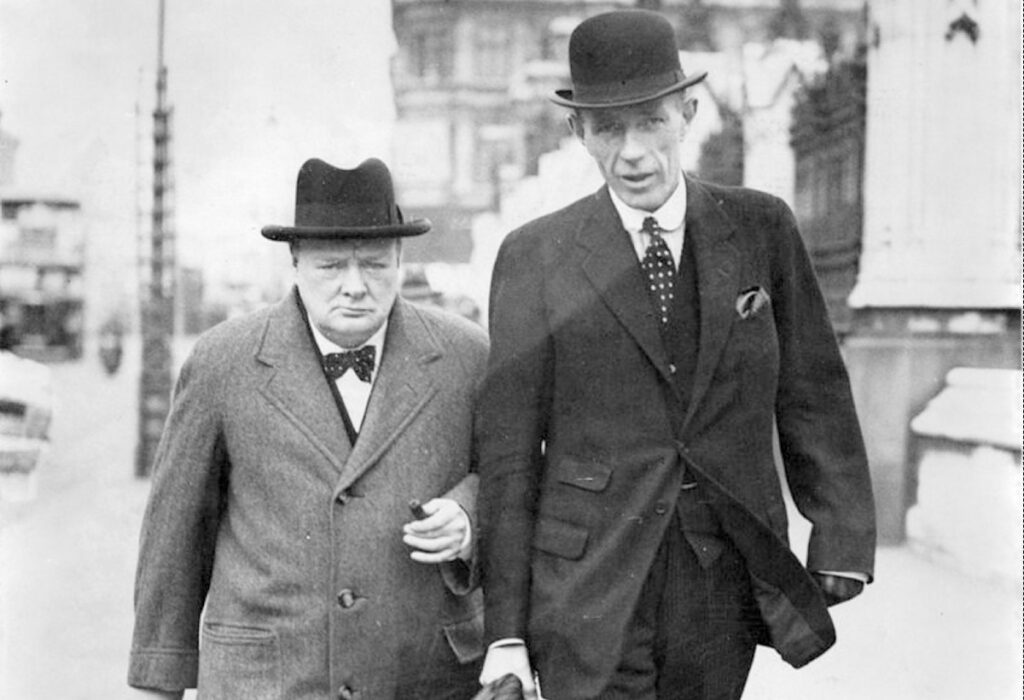
“We shall not flag or fail. We shall go on to the end ….We shall fight on the beaches, we shall fight on the landing grounds, we shall fight in the fields and in the streets, we shall fight in the hills; we shall never surrender.” Winston Churchill 4 June 1940
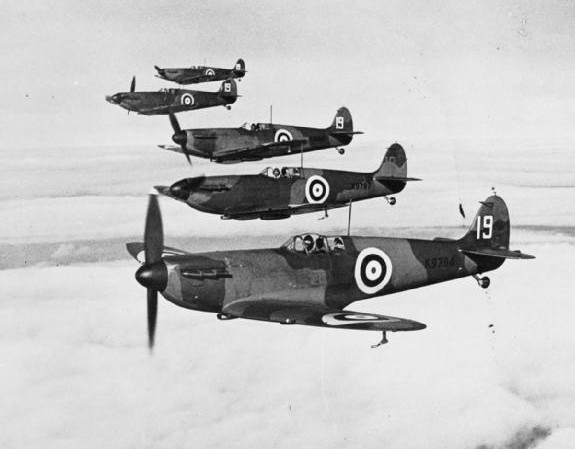
“Never in the field of human conflict was so much owed by so many to so few. All hearts go out to the fighter pilots, whose brilliant actions we see with our own eyes day after day; but we must never forget that all the time, night after night, month after month, our bomber squadrons travel far into Germany”. Winston Churchill 20 August 1940
The Battle of Britain
The brunt of the war fell on Britain with the German decision to launch an air offensive in August 1940, which had the aim of destroying the RAF. Churchill spoke on 20th August.
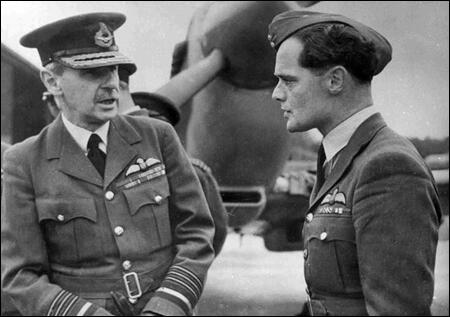
Hitler and Goering, the head of the German air force, thought that bombing British cities was more important than destroying the RAF. They believed that civilian populations would not withstand the bombing, that morale would crack and that this would make a continuation of the British war effort impossible. In September, the Germans diverted their attention from the RAF airfields to the bombing of British cities, which had the unintended effect of enabling the RAF to recover. Sir Hugh Dowding, the head of RAF Fighter Command, must take much of the credit for victory in the Battle of Britain. Not only was the organisation of the RAF defences his responsibility, but he had opposed Churchill in two crucial decisions.
- He urged Churchill to not send promised squadrons of fighters to aid the French army – these aircraft could be used for home defence instead.
- He resisted Churchill’s suggestion that an all-out attack should be launched on the German airforce following the first day of the Battle of Britain. Dowding knew it was vital he kept his forces intact in order to defeat the Germans and could not risk so many fighters in the early stages of the battle.
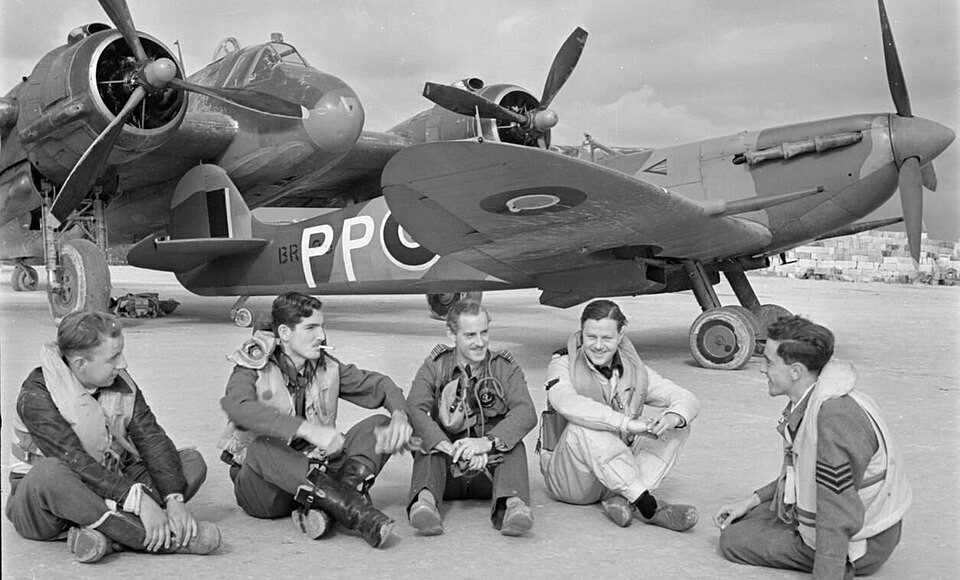
The very effective British aircraft, the Hurricanes and Spitfires, had been developed under Churchill’s much-criticised predecessors, MacDonald and Baldwin. Churchill had played little part in this or in the growth of radar. His operational advice was often unsound and he failed to prevent Dowding falling victim to rivalries with the top RAF command and being virtually sacked after the battle. The Labour leader, Attlee, was asked what Churchill’s contribution to the battle was and he replied, “just words”. However, Churchill’s memorable and splendid oratory was indeed inspirational and gave the RAF pilots their place in history.
By the end of 1940 Britain had enjoyed some victories in North Africa and had defeated the German air offensive. Churchill had established his position over his rivals and his oratory had become a weapon of war. His determination had prevented any negotiations with Germany and the nation had steeled itself for a long struggle. Given the situation – with no commitment to help from the USA and with a population who had suffered the terrible losses of the First World War – this was a remarkable achievement.
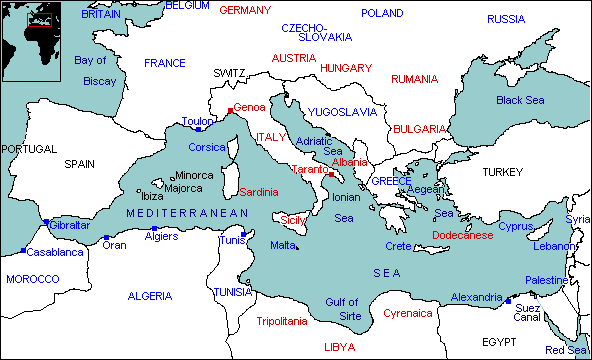
The Mediterranean Strategy
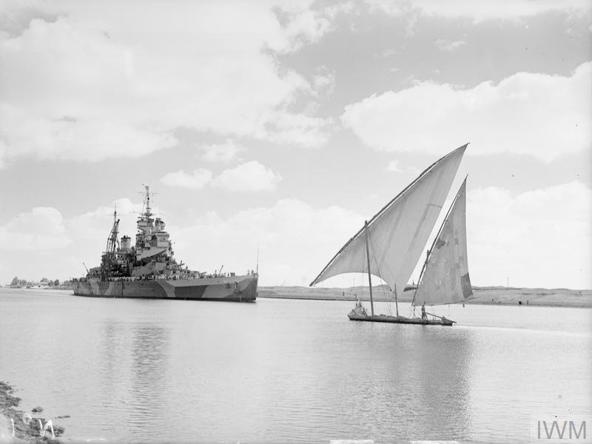
Britain had a long history of concern with the Mediterranean as a vital trade route. This had increased with the building of the Suez Canal. Opened in 1869 the Suez Canal created waterway from the Mediterranean to the Red Sea. From 1876, the British had used the canal and developed a key role in its running and a dominance in Egypt. The canal became a vital trade route for the British Empire.
Before 1939 British military leaders were intensely concerned about the Mediterranean and the danger that Italy might pose if it allied with Germany against Britain in a war. Italy joined the war in 1940 and invaded southern France. A major concern to Britain was the presence of Italian troops in her North African colonies (modern-day Libya) which bordered on Egypt. Britain controlled the entrance to the Mediterranean at Gibraltar, but there was a danger that Franco, the Spanish dictator, might threaten that control by joining the war on Hitler’s side. This could weaken Britain control in its Mediterranean territories, and in particular threaten its control of the Suez Canal which was a major link to Britain’s Asian colonies, especially India. The Mediterranean was also the key to the defence of oil supplies from the Middle East.
From 1942, another problem emerged. Germany had gone to war with Russia in 1941 and by 1942 had driven the Russian forces back considerably in the south. Britain was worried that if Germany broke through into Egypt, then German forces might link up with forces in Russia and secure the vital oil fields of southern Russia and the Middle East. The outcome of the entire war was thus at stake in the war in the Mediterranean. Churchill hoped for a Balkan front consisting of Greece, Yugoslavia, and Turkey, and to achieve that sent forces into Greece when Italy invaded in 1940. A front in Greece would draw German resources and open up the prospect of increased British influence in south-east Europe. Churchill, during the First World War, had talked of this area of south-eastern Europe as “the soft underbelly of Europe”. However, in 1940-41, as in 1915, the Balkans proved not to be such a soft underbelly as British forces were defeated in Greece and forced out.
British forces were highly successful against the Italians in North Africa but faced a more serious enemy in the form of the German Afrika Korps and its commander, General Erwin Rommel. Under Rommel’s command North Africa turned into a difficult battleground where British troops faced a well-equipped German force. By 1941 Egypt was under threat. However, Rommel was too short of men and supplies to take Egypt and was forced back after the Battle of El Alamein in 1942. The US joining the war in December 1941, put pressure on Churchill to move his focus away from the Mediterranean strategy. The American general, George Marshall, saw little point in wasting resources in the Mediterranean and argued for taking the pressure off Russia and establishing a western front. The Americans believed that the success of the war depended on the survival of Russia and engaging with and defeating the main German forces. From their perspective, the Mediterranean was a distraction and of limited strategic importance. They held long-time suspicions that for Churchill, the Mediterranean Strategy was more about the protection and preservation of the British Empire than the defeat of Nazi Germany.

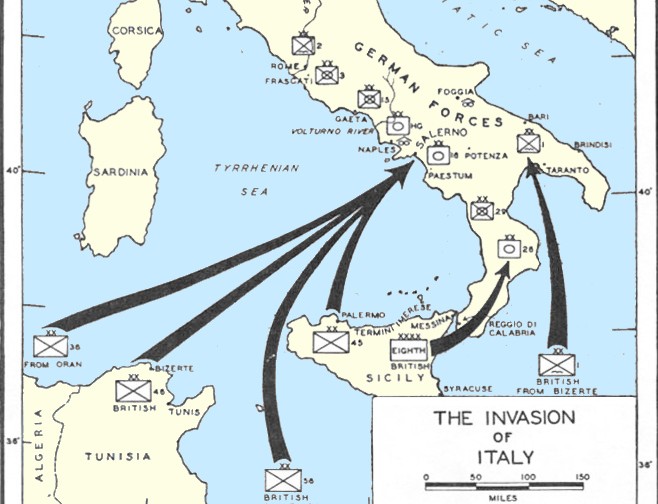
Churchill’s military decisions: War in Italy
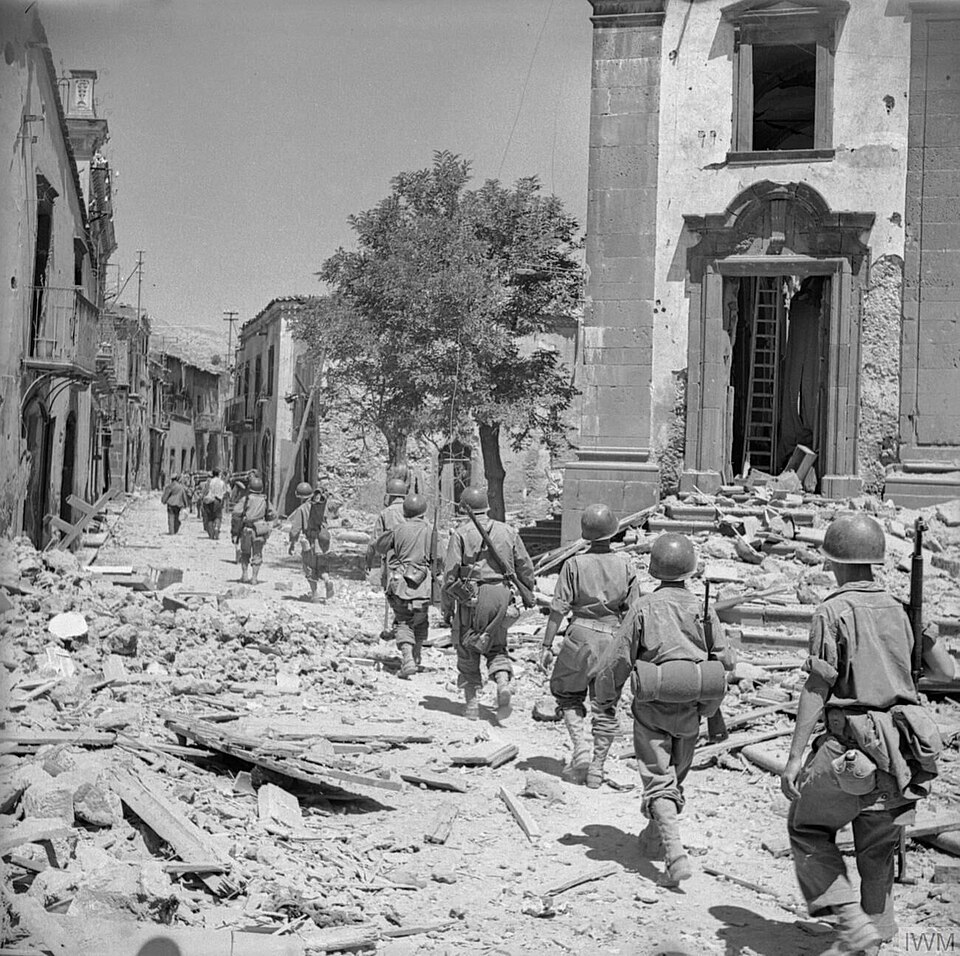
In 1943 considerable resources were devoted to an invasion of Sicily by British and US forces. This decision to commit troops to Italy in 1943 remains one of the most puzzling decisions of the war. For example, many argue that with North Africa, Gibraltar, Malta, Cyprus and Sicily in Allied hands, the Mediterranean was secure. By 1943, also, Italy had been weakened by defeats and was no longer a serious threat. The Germans were established in Italy and many were unconvinced about an extended campaign to take Italy. However, sixteen Allied divisions were occupied in heavy fighting in Italy. As the Germans had roughly the same number of forces, there was no question of a smaller Allied force being able to effectively fight and hold back German troops who could have been used against Russia or to counter the Allied invasion of France. It was rather the Allies who were tied down. Finally, if Italy had fallen, it is difficult to see how this would have led to the defeat of Germany. This required a decisive defeat of the German forces in France, rather than in Italy, and an invasion of Germany itself.
The Russians found Churchill’s insistence on the invasion of mainland Italy particularly frustrating. Facing the bulk of fighting against German forces in the east, Stalin believed that Churchill was using the campaign in Italy as an excuse to delay opening the Second Front (Allied invasion of Western Europe). He saw this delay as a sign of disrespect and evidence that Britain was happy for Soviet forces to continue to bear the brunt of high casualties. It was not entirely unreasonable of Stalin to hold this view. It was not until June 1944 that Britain and the US launched the long-awaited D-Day invasion of occupied France. Thus, the bulk of the war in Europe had been centred on the Mediterranean. Why was there such a delay? High casualties were expected to come with the invasion of France, and therefore, Churchill was keen to put it off for as long as possible. Many wanted to wait for Germany to be weakened further by their battles against Russia and the Allied bombing of German cities. However, such a long struggle in Italy was not expected. The allies encountered a range of failures such as the landing at Anzio, south of Rome, in 1944.
Churchill and his Generals
Churchill not only became Prime Minister in 1940, but also Minister of Defence. Unlike previous civilian war leaders, he was directly involved by his membership of the two leading committees which ran military affairs: the Defence Committee of the Cabinet and the Chiefs of Staff Committee.
He was very concerned not to repeat the situation in the First World War, in which responsibility for the war was handed over to military experts such as Field Marshall Sir Douglas Haig. He was one of the few prime ministers to have direct military experience – even if this was limited to junior command in colonial wars and a brief period as a lieutenant-colonel on the Western Front in 1916. His writings had led him to a study of military history, and he had great confidence in himself as a strategist. Like Hitler, however, he was an amateur working alongside highly-trained professional soldiers. The results were not always harmonious. Churchill believed in direct supervision and detailed questioning of his military leaders. This could either be seen as an essential function of leadership – to be a critic and ensure that military leaders were up to scratch; or it could be a sign of irritating micro-management and undermining of professional soldiers.
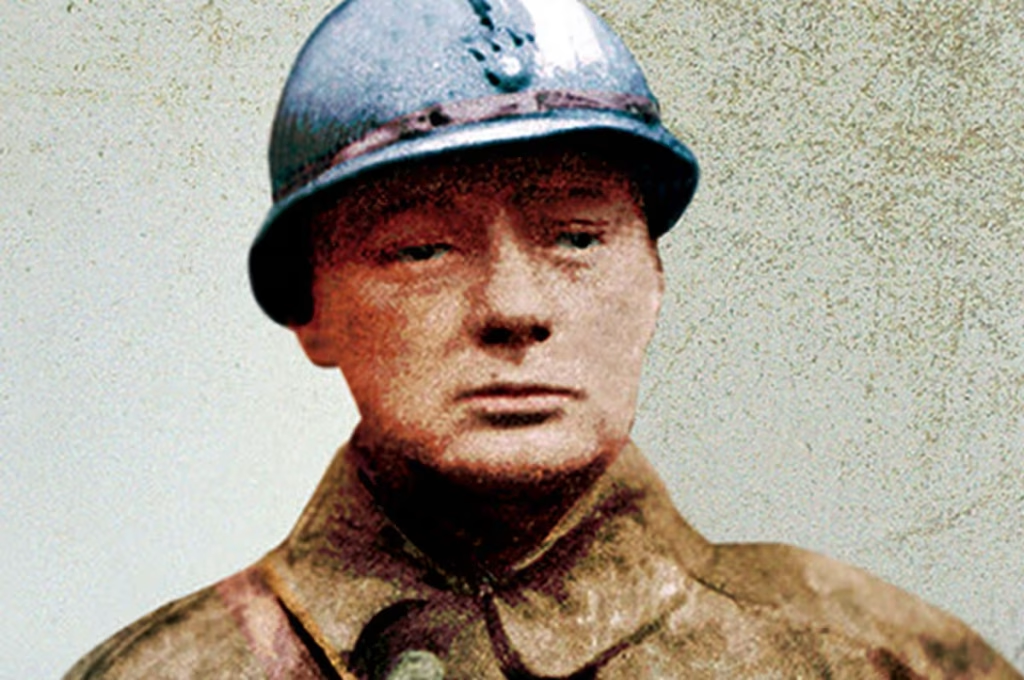
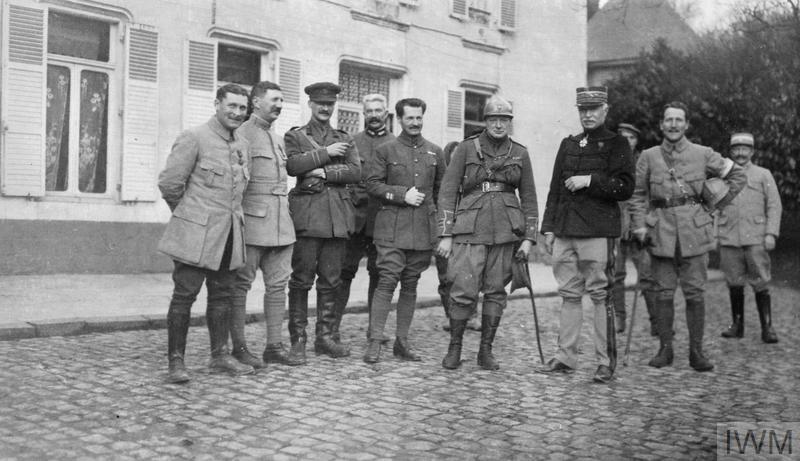
NORTH AFRICA CAMPAIGN SUMMARY
Prioritised by Churchill in 1940 as German and Italian presence in North Africa – especially Egypt could threaten sea routes (SUEZ CANAL) to the Empire. Formed part of Churchill’s “Mediterranean Strategy”. US troops joined in support of British action in 1942 in what was known as OPERATION TORCH. Most famous victory – BATTLE OF EL ALAMEIN against German troops led by GENERAL ROMMEL.
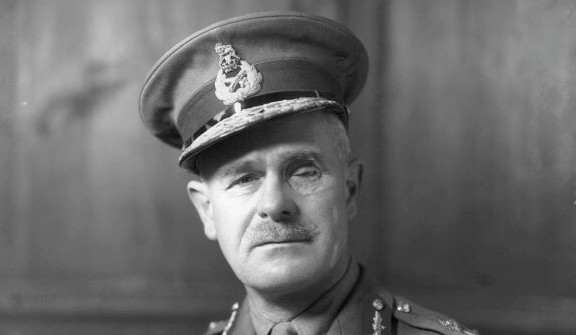
Churchill and his Generals in North Africa
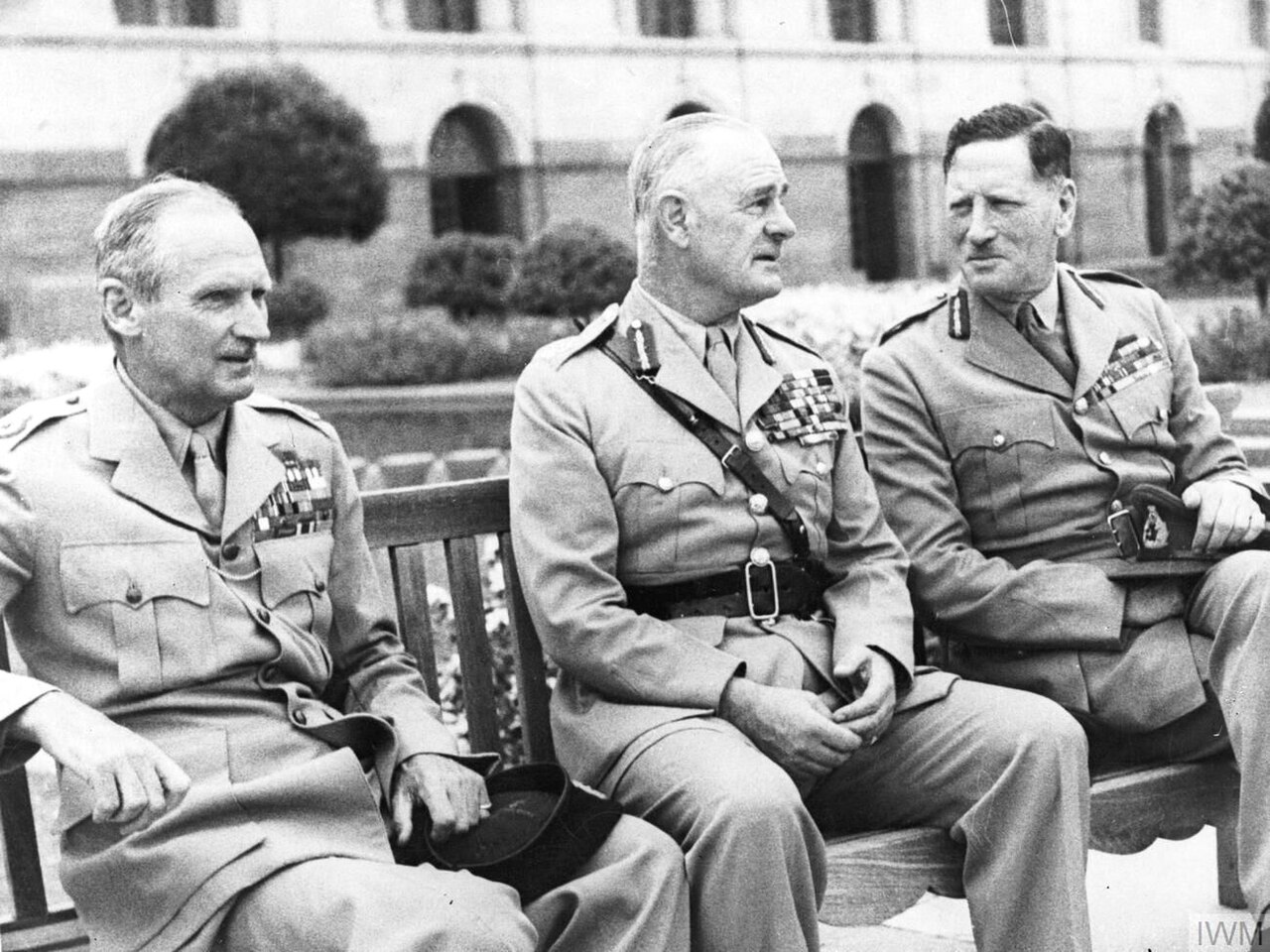
Relations with Sir Archibald Wavell
The rapid British advance in North Africa in 1940 justified the decision to concentrate on fighting in North Africa, but Churchill gave little credit to the commander, Sir Archibald Wavell, whom he personally disliked. Churchill took forces away from him when Italy invaded Greece in 1940 and the cabinet made a decision to send troops to defend it and establish a new Balkan front. Wavell was not given any time to
prepare properly. His troops were taken off to a deeply flawed campaign. Without proper planning and resources, this was another expedition that failed when German troops invaded. The British had to be evacuated to Crete and then were defeated there by a German attack and forced out again. The early successes in North Africa were thrown away, and Wavell did not have the resources to meet German forces under Rommel who were sent to Africa. He took the blame and was demoted.
Relations with Auchinleck and Montgomery
Wavell’s successor, Sir Claude Auchinleck, was not prepared for a premature attack on the Germans and, to Churchill’s annoyance, he insisted on delaying until he was well prepared. “The Auk” was a thoughtful leader who realised the importance of taking advantage of the German concentration of invading Russia to give Britain time to build up its resources in Egypt before attacking. Despite an effective defence against German attacks and making thorough preparations for a counterattack, he too was sacked for his delays and not being sufficiently daring and aggressive. His replacement, Bernard Montgomery, won
over Churchill by his self-confidence but insisted on very thorough
preparations involving accumulating more than twice the men that Rommel had before attacking at El Alamein in October 1942. Much of the credit for the first major British victory in the war should have gone to Auchinleck because of the efficient preparations he had made, even though he did not actually lead the attack. However, Churchill disliked him and favoured “Monty”. Montgomery was very slow in following up his victory after El Alamein, which allowed the Germans to retreat to Tunisia. But Churchill continued to favour him.

Relations with Sir Alan Brooke
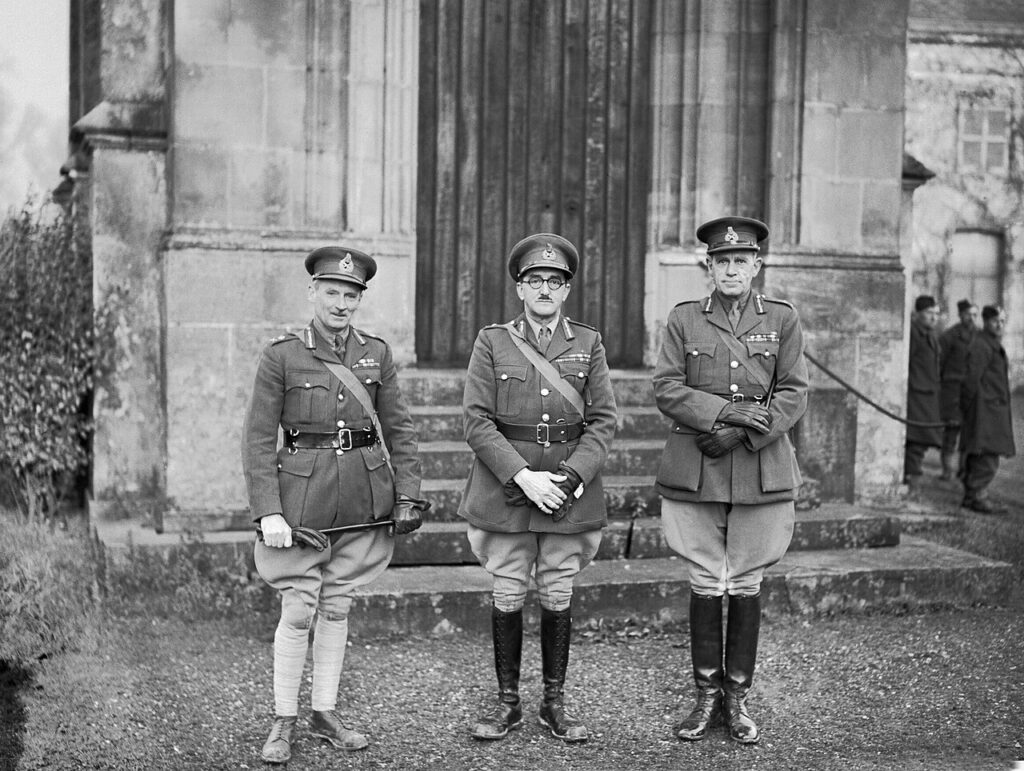
Throughout the war, Churchill constantly interfered with operational matters, sacked able and thoughtful commanders and preferred military leaders with often doubtful abilities but with the “right attitude”. The main burden of Churchill’s interference fell on the head of the army, Field Marshal Sir Alan Brooke. Brooke was a highly competent organiser and thorough professional. However, in temperament, he was very different from Churchill, yet the working relationship of the two opposite personalities was one of the greatest wartime partnerships. He was conscious of the need to deploy British forces carefully and avoid heavy casualties. He was often annoyed by Churchill “thinking aloud” and coming up with all sorts of different military ideas. His wartime diaries, often written up after long and exhausting meetings, give a sense of frustration with political interference. They are supported by many other recollections by senior officers. Personal dealings with Churchill, a highly opinionated and charismatic leader, tended to be tricky, but when it came to major decisions, there were fewer disagreements between Brooke and Churchill.
Question: Rank the relationships that Churchill maintained with Generals from strongest to weakest and justify your reasoning.
Bombing of Germany
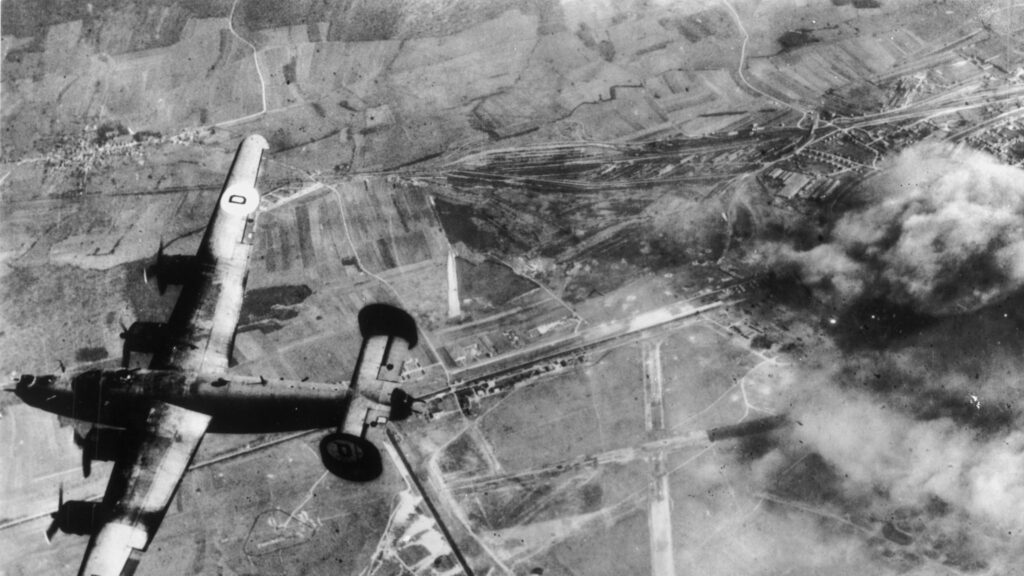
If waging war against Germany in North Africa had been an alternative to invading France, then another was to destroy German morale and its capacity to provide for its extensive armed forces by relentless bombing. Germany had used civilian bombing to create terror in Poland in 1939 and in the Low Countries, Belgium and France in 1940. British cities had been the subject of a “blitz” after the focus of the Battle of Britain had switched from attacking the RAF to other major cities. There was considerable public pressure to take the war to Germany in the same way. The RAF Bomber Command had been created with a bomber offensive in mind and was eager to show that it could hasten the end of the war by destroying both morale and war capacity. There were some problems, however:
→ A specialist report in 1942 had indicated that
bombing was not effective or precise enough to .
substantially damage German industrial production.
→ The Blitz had not destroyed civilian morale in Britain. There was little chance that it would destroy German morale either, as so many had supported the Fuhrer before 1939. This did not weaken, as from 1943, many Germans saw Hitler’s supposed genius as the only way to stop Russia invading and taking terrible revenge once it was clear that Germany could not defeat the USSR.
→ There were also ethical objections to killing large numbers of civilians, including women and children. These were voiced by brave objectors such as Bishop Bell of Chichester when heavy bombing raids initiated by Sir Arthur Harris began In 1942 and continued throughout the war with the enthusiastic support of the USA.
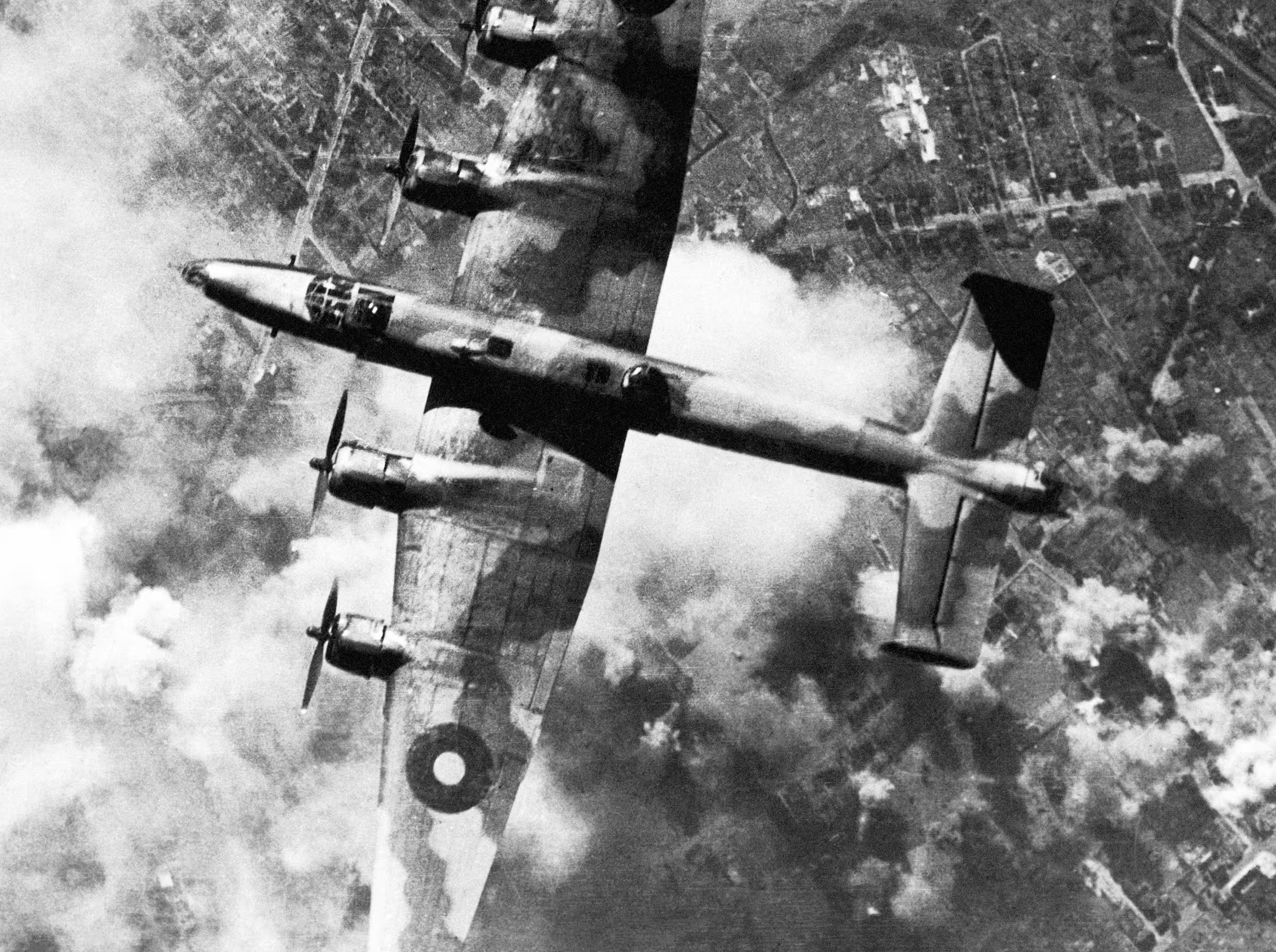
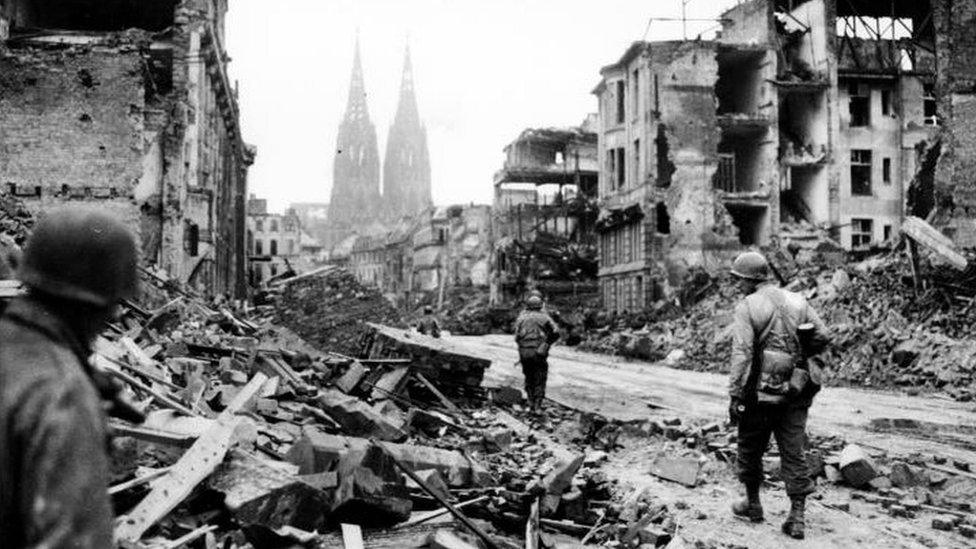
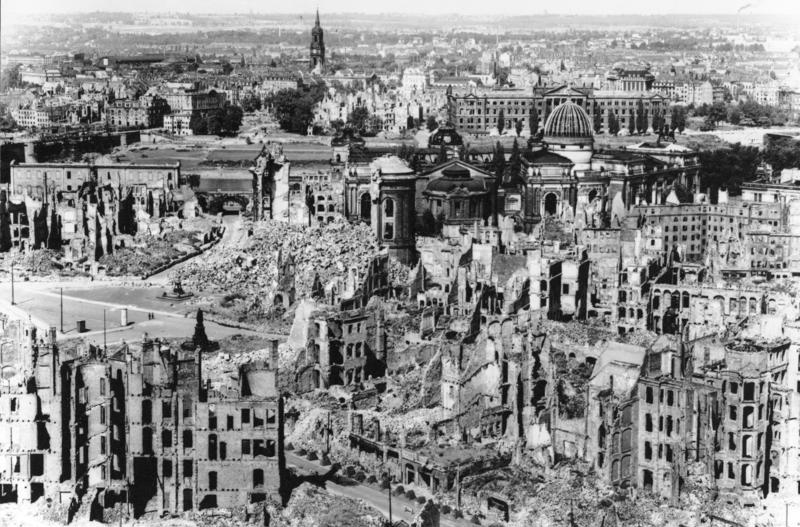
Harris deliberately aimed at as much destruction of German cities as possible by assembling large forces of bombers with incendiary bombs to deliberately create firestorms. There was considerable loss of life in major cities like Hamburg, the industrial cities of the Ruhr, Berlin and in February 1945, Dresden. The death toll for this raid on one of Germany’s most famous and historic cities was probably 40,000. Total casualties for the bombing of Britain from 1939 to 1945 were 60,595. In all, between 400,000 and 600,000 Germans died in bombing raids. Dresden was not an obvious military target. Bombing a city which was sheltering thousands of refugees led to criticisms at the time. It remains one of the most controversial acts of the war. Despite the heroism of the bomber crews and the heavy losses they endured, the effectiveness and morality of their work have both been questioned. Churchill himself had doubts about a policy he had enthusiastically supported.
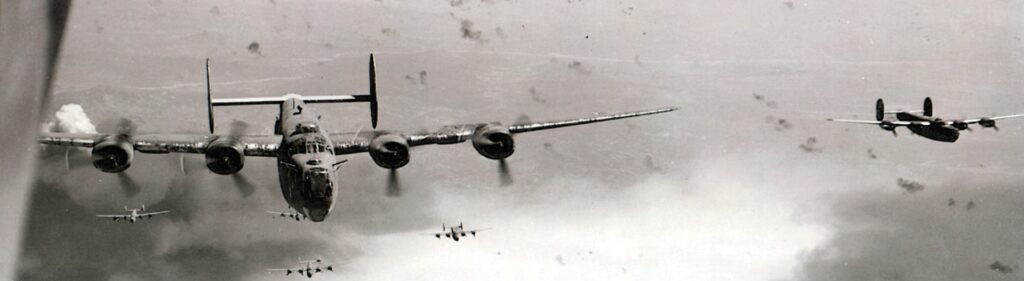
Bombing of Dresden
→ 13th to 15th February 1945.
→ 3,300 tons of bombs were dropped on the city which created so much fire that a firestorm developed – temperature peaked at 1,800 degrees Fahrenheit. The surface of roads melted and fleeing people found that their feet were burned as they ran.
→ After the raid had finished, SS guards brought in from a nearby camp, burnt the bodies in the city’s Old Square (the Altmarkt). There were so many bodies that this took two weeks to complete.
Bombing of Hamburg
→Codename Operation Gomorrah.
→ Began 24 July 1943 and lasted for 8 days and 7 nights.
→ Killed 42,600 people, left 37,000 wounded and caused some one million German civilians to flee the city.
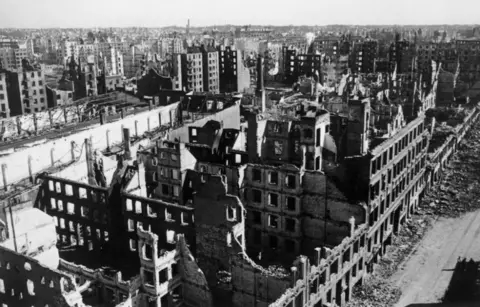
“There were no warning sirens. We were completely surprised and rushed back down to the cellars of the hospital. But these quickly became hopelessly overcrowded with people who could no longer find shelter in their own burning buildings. The crush was unbearable, we were so tight you could not fall over. Apart from the fire risk, it was becoming increasingly impossible to breathe in the cellar because the air was being pulled out by the increasing strength of the blaze.” “We could not stand up, we were on all fours, crawling. The wind was full of sparks and carrying bits of blazing furniture, debris and burning bits of bodies.”
Rudolph Eichner – Dresden eye-witness
Relations with Wartime Leaders
Who were the leaders of nations?
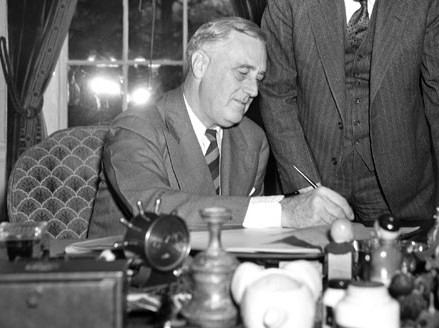
Franklin D. Roosevelt
→ Leader of the USA since 1932 during the Depression.
→ Popular and energetic leader.
→ Despite not joining war until 1941 – did support Britain via Lend Lease scheme.
→ Died in 1945 before the end of the war
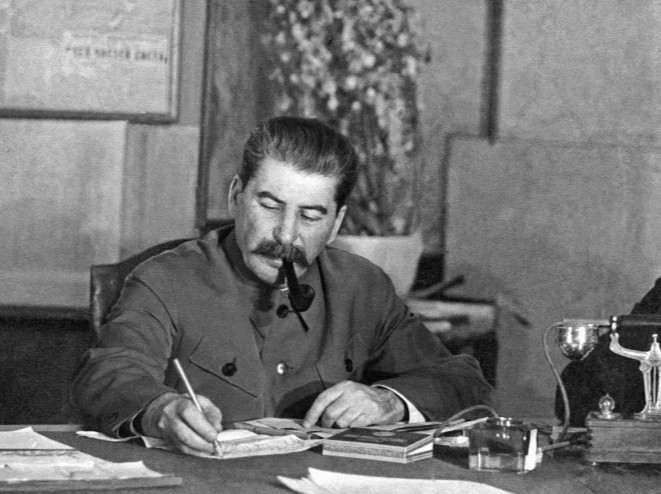
Josef Stalin
→ Leader of the USSR since 1928.
→ Played a role in the communist revolution of 1917 → Reputation for ruthlessness.
→ Established the greatest police state of its time.
→ Signed a non-aggression pact with Hitler in 1939.
→ Surprised by German invasion of June 1941.
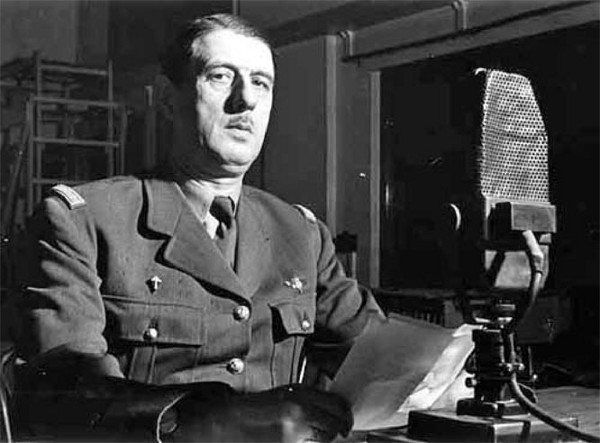
Charles de Gaulle
→ Totally devoted to France and the continuation of the war effort in France.
→ Led the free French movement.
→ Became president of the French Committee of National Liberation in 1943.
→ On December 21, 1958, de Gaulle was elected president of the republic.
Relations
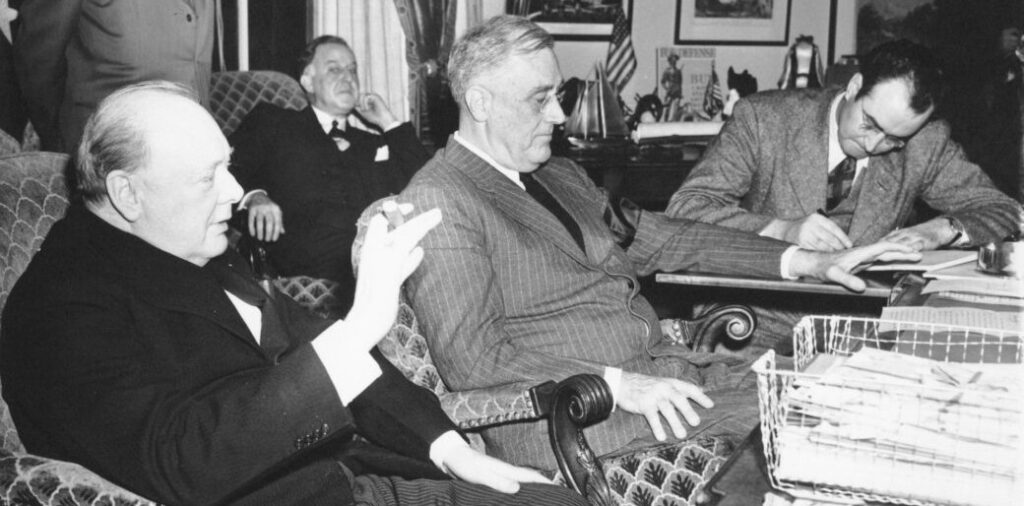
It seemed as if Churchill might be a more natural ally of Roosevelt than of Stalin; both headed English-speaking democracies. However, the US leader was a difficult person to know. On the surface he could be charming and seemed to be sympathetic; but he had a reputation for not committing himself, despite giving his listeners the impression he had. As his biographer Conrad Black wrote about a meeting between the two in Canada in August 1941, “Churchill would not have noticed the conditions and qualifications and nuances with which Roosevelt clouded almost everything he said”. Their correspondence reveals far more affection from Churchill than from Roosevelt and Roosevelt’s deliberate snubbing of Churchill at the Tehran Conference of 1943 was more characteristic of the US leader than of the more open Churchill. Their personal relationship had been seen as “the partnership that saved the West” and Churchill worked hard to maintain it.
However, the relationship had started badly. Roosevelt had first met Churchill in 1918 and took a dislike to him. He thought him “a stinker” and that he had “lorded it” over him. Churchill had made unfavourable remarks about Roosevelt in 1937 which were quoted by Roosevelt’s opponent, Wendell Willkie, during the US election campaign of 1940.
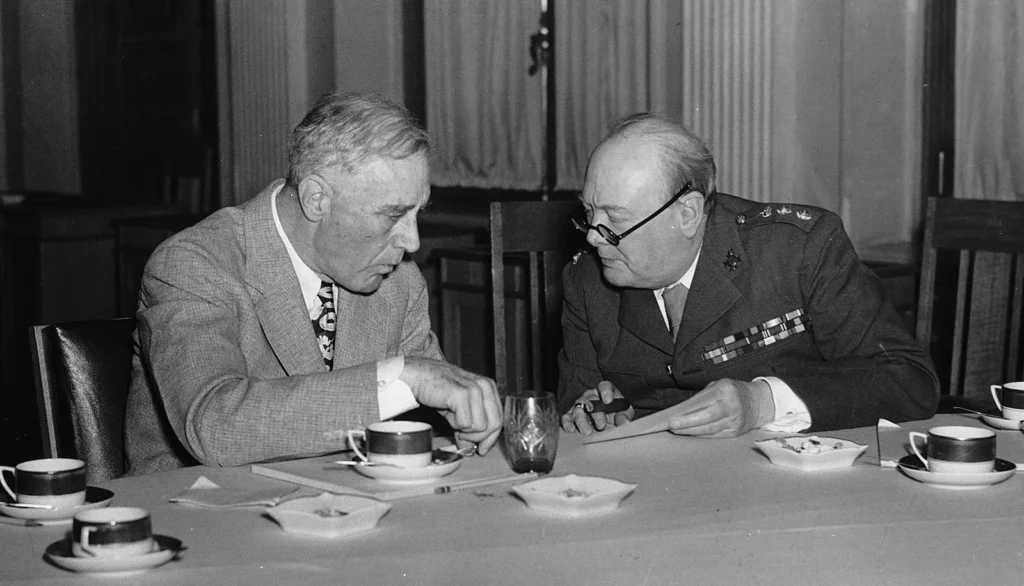
On 12th September 1942 Churchill send Roosevelt this message: “You know how I treasure the friendship with which you have honoured me and how profoundly I feel we might together do something really fine and lasting for our two countries.”
The Atlantic Charter
This document confirmed that neither the US nor Britain wanted territorial gains out of the war. It stated that “they respect the right of all peoples to choose the form of government under which they will live” and that all states should have “access on equal terms to the trade and raw materials of the world”. A further point committed both nations to work for “improved labour standards, economic advancement and social security”. There was also a commitment to peace and disarmament. Churchill never accepted that it applied to Britain’s Empire and accepted it only as a sign that the USA had entered into a “tacit alliance” with Britain.
US support but non-intervention
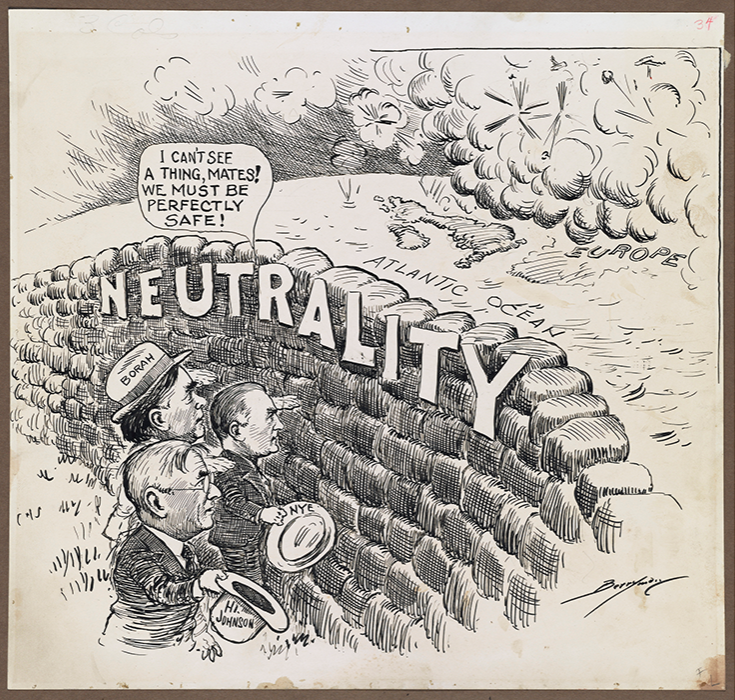
Churchill had hoped for US intervention in the war, but Roosevelt had to be careful, as there was a danger of war with Japan and US public opinion was generally against a war in Europe. Nevertheless, the USA did offer some support:
→ In November 1939 the USA repealed the Neutrality Act which allowed Britain to purchase American arms.
→ In October, the USA declared a neutral zone along the entire coast of the USA and South America and the US navy patrolled this to prevent the sinking of merchant shipping by the Germans. This involved Anglo-American naval co-operation.
→ In September 1940, 50 old US destroyers were exchanged with Britain for leases to 8 British naval bases from Newfoundland to British Guiana.
→ In December, Roosevelt used the phrase “arsenal of democracy” to defend sales of arms to Britain.
→ In March 1941, the Lend-Lease Act was passed permitting the President “to sell, transfer title to, exchange, lease, lend or otherwise dispose of” defence articles “to any country whose defence the President deems vital to the defence of the USA”. It led to $31.6 billion of assistance going to Britain by 1945.
→ In April US troops occupied Greenland and, on 1 July 1941, Iceland, in order to stop Germany using either as a military base.
However, despite this support, Churchill disliked the way that Roosevelt failed to fully commit and continued to stress US isolationism. Churchill believed that Roosevelt was putting domestic political reasons (i.e. re-election in the 1940 election) over what he believed was the potential destruction of Western Democracies. Their first meeting as national leaders took place in Placentia Bay in Canada in August 1941. Churchill was keen to make a good impression and obtained a joint declaration of “certain common principles”, known as the Atlantic Charter. This was remarkable as the USA had not declared war, yet the document referred to plans “after the destruction of the Nazi tyranny”.
Churchill was well aware that the problem was, though Roosevelt could offer support for Britain, a declaration of war lay in the hands of the US Congress (equivalent of the British parliament; they had to approve any act of war declared by the President). Further pressure from Churchill at this point, may not have succeeded, as Americans were concerned about a number of issues.
American Concerns in 1941
Many argued that the very existence of the British Empire stood in the way of world free trade, which was likely to become a US war aim.
There were suspicions that Britain would want to gain territories to add to the Empire..
Roosevelt thought it was morally wrong for Britain to still rule over an Empire and wanted self-determination for the peoples of the Empire.
Military chiefs were concerned that Britain had too many troops based in North Africa instead of getting ready to fight back in France.
Why did the Americans enter the war?
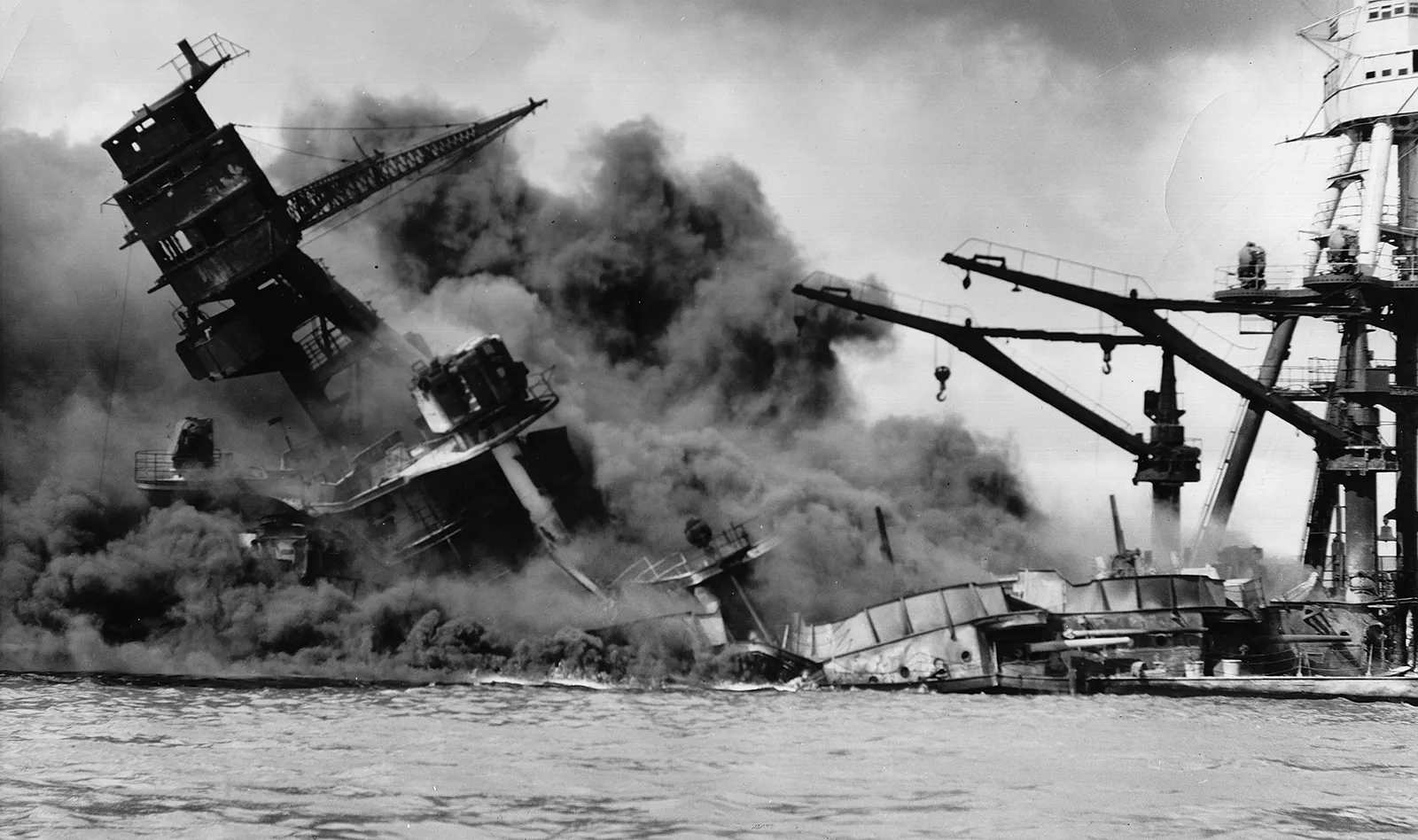
By December 1941 it seemed increasingly likely that Japan’s war in China would lead to conflict with the USA, as America had imposed embargos on oil and metal ore supplies to Japan. When Japan attacked the US Pacific fleet in Pearl Harbour, Hitler made possibly his greatest mistake of the war and declared war on the USA. Churchill had been proved right that “the tide is turning our way” and had helped to prepare the ground by his meetings; but he could not really have foreseen Hitler’s decision and his strategy was based on hope.
What followed was a remarkable turn of events. Though Roosevelt wanted to wait before meeting Churchill, the Prime Minister went to Washington as soon as possible, where he made a very positive impression. America was now more inclined to see Churchill as a heroic figure in a very emotional time rather than an oldfashioned imperialist warmonger and Churchill’s oratory and confidence now were major elements. British policy prevailed. The US General Marshall did not get his way and there was no invasion of northern France immediately. The USA supported Churchill’s strategy of fighting mainly in the Mediterranean. From being alone, Britain was now a member of a Grand Alliance of 26 nations.
“God is on your side? Is He a Conservative? The Devil’s on my side, he’s a good Communist.”
Joseph Stalin to Winston Churchill, November 1943
International Diplomacy, 1939-1941: Churchill and Stalin
Churchill had held a hostile view of communism since the Russian Revolution of 1917, and in support of his viewpoint, it did indeed, as he had warned, lead to the creation of a bloodthirsty dictatorship under Josef Stalin. However, when a greater threat arose from Hitler after 1933, Churchill proposed forming a Grand Alliance that would have included Russia on purely practical grounds. He did not, however, alter his view that communism was an evil. In fact, many of the early Russian activities in the war appeared to prove this.
USSR at War: 1939-1941
→ August 1939 Stalin agreed to a non-aggression pact with Hitler.
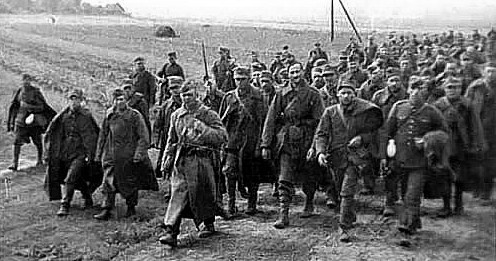
→ Working with the Germans the USSR occupied Eastern Poland in September 1939. This was accompanied with violent repression which mirrored many of the atrocities carried out by the Germans.
→ In 1940, the Soviet forces carried out a massacre of Polish prisoners in Katyn forest, just outside of Smolensk. It is estimated that 4,253 people were executed, mostly with their hands tied behind them in a cold-blooded manner similar to earlier Soviet internal purges and to Nazi ethnic killings. Stalin gave personal orders for this massacre.
Operation Barbarossa, June 1941
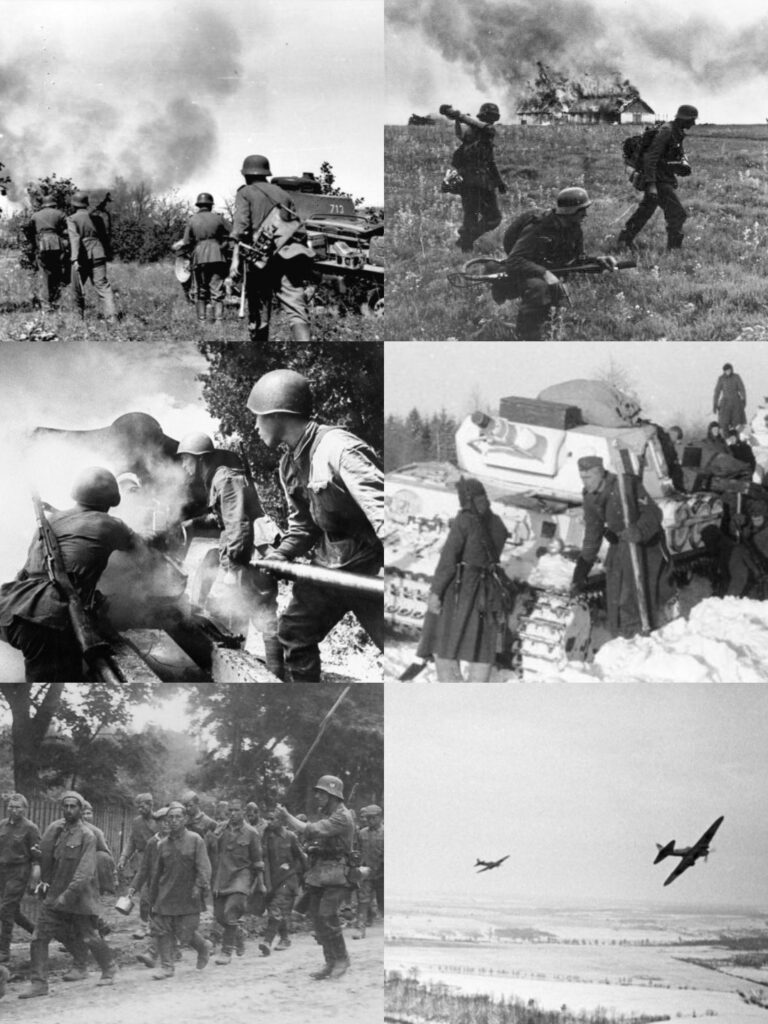
When Hitler’s armies invaded Russia in June 1941, Churchill was quick to offer support to the USSR. There was little expectation that Hitler would lose. Russia had not performed well militarily in the war against Finland in the winter of 1939-40, and following the rapid early German victories in Russia, it seemed certain there would be a Russian defeat. However, Churchill made he view towards the Russians clear in one of his most famous comments: ‘If Hitler invaded hell, I would make at least a favourable reference to the devil in the House of Commons.’
This made it clear that Churchill was aware that the Soviet regime to which Britain was allying itself was maintained by brutal repression, but that the threat from Germany in 1941 was great enough to warrant such an alliance.
In the event, despite massive Soviet losses of men and equipment, the German advance was halted before Moscow and Leningrad. The prospect of a long and gruelling struggle in Russia emerged and was followed by the US entry into the war. Churchill now had his Grand Alliance, even if it did mean dealing with “the Devil”. When the British ambassador to the exiled Polish government produced a report making it clear that evidence pointed towards Soviet responsibility for Katyn, this was not made publicly available and remained top secret. Roosevelt was sent a copy but suppressed it and refused to entertain any opinion that Russian behaviour was so brutal. Perhaps it was a simple necessity – to defeat the Germans. Both the USA and Britain had to maintain a favourable image in their countries of “Uncle Joe” Stalin and the heroic Russian people.
First discussions between Britain and the USSR, 1941
After 1941, Churchill had clear aims:
1. Russia must stay in the war in order to weaken Germany.
2. Russian demands that a second front should be opened in France should not be met for as long as possible.
Stalin had clear aims too, which involved a restoration of its 1941 frontier, including the gains it had made in 1939-40. As this was a war being fought for freedom and whose idealistic aims had been set out in the Atlantic Charter, this presented moral problems for Churchill. Stalin’s aims were in direct contradiction to the wishes of the countries of Eastern Europe who had no desire to have a brutal dictatorship forced on them by the USSR. In the first meeting with the British, attended by British Foreign Secretary Anthony Eden in December 1941, Stalin made these claims clear and demanded a second front by the invasion of northern France to take some pressure of the Soviet army.
At this stage, Roosevelt was completely against any promise of territorial gain. When Eden suggested negotiating possible USSR post-war frontiers, Churchill issued a considerable rebuke. All territorial decisions should wait until the war had been won. Appeasing the USA was more important than appeasing Stalin. However, if Russia did not co-operate, then difficulties might arise. There was no certainty that Stalin would not negotiate with Hitler, as he had done in 1939 or simply fight his own war. Convoys were sent to Northern Russia carrying supplies, with considerable loss of life among British seamen, to assure Stalin of Britain’s goodwill. And Churchill decided to see Stalin personally.
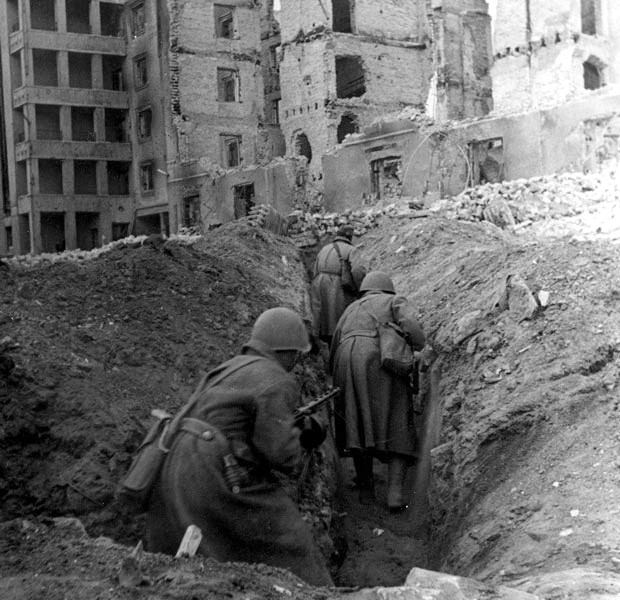
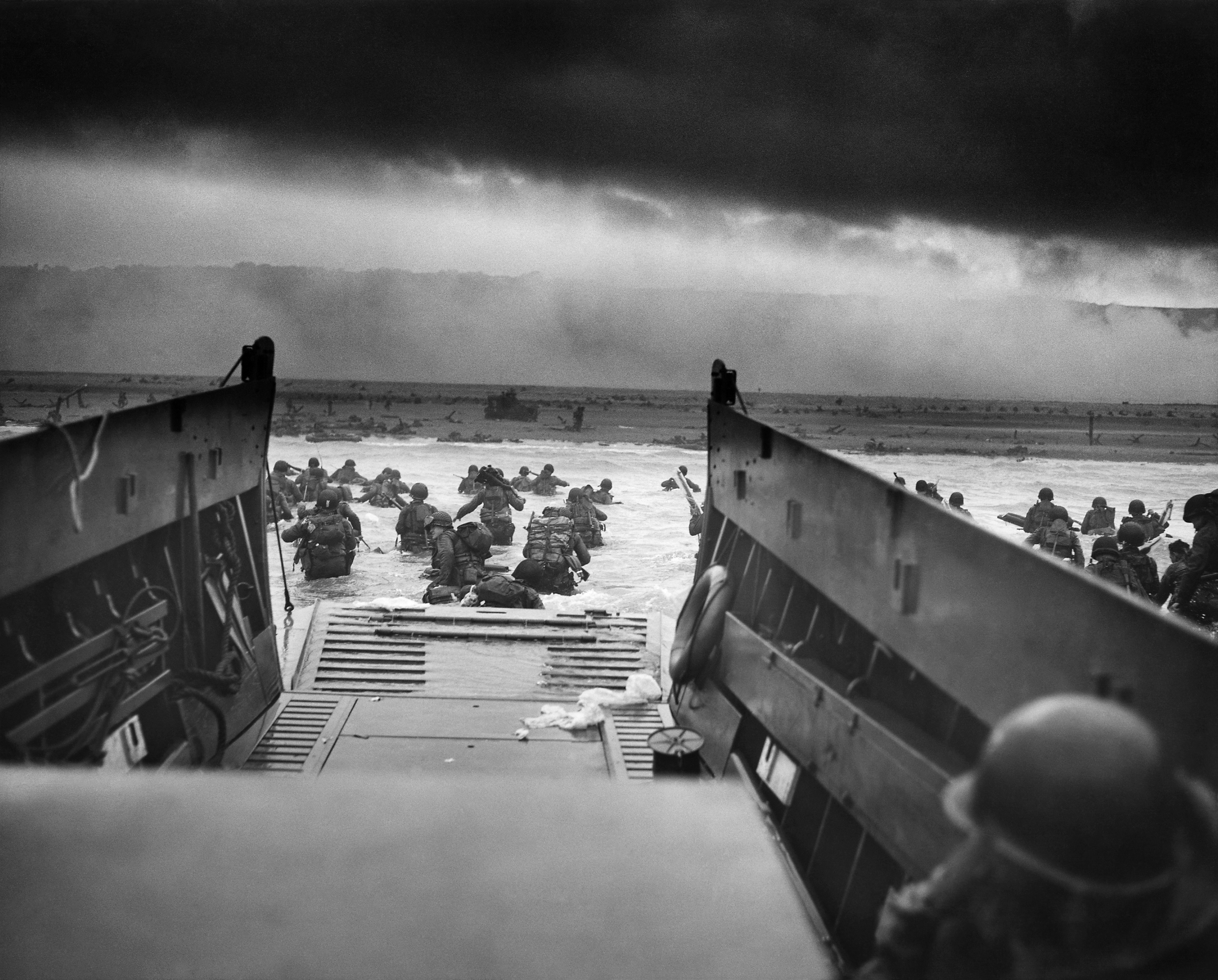
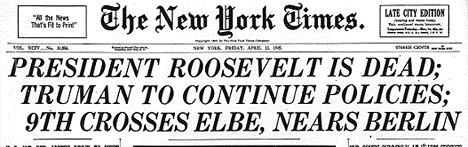
Churchill and Roosevelt
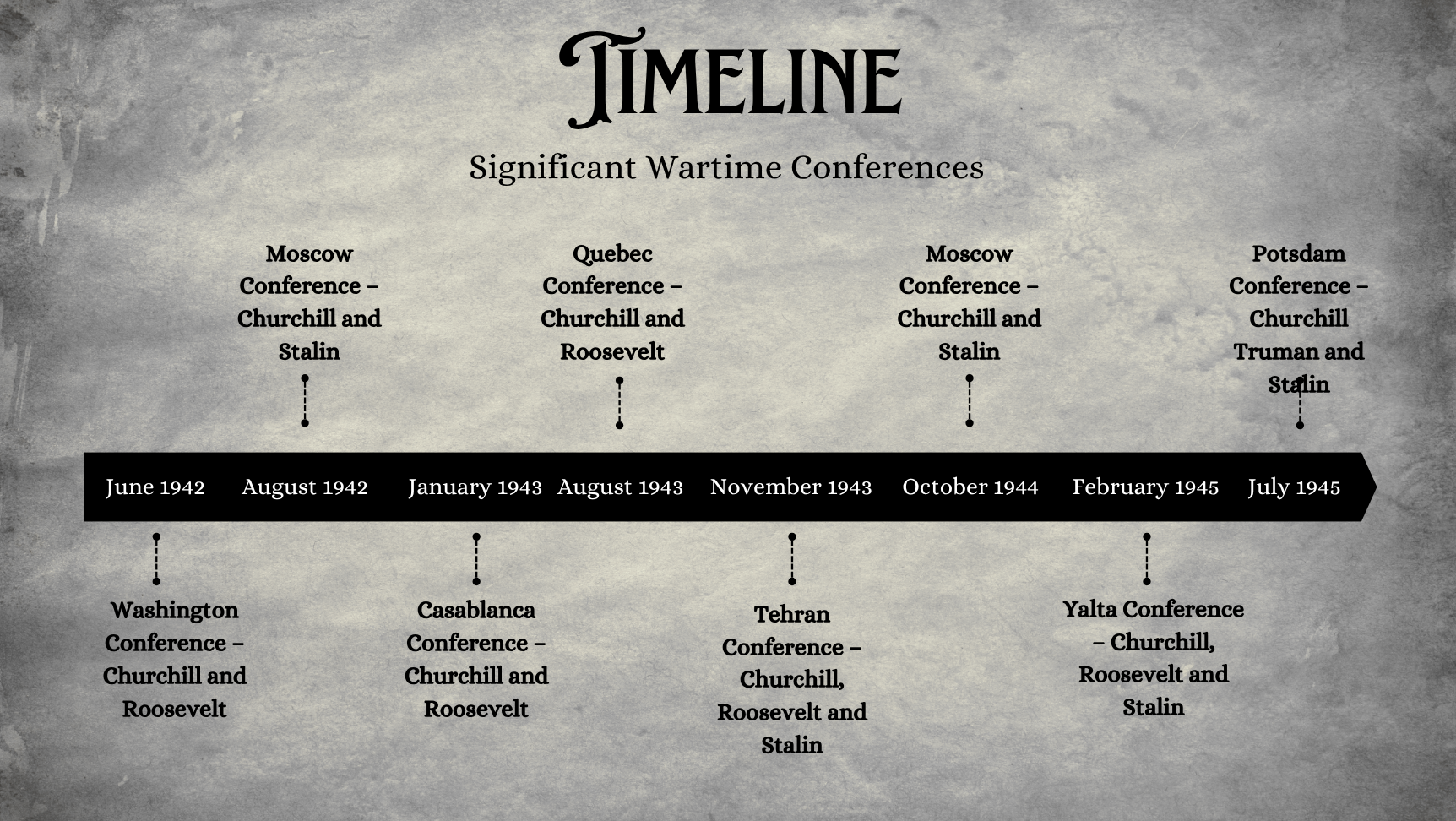
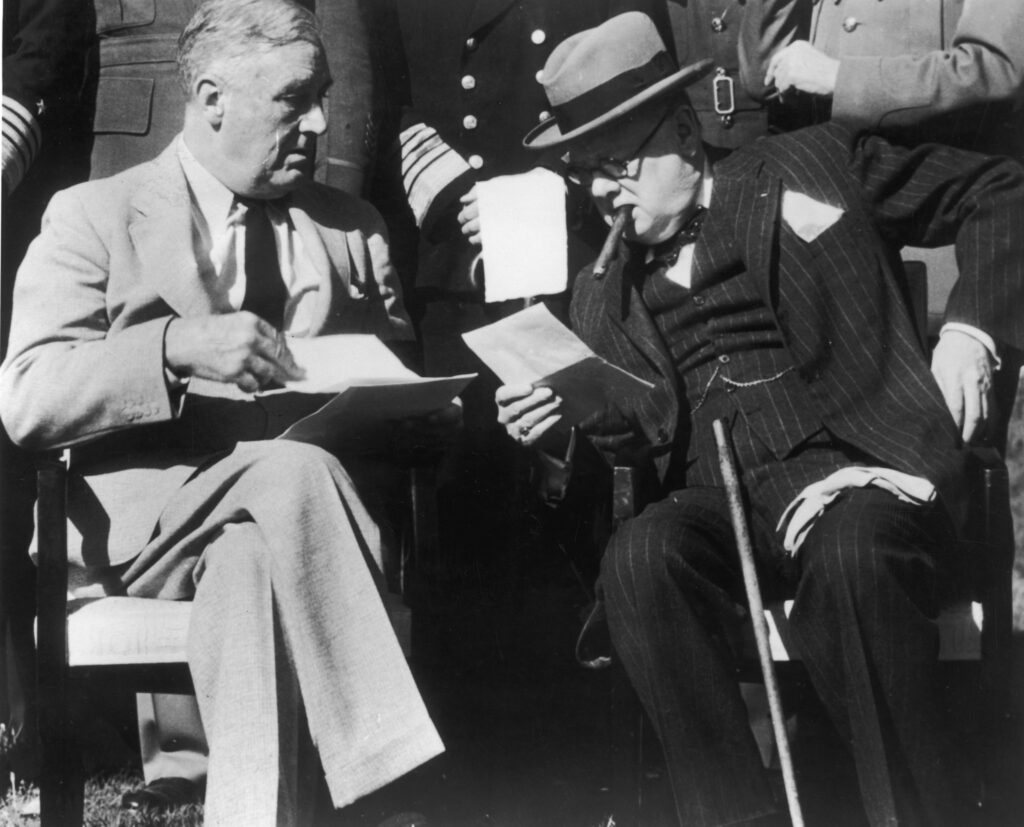
In meetings throughout June 1942 in the US, Churchill persuaded Roosevelt against what had become known as “Operation Sledgehammer”, the opening up of a second European front via the invasion of France to help ease the pressure on the Russians. Instead Churchill promoted the idea of a joint campaign in North Africa. Roosevelt during these early meetings agreed to the movement of over 1 million US troops to Britain; from which they were either shipped to North Africa and Italy, or preparing for the invasion of France.
Despite reluctant American support for Churchill’s Mediterranean Strategy, there were bumps in the relationship during this period. Roosevelt disliked Britain’s backing on de Gaulle as the representative of the French. The Americans preferred to work with the French General Giraud, a higher ranking officer. Tensions over this issue were evident at the Casablanca conference at which both de Gaulle and Giraud were present.
In meetings throughout the summer of 1943, US pressure forced a planned date for the invasion of France to be agreed upon – May 1944. Roosevelt was also moving to the logical position that, given Russia’s immense war effort – the USSR was for example bearing the brunt of military casualties: an estimated 8-10 million compared with 380,000 British and 416,000 American during the entire war – the key element in US diplomacy should be to negotiate with Stalin and to sideline Churchill, whose forces were not contributing to the war on the scale of the US and USSR. By the time of a meeting at Quebec in August 1943, splits were apparent. The USA favoured an attack on southern France, which Churchill did not. Churchill favoured attacks in the Balkans which the USA did not.
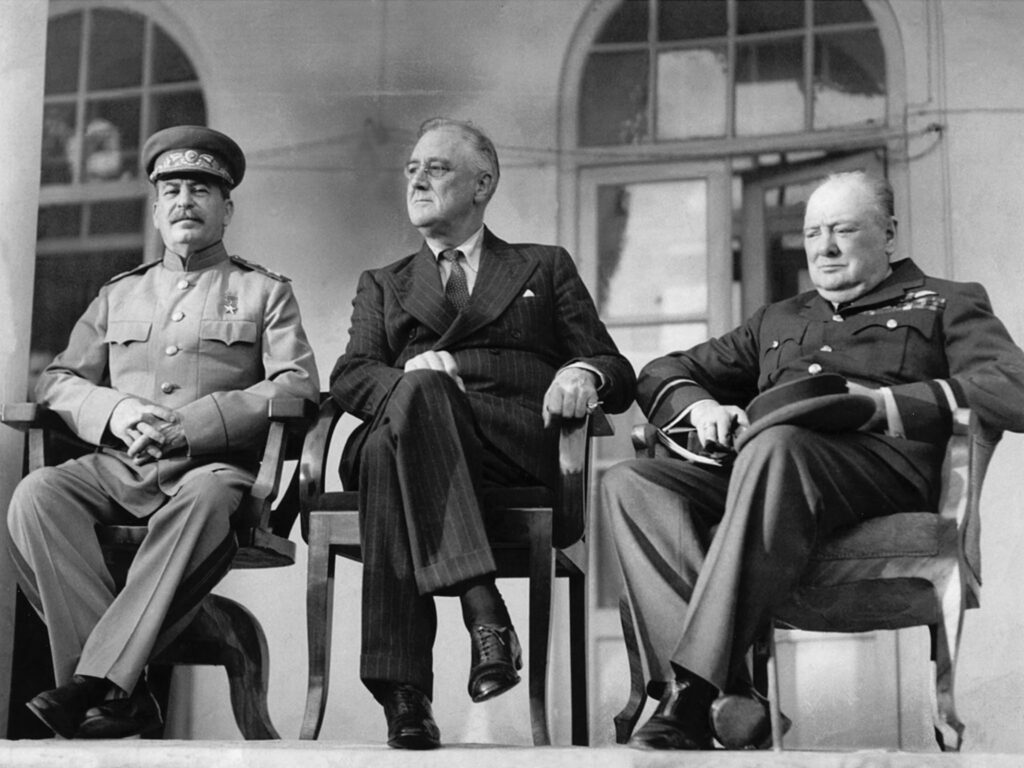
The meeting at Tehran was the first conference that all three leaders attended, but it is perhaps more significant as it highlighted how poor relations between Churchill and Roosevelt had become.
→ Roosevelt refused to meet privately with Churchill – but he did meet with Stalin. He discussed plans for post-war Germany with the Soviet leader.
→ He met with the Chinese without Churchill’s knowledge.
→ He made it clear that the USA was switching more of its attention to the defeat of Japan – abandoning the common “Europe First” strategy that had been deployed until then.
→ Following bitter discussions, a planned date for the invasion of northern France was agreed. Churchill reluctantly agreed that the operation (Operation Overlord) would be led by the Americans.
At a meeting with Roosevelt in Quebec in September 1944 Churchill had to implore Roosevelt to extend Lend Lease credit after the war to Britain. At one point he exclaimed “What do you want me to do? Get up on my hind legs and beg for you, like Fala?”, (Fala was Roosevelt’s dog). Similarly when he raised the issue of the need to push on to reach Berlin before the Russians, the Americans were not convinced. It was becoming increasingly clear that the Americans were not as concerned as the British were at the prospect of post-war Soviet expansion.
The Yalta Conference of February 1945 was the last between Churchill and Roosevelt. There was little to be done except to accept Stalin’s control of Eastern Europe and Roosevelt made it clear that US military forces would only be deployed for a further two years at the most. However, both Roosevelt and Churchill did agree that there should be free elections and democracy in post-war Europe; and to let the individual countries to decide their own fate. Roosevelt, however, was concerned that the same principles would not be applied to the British Empire.
Roosevelt’s death in April 1945 produced a heartfelt reaction from Churchill, but the hopes for a post-war world based on a special relationship were not really founded on reality.
Churchill and Stalin
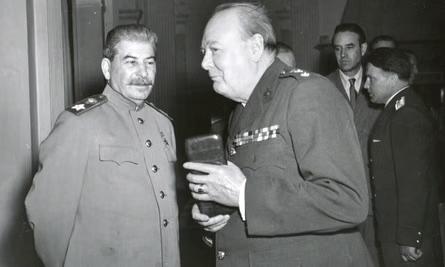
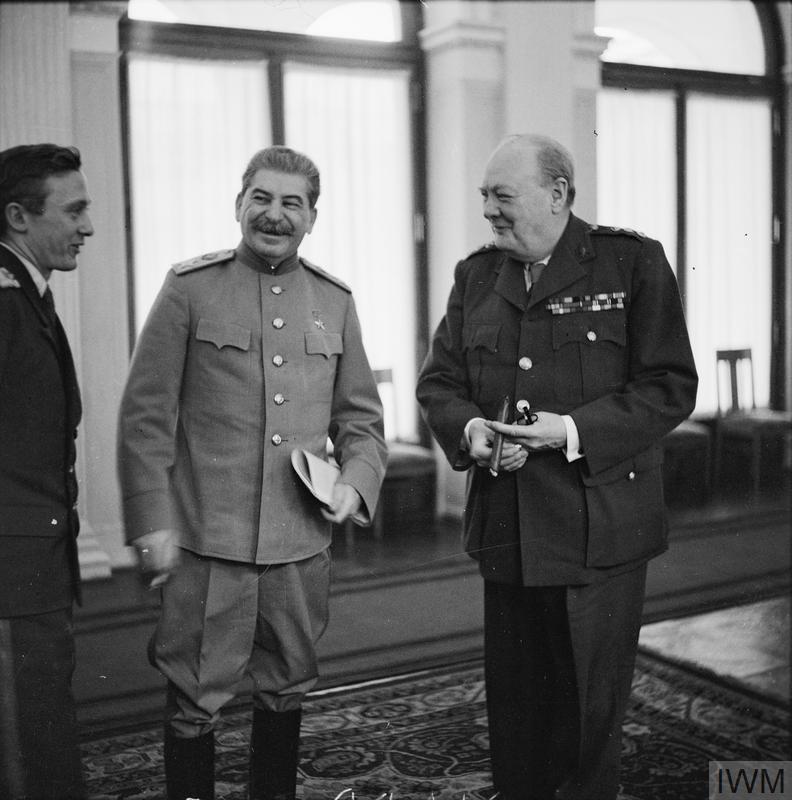
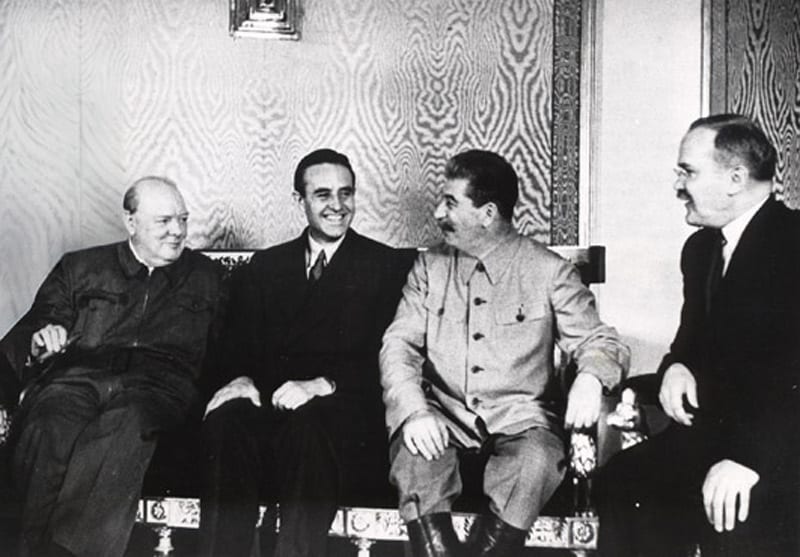
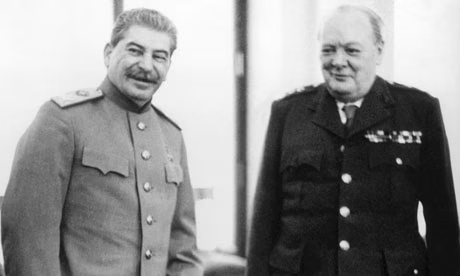
Churchill’s first meeting with Stalin in Moscow in August 1942 did not go well at first. Stalin bluntly demanded a second front to ease the pressure on his forces in the east. Churchill’s explanation of the “soft underbelly” strategy, which included drawing a crocodile to represent Germany and Italy to show why a Mediterranean strategy was vital, was met with Russian scepticism. Churchill felt as though he was not being treat as the hero of 1940 but as some sort of cowardly weakling. Tempers were frayed. Eventually, and with a large consumption of alcohol, Stalin and Churchill became more friendly and Churchill seemed to warm to him. However, there was little actually settled. Stalin did not get a second front, only promises of one, and there was still the unresolved issue of the post-war territory.
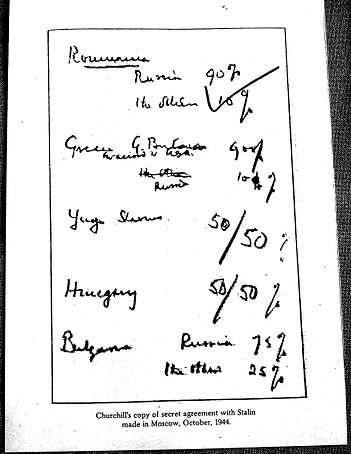
Churchill met with Stalin again in Moscow in October 1944. By now his own reservations about discussing post-war settlement had gone; and there was less need to worry about offending the USA. The invasion of France had been successful – but Churchill could not really set the 156,000 troops who went into action on the 6th June 1944 (D-Day) against the 2 million Russian troops who were fighting the Nazis in the simultaneous battle of Kharkov and pretend that the war was being fought equally by Russia and the West. Here was the essence of the problem for Churchill. For Britain, D-Day was and remains a monumental and heroic event. For the USSR, it was a long-delayed and relatively under-resourced diversion. The fact is that Stalin did not particularly need Churchill. In any negotiation, Churchill did not have a strong hand. Indeed, it could be said he really had no hand at all as it is probable that the USSR could have defeated Germany without the second front. However, at least the second front was established, which generated more good will, and some negotiation could take place before Russian troops broke through into Europe. Given the relatively weak hand that Churchill had in 1944, he did well to maintain the relationship with the USSR, keeping the door open for future negotiations with Stalin.
The “Percentages Agreement”
In Churchill’s memoirs on the 1944 Moscow Conference, he discusses a piece of paper which he describes as “naughty”. This paper proposed dividing Eastern European countries into “spheres of influence” – meaning that regions or countries could be dominated by a greater power who would not necessarily rule the areas directly. The infamous “percentages agreement” challenged the idealistic vision of Britain as a fighter for freedom and was more typical of cynical power politics. There was no question of consulting the people of the countries that were to be dominated by the USSR and the West. It was the sort of deal that Stalin understood and oddly he respected it. In the aftermath of the agreement, Stalin showed his allegiance to Churchill by not offering help to the Greek communists in a civil war in which Britain supported the royalist side.
Churchill and De Gaulle
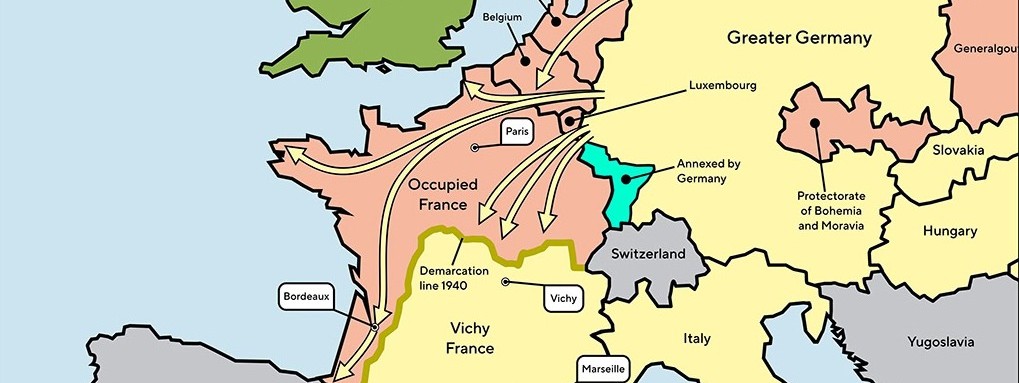
Churchill loved France and spoke fluent is heavily accented French. He had been in close contact with the French as soon as he took power and was devastated by the French surrender, being willing to send further forces even after Dunkirk and to commit air resources to France against the advice of the RAF commanders. He even offered a union between Britain and France as a desperate attempt to keep France in the war. Hitler occupied northern France, but allowed a reduced, pro-Nazi French state considerable independence after the peace treaty in 1940.
This pro-Nazi state was known as Vichy France as its capital was the southern town of Vichy. Churchill was shocked at the French surrender and concerned about the French fleet falling into German hands. The actions taken against the French navy by Britain were brutal and, some thought, unnecessary: 1297 French servicemen were skilled when five ships were sunk by Britain. These actions ensured that future relations with Vichy France were impossible.
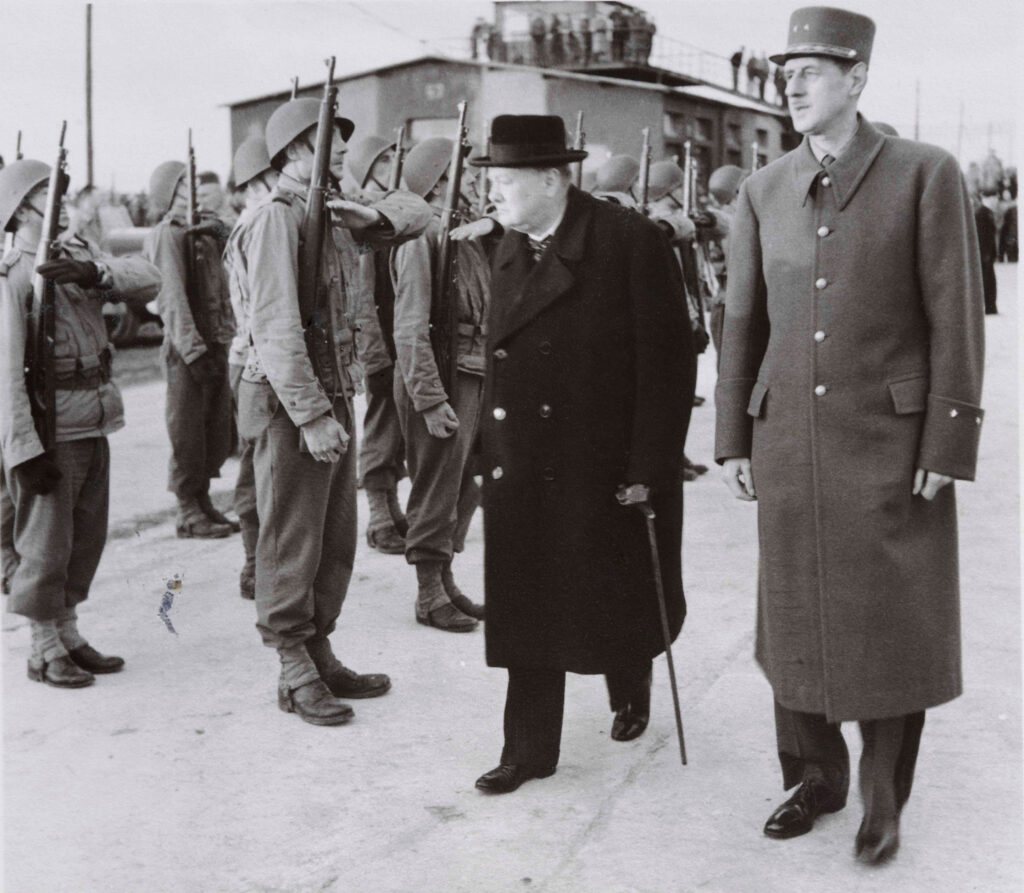
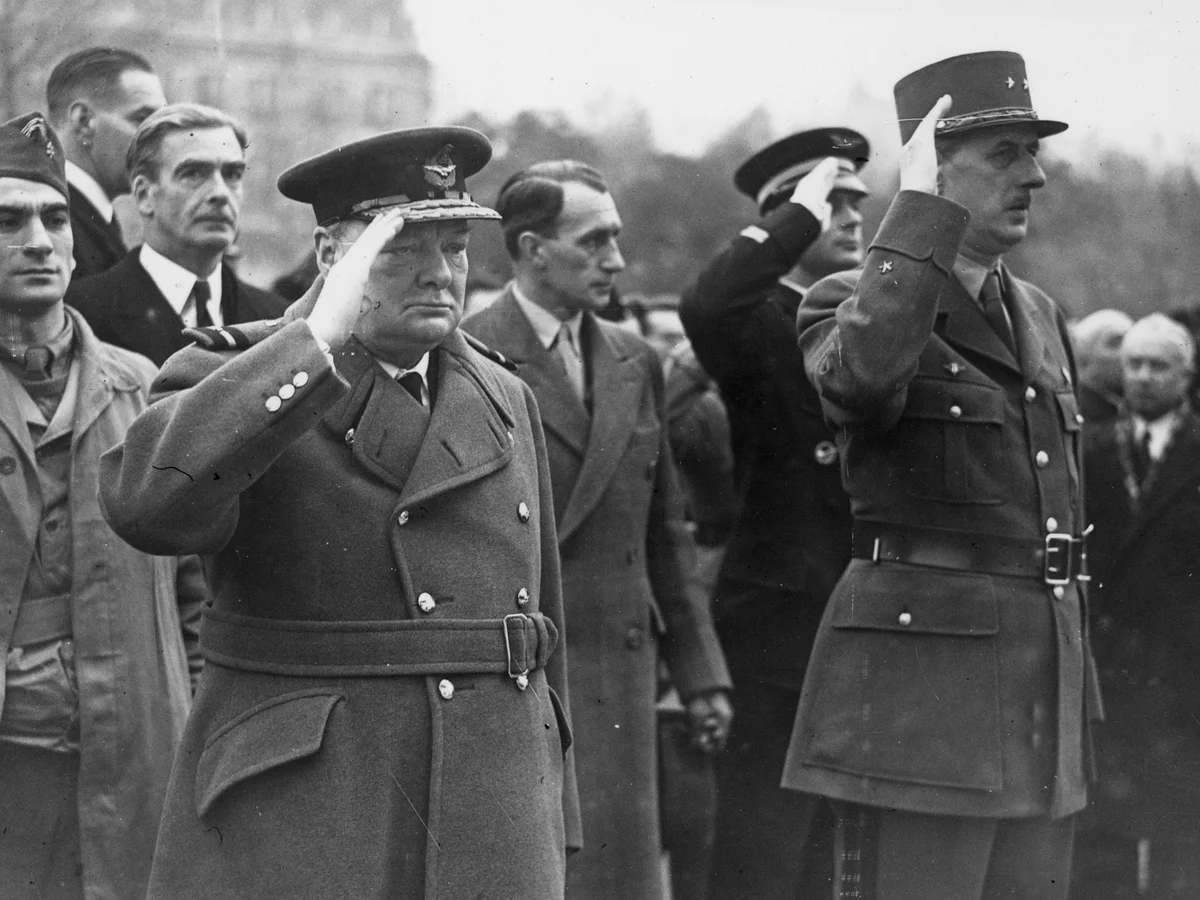
The French saw the British retreat as a betrayal. The symbol of continuing French resistance came to be as the tall, proud Colonel Charles de Gaulle who saw himself as the spirit of a free France and led the forces known as the Free French (exiles from occupied France who were based in Britain). Churchill admired de Gaulle but found him difficult to work with. De Gaulle was uncompromising and often unco-operative and was also disliked by the Americans. De Gaulle was not a political leader or a high-ranking officer; as well as being the self-proclaimed champion of France, he also saw himself as the natural leader of post-war France – something that Churchill and Roosevelt did not accept. De Gaulle would not work closely with former Vichy leaders in North Africa which annoyed Roosevelt and embarrassed Churchill. Churchill had to work hard to restrain his temper and impatience. De Gaulle, despite being totally dependent on British goodwill, felt no obligation and relations between himself and Churchill were stormy throughout the war.
Post-War Reconstruction
Churchill during his years as a Liberal MP had been a well-known supporter of social reform. However, during the Second World War he saw discussion of what might happen after victory as a distractions to achieving that victory. Nevertheless, the wartime coalition which Churchill headed had made substantial progress in planning the post-war period and paved the way for important reforms after 1945. These changes during the war largely came as a result of the work of the Labour members of the war cabinet – Clement Attlee and Arthur Greenwood.
Some of the social changes made during the Second World War
| Rest centres and meal service centre | To help those who had suffered in air raids. |
| Committees for the homeless | A million homes were made habitable. Prefabricated homes were created to meet the housing shortages. |
| National Assistance | The old “means test” was abolished in 1941 and help was given to the needy. |
| Emergency Hospital Service | By 1941 8 out of 10 hospitals were brought under a national scheme for the first time. |
| National Fire Service | Over 1500 different fire services were brought together |
| Mothers and children | Diphtheria immunisation; free milk to school children; extension of free school meals; orange juice and codliver oil provided. Led to reductions in infant mortality. |
| Railways | In 1942 British railways united and nationalised the rail network. |
| Factory Acts | Improved welfare for 6 million workers; Catering Wages Act and Wages Council Act led to improved wages for the low-paid. |
| Education Act | The school leaving age was to be raised to 15. Education to be divided into primary (5-11) and secondary (11-16) and tertiary (16+). School fees in state schools ended and milk and meals provided. 11+ exams introduced to decide on future education path. |
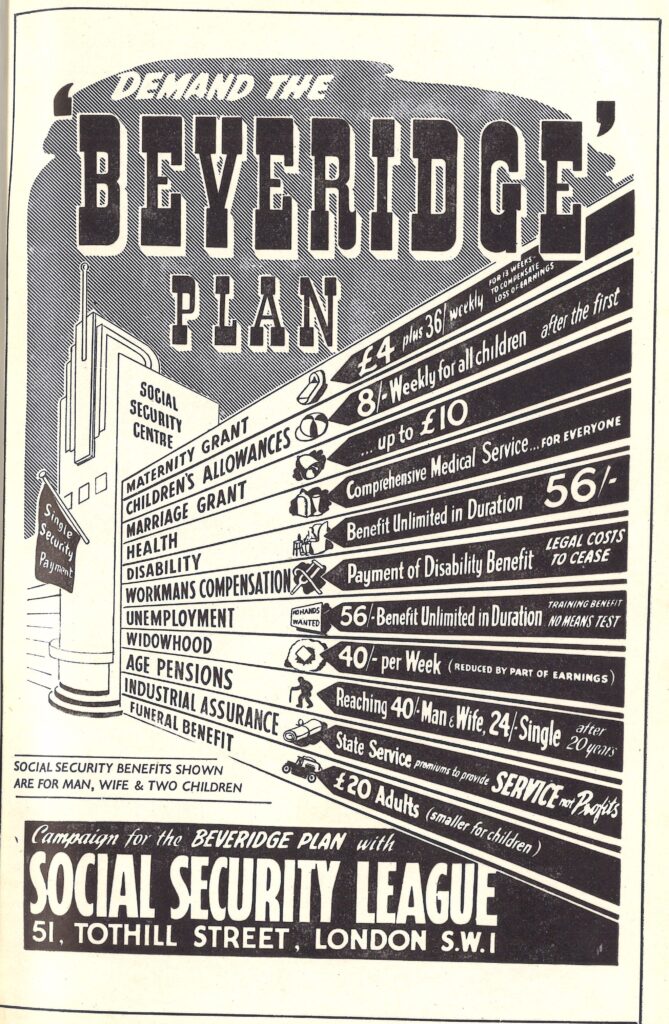
Despite the evident examples of social progress made during the war as outlined above, the key turning point in the war, which pushed demand for whole-scale social reform, came in 1942 with the publication of the Beveridge Report.
The Beveridge Report, 1942
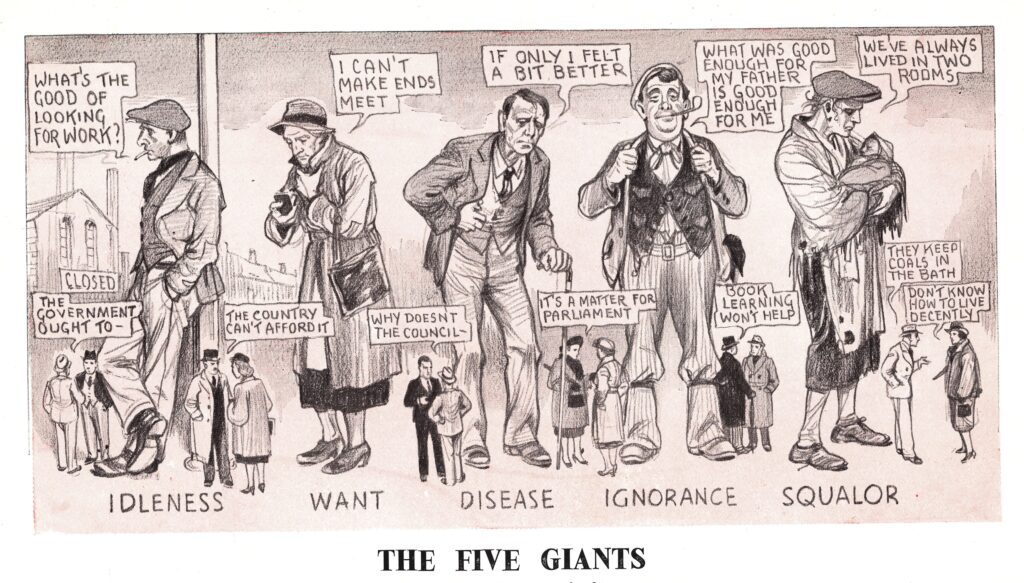
Sir William Beveridge produced a report on 1st December 1942. He argued that poverty could be abolished if there were an extended social insurance scheme in which everyone of working age would be expected to pay a weekly National Insurance contribution. He identified the five causes of poverty – which he labelled “the five giants” –want, disease, squalor, ignorance and idleness. In order to tackle these he recommended child allowances and foresaw a national health service and an end to mass unemployment. His report sold over 600,000 copies and became symbol of a desire for greater social welfare.
Thus the war had forced the state to extend medical services, care for the poor and homeless, plan for future extension of the welfare state, make provision for more town and country planning and reform education. There was a determination not to return to the disappointment which followed the First World War and the poverty and unemployment in many areas in the 1930s.
Although the Conservatives as a whole supported the Beveridge Report, many – including Churchill – feared the growth of the state. These concerns were borne out of political thinking. Churchill believed that an expansion of the government in the role of British citizen’s lives would lead to greater support for more left-wing and socialist policies and would naturally lead to a growth in support of the Labour Party. The report was debated in February 1943 and aroused passionate arguments from all sides of the House of Commons. Churchill expressed concerns at the costs but the Conservatives and Liberals accepted the principles of what Beveridge called “a social service state”, with citizens paying contributions for health and welfare benefits, and Labour thought it did not go far enough.
1945 Election
→ The general election took place on 5 July 1945 but results were not available until 26 July because time was needed to collect and count votes from overseas servicemen.
→ Labour was consistently in the lead from 1943 in by-elections, and opinion polls were suggesting that they had a substantial lead over the Conservatives.
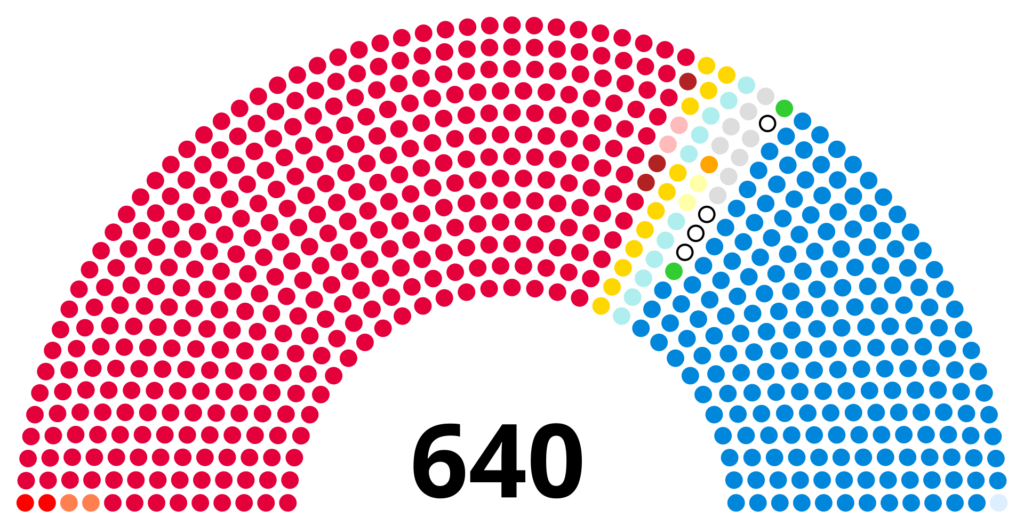
→ On 26 July the results showed that Labour had won 393 seats, a gain of 227. The Conservatives had lost 185 seats to Labour.
Labour
Were the election results really that big of a surprise?
→ The electoral fortunes of the Labour Party had also been improving before the war. Opinion polls by 1941 showed increasingly popular support for Labour and from 1943 onwards the polls consistently showed a 10-20% Labour lead over the Tories.
→ Evidence suggests there was a steady leftward trend amongst the electorate during the early 1940s. This trend was helped by the expansion of the trade union movement during the war. The war also made people aware of the enormous contribution made by Soviet Russia towards the defeat of Hitler, putting socialism in a good light.
→ Another influence on the public mood was exerted by memories of the 1930s. Ironically, the Conservatives in 1945 paid the price for their sweeping electoral success in 1931 and 1935. In 1945, many voters blamed the Conservatives for the failings of the 1930s: not only unemployment and social deprivation, but the failure of appeasement to prevent another war and the inadequacies in Britain’s defences which were revealed when the war began. Labour’s electoral propaganda played on these bad memories and the need to ensure that they never occurred again. Harold Macmillan, a Conservative who lost his seat in 1945, wrote later that: “It was not Churchill who lost the 1945 election; it was the ghost of Neville Chamberlain”.
How important was the war in Labour’s fortunes?→ The war had also transformed attitudes towards state planning. The massive extension of state control, regulation and planning seemed to have led to full employment and a sense of working together for a common goal. Voters felt that If these methods produced these results in wartime, then they should be applied in peacetime. As a result, Labour’s plans for the nationalisation of key industries no longer seemed wild or dangerous. Belief in state planning and government intervention suited Labour’s ideas and approach far more naturally than it suited the Conservatives. → Although the war did not in reality create as strong a communal spirit as the propaganda image might suggest, it did forge a greater sense of national unity. The social mobility caused by the war meant that some of those for whom the 1930s had been a period of affluence were brought into contact with those for whom the 1930s had been a decade of poverty and despair. Such experiences led to the feeling amongst many middle-class voters too that things had to be different after the war, with no return to the divisions of the 1930s.
→ Labour politicians had played a key role in the war coalition, especially on the Home Front. The work of Attlee, as deputy prime minister, Ernest Bevin as the Minister of Labour, and Herbert Morrison as Home Secretary kept Labour’s leaders in the forefront of voters’ minds throughout the war.
→ The tendency of those who served in the armed forces was to be pro-Labour. In 1945, Churchill remarked to his RAF Chief, Marshal Tedder, that he hoped servicemen would vote for him in the forthcoming election. “No, Prime Minister,” said Tedder, “Eighty per cent of them will vote Labour”. Churchill said furiously that he was grateful to learn that 20% would vote for him. “Sorry, Prime Minister,” said Tedder, “The other 20% will not vote at all”.
Conservative
Problems of policymaking were fundamental to the Conservatives’ defeat.
→ There was a lack of official policy-making on home affairs –
the Conservatives focused on “let’s win the war first”. The Conservatives became preoccupied with Churchill’s vision of internationalism and concern over the Soviet Union, at the expense of welfare reform and reconstruction.→ Churchill himself had no message on domestic policy, apart from warnings about increased involvement of the government in social and economic affairs.
→ Generally the Conservative Party was not associated with welfare reform and a split developed within the party between those who were proreform and those who were antireform.
→ This split can be seen via the party’s response to the Beveridge Report. It was embraced enthusiastically by the Tory Reform Group, who were also in favour of more government intervention, but it was treated with suspicion by others, such as Churchill, who feared the extension of state intervention and higher taxation in peacetime.
→ The campaign was principally based on Churchill’s wartime leadership. It was not understood that the public would differentiate between Churchill as the effective wartime leader and Churchill the peacetime Prime Minister.
→ Too little was spent on publicity, only £3,000. This was less than one-tenth of the £30,000 spent in 1935. → Local Conservative Party activism was virtually nonexistent up to a few months before the 1945 general election.
Was there a failure of leadership from Churchill?
There was a leadership vacuum because:
→ Churchill was not a good party man. He had been in the political “wilderness” until the war and had no power base within the party.
→ At the time, he was identified as a war leader. This was fine for war but not for peace. He was totally involved with strategy and wartime diplomacy.
→He did not have close relations with the party organisation hierarchy and tended to listen more to his cronies, Beaverbrook and Bracken.
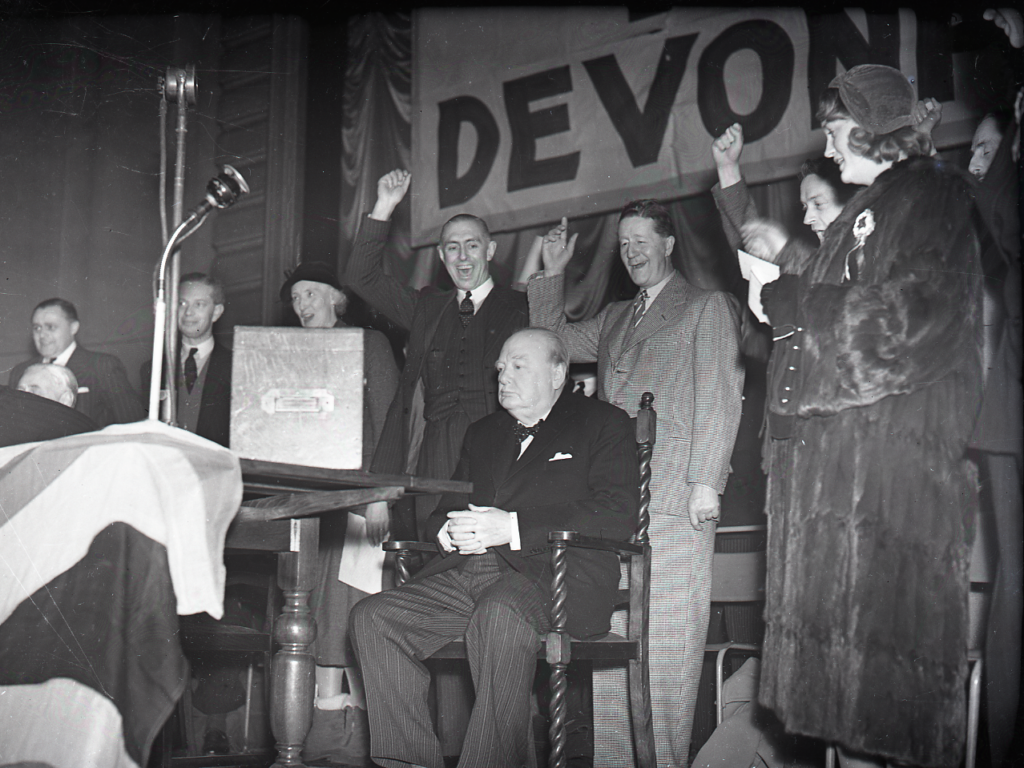
→ During the election campaign Churchill in what has become known as his famous “Gestapo” speech, suggested that a Labour government would need some form of secret, political police force to ensure its control of the economy and society. This infuriated Labour and the public generally. It was insulting to the democratic traditions of the Labour Party and to his wartime allies. It probably cost the Conservatives votes. Attlee’s calm and measured response only deepened public sympathy for Labour.
→ Churchill’s age was also an issue – 70 in 1945.
Churchill’s activity after the 1945 election defeat
After his defeat in the election of 1945, Churchill had time to reflect on Europe and made a major speech in Zurich in September 1946 which added to his reputation as a major figure in the European movement. His name has been used by supporters of greater European unity, but also by its opponents. For all his patriotism and love of Empire, Churchill had never been a “little Englander”. He had warmly supported the French statesman Briand’s idea for a European union in 1930. He had offered union with France in 1940, drafting a declaration that “France and Great Britain shall no longer be two nations but one Franco-British union”, and in 1942 during the war had written about “a united states of Europe which reduced barriers of trade and movement”.
A key position Churchill took in the 1930s was that Europe was central to the defence of the Empire, and he despised those who thought that Britain could opt out of European affairs. There were many instances of his support for European unity. However, his view of Europe must be seen as part of his belief that Britain and her Empire were in a unique position. They were part of three major non-communist groupings in the world – the Anglo-American group, the Commonwealth and Empire group, and Western Europe. Greater unity in all these groupings would strengthen Britain’s position and security. As a concept, this was very grand, but there were also problems:
→ Being part of all of these groupings involved obligations as well as benefits.
→ In all three groups there were those who did not want Britain to dominate.
→ Post-war Britain was struggling economically and the defence costs of having such a key player in the world were very high. However, Churchill did want to see greater economic co-operation and a reduction of trade barriers across the continent.
→ There were those who were sceptical about the value of all the groups; on the left there was concern that Britain was getting sucked in to American hostility towards Russia; within the Commonwealth there was resentment about British dominance and a desire for independence; in Conservative circles, the whole idea of greater European union was seen as undermining Britain’s traditional freedom of action.
→ Churchill himself did not really favour much more than a loose association of European nations affirming shared values. His son in law Duncan Sandys organised a meeting of 800 influential Europeans in 1947 which led to the formation of the Council of Europe in 1949, but this was a long way from being a real union and was more an arena for sharing ideas and affirming western values.
In any case, Churchill did much to establish the view that Europe was divided by an “iron curtain”. European unity was very much in the context of Britain’s world role and was confined to Western Europe.
Exam Zone
This section has been designed to help you build confidence, sharpen your skills, and achieve your best possible results. Whether you are preparing for mock exams, end-of-unit tests, or final assessments, the Exam Zone provides everything you need in one place.
The Exam Zone is not just about testing your knowledge. It is about developing the key historical skills required for success: critical thinking, evaluation, and clear written communication. By practising regularly and reflecting on feedback, you will strengthen both your understanding of the past and your performance in exams.