Britain and the Wider World
1930-1997
Explore a global superpower navigating the transition from a dominant imperial force to a junior partner of the United States and a member of the European community.
International Crisis
Cold War
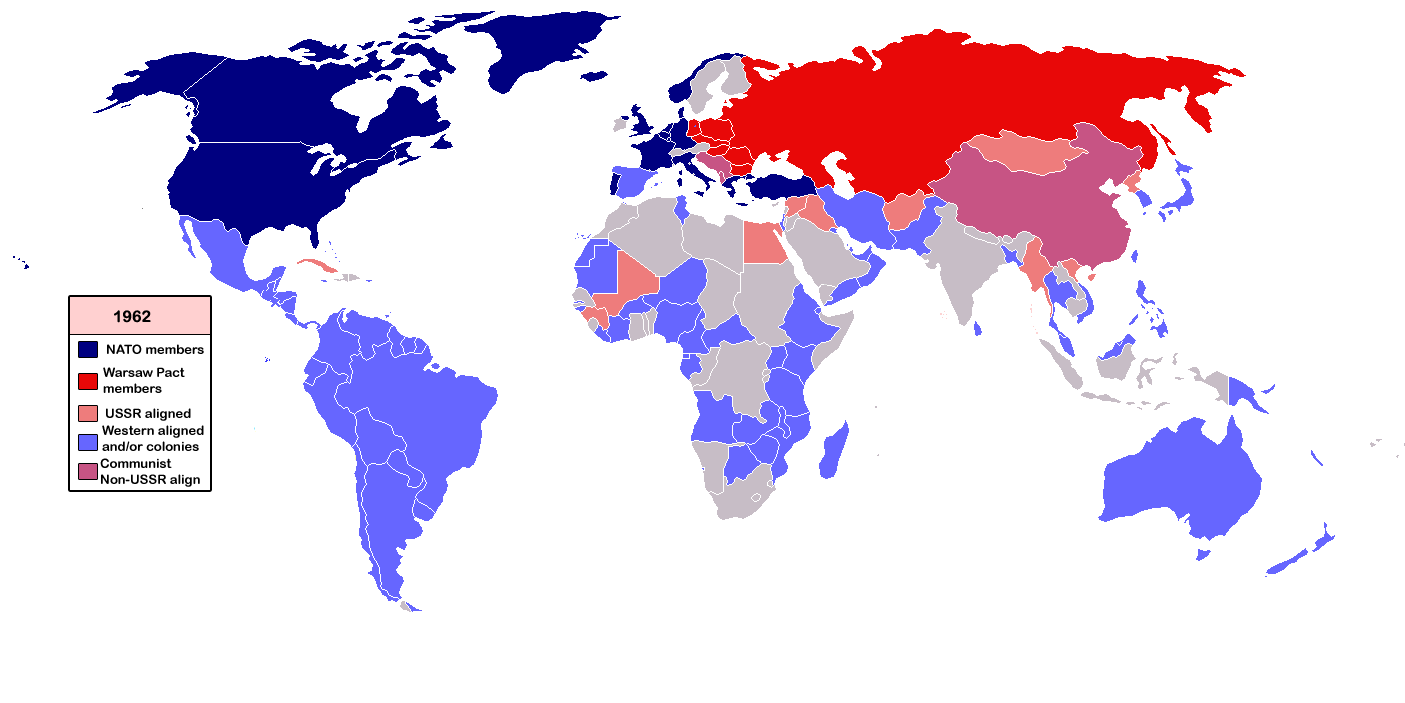
Europe was divided into two political and economic camps. There were the Western European countries – including Britain, France and USA – and the USSR and the Eastern Europeans communist states. Stalin wanted to see what the West would do if it was challenged.
Germany Divided
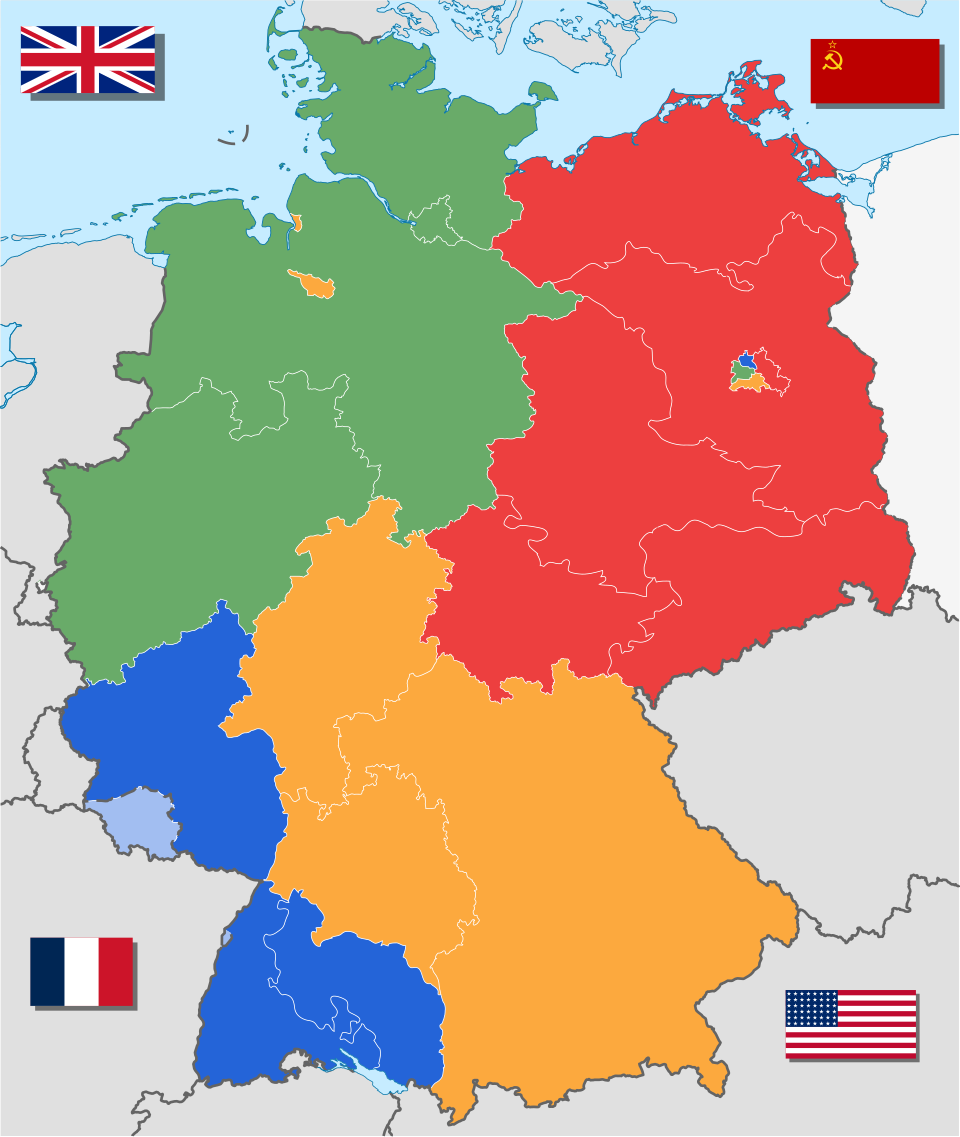
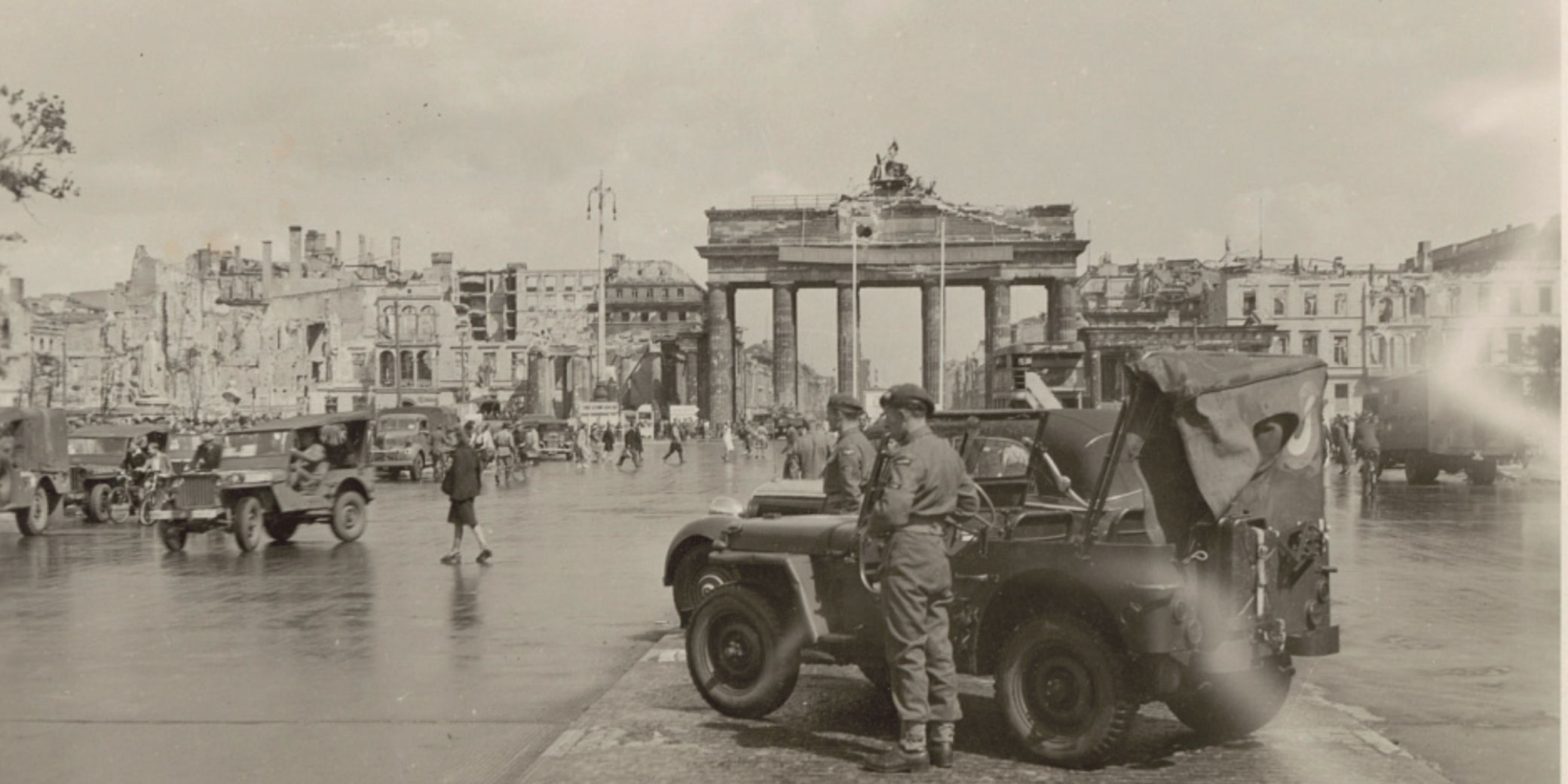
At the Potsdam Conference in 1945, the Grand Alliance had agreed to divide Germany, and its capital Berlin, into four separate zones controlled by the Soviet Union, the USA, Britain and France. The division was meant to be temporary but lasted many years. There were soldiers on the streets, in Berlin, and there were military checkpoints between zones.
Uniting the Western Zones
With the Soviets no longer co-operating, the remaining allies had to decide how to run their parts of Germany. In March 1948, they combined their zones into one zone, ‘Trizonia’. The result was that Germany and Berlin were now split into two parts, western Trizonia and eastern Soviet-controlled Germany.
Then, in June 1948, the three Allies created a single currency, the Deutschmark, which became the currency of Trizonia. The soviets were furious about the decision for two reasons:
- The new single currency in Trizonia meant that the two zones now became two separate economic states.
- This showed that there were two Germanys, West and East.
To Stalin, this was a further example of the West ‘ganging up’ on the Soviet Union. He was determined to make Germany one united country under communism.
The Berlin Blockade, 1948
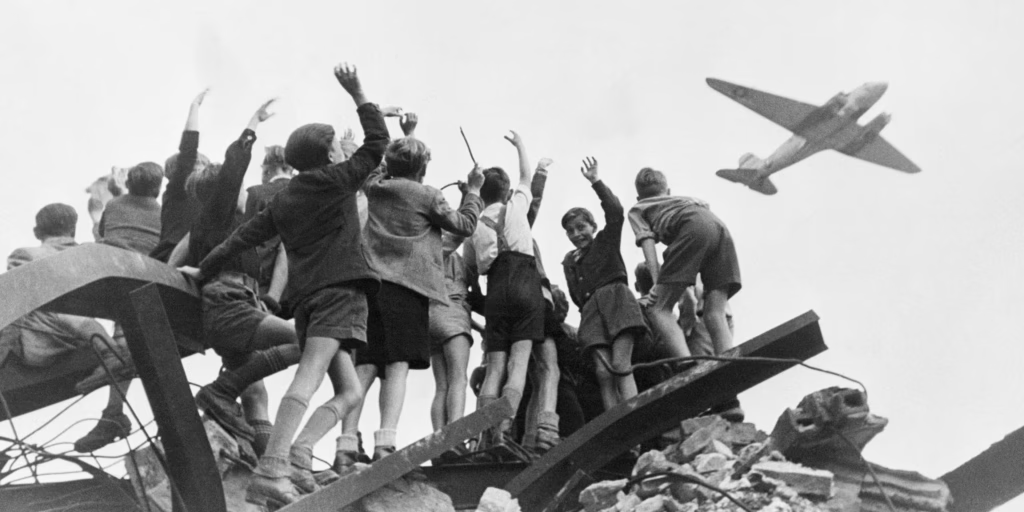
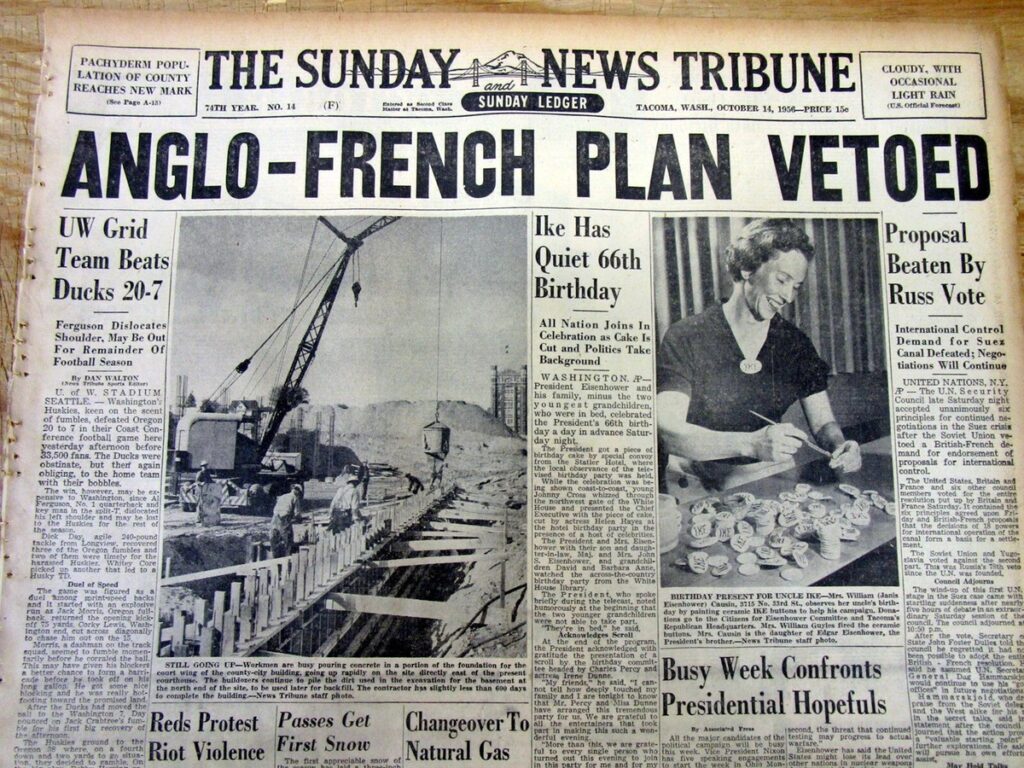
Stalin knew that the Western-occupied zones of Berlin were in a weak position because they were surrounded by Soviet-occupied territory. In June 1948, Stalin decided to shut the land routed across Soviet-controlled Germany into Berlin, in what has become known as the Berlin blockade. He wanted to show the USA, Britain and France that a divided Germany would not work. The people of Berlin would soon run short of food. If the blockade was successful, Stalin would win a huge propaganda success. It might also mean that the Western powers would give up control of their zones in Berlin. The West could not get to Berlin by land without invading Soviet territory and risking war. Truman thought that the Allies could fly supplies in. He thought that Stalin would not be willing to risk war by shooting down a plane. The end of the Berlin blockade made the USA look stronger, as it had won without any casualties. The Soviet Union looked weak as it had backed down.
The formation of East and West Germany
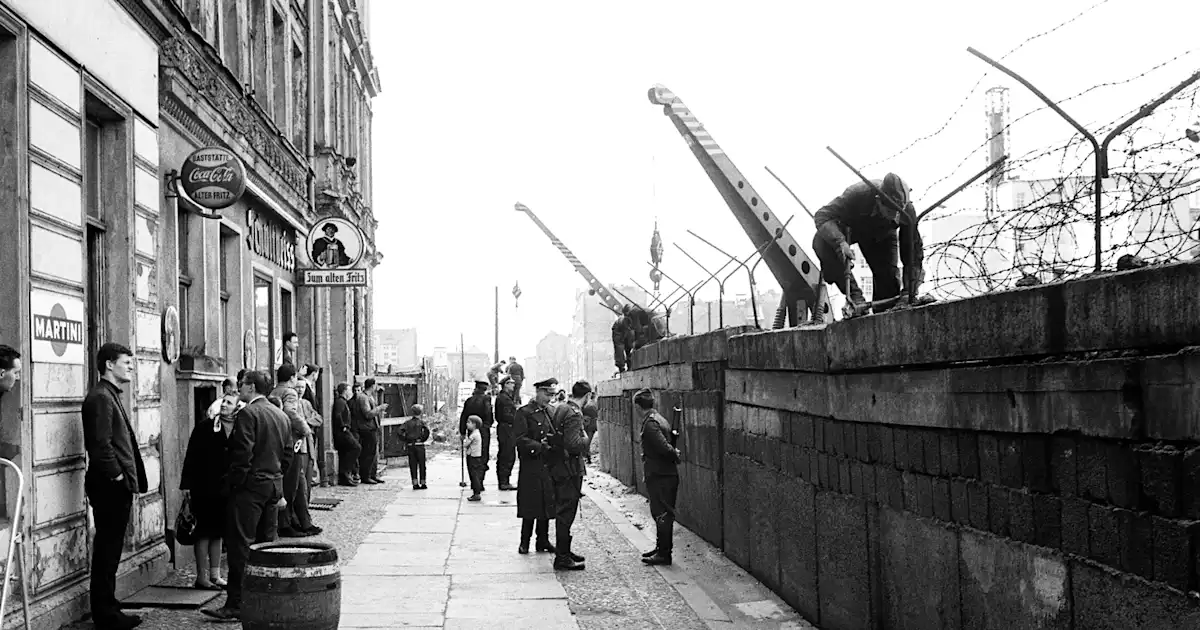
After the Berlin blockade, it was clear that the division of Germany would continue. Britain, France and the USA quickly moved to create a separate West Germany named the Federal Republic of Germany. Stalin responded by creating the German Democratic Republic in October 1949. It became known as East Germany. For the next 40 years, people would talk about West Germany and East Germany but, for most of this time, each German regarded their own state as the only real one.
Analysis of British involvement
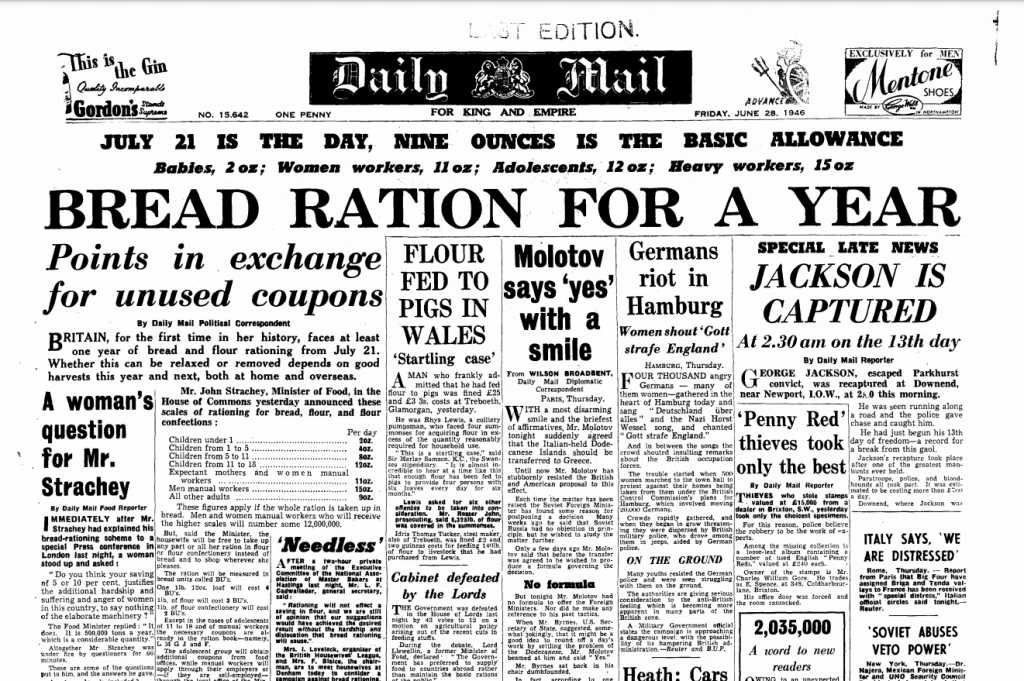
Whilst the British did indeed have a strong commitment to defending Berlin, they were less confident than their American allies about the success of the airlift and more concerned about the adverse effect the blockade would have on German resilience. British economic weakness impacted their influence and the USA’s confidence in their control. Analysis of British policy reveals significant differences between British and American attitudes in Berlin, and shows that the British had less influence over policy than has been previously suggested. However, to keep West Berlin supplied with grain, Britain diverted grain ships bound for Britain to German ports. This resulted in the introduction of bread rationing in Britain, which had not been rationed even during the height of the Second World War. The RAF flew over 65,000 missions supported by crews from Australia, Canada, New Zealand and South Africa. British missions including civilian companies totalled 87,000.
Post-War Economic Recovery
Stalin’s Response
The Korean War
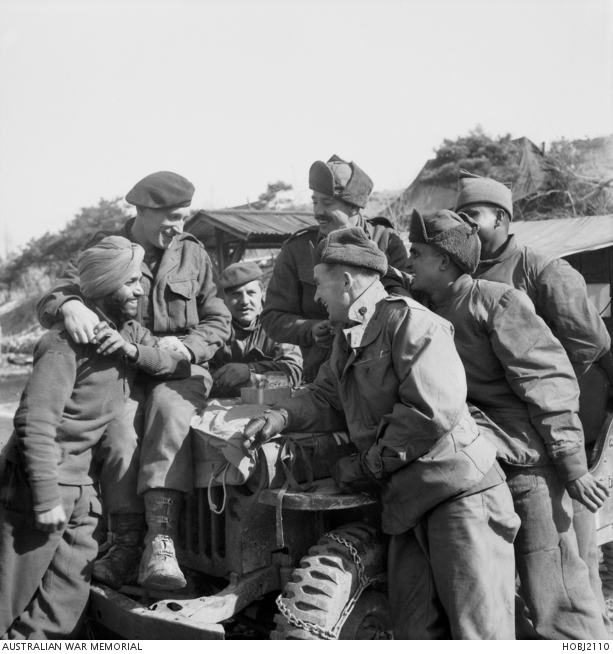
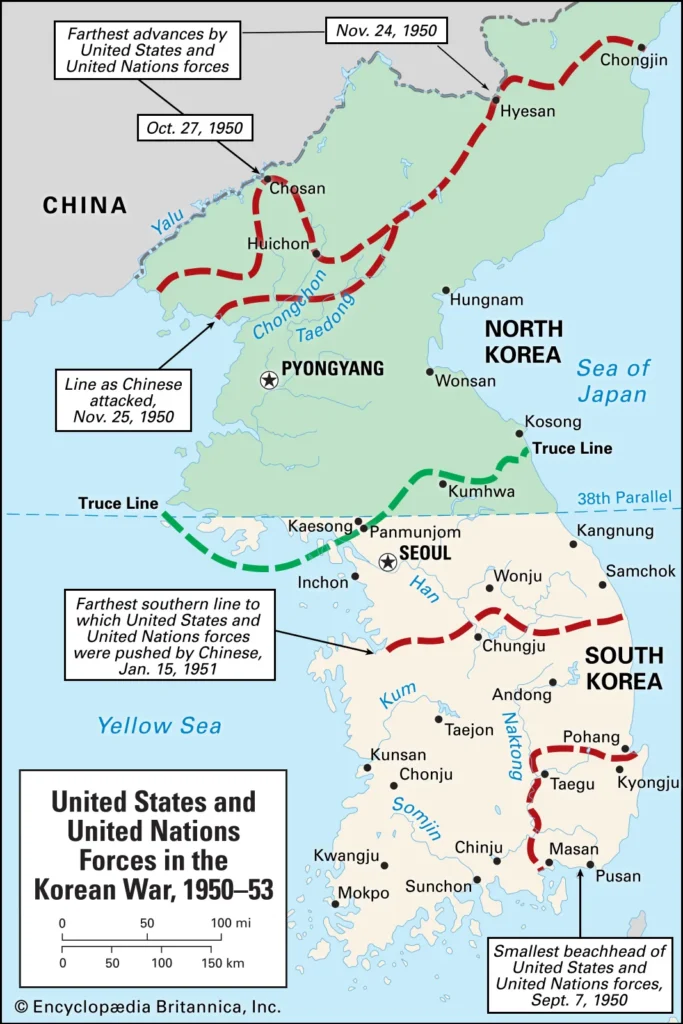
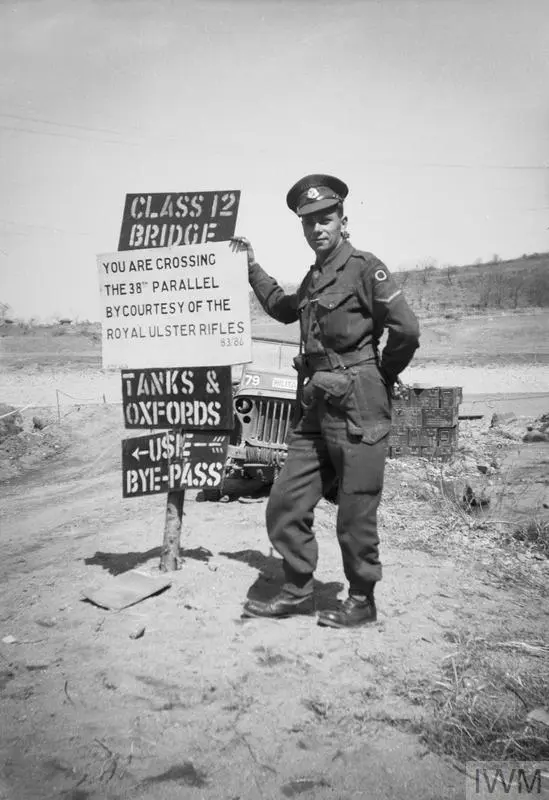
At the end of the Second World War in 1945, Korea was divided at the 38th Parallel, with the Soviet Union occupying the north and the United States occupying the south. This demonstrates the communist influence of the Soviet Union in North Korea. 25th June 1950, North Korean forces invaded the South, overwhelming the ill-equipped South Korean army. The Soviet Union supported the North Korean’s with military equipment and resources. The same day, the UN Security Council – in the absence of the USSR, which is boycotting it – votes to condemn the North Korean invasion and calls upon member states to provide military assistance to South Korea. In July, the United States, Britain and others sent naval and air forces, and then land forces, stabilising the situation. After initial success for the Western Allies, in October the war swings back the other way as Communist China intervenes to prevent the collapse of North Korea; initial attacks in October are followed by a huge offensive in November, which throws back the UN forces. By May 1951, however, the Chinese advance runs out of steam, is halted and then pushed back, with the line between the two sides stabilising around the 38th Parallel. By Summer 1951, the two sides start negotiations, but these drag on – deadlocked over the issue of whether communist prisoners should be returned home against their will – and the fighting continues for two more years. The war doesn’t end until July 1953, the new Eisenhower administration takes office, and the death of Stalin in March 1953 helps to break the deadlock, and in July 1953, an armistice is signed, ending hostilities with Korea, but the country is still divided.
Analysis of British Involvement
Britain had shown it would take part in defending independent states supporting the UN and working alongside the USA. The North Korean invasion was defeated and South Korea protected. However, political and strategic control of the war remained firmly in American hands and underlined that British were junior partners. British and Commonwealth forces made an important contribution but they were dwarfed by the American commitment. Over 81,000 British service personnel were deployed during the Korean war. This was the second largest international contribution after that of the United States in support of the UN response. By the time the war ended, the British had suffered almost 700 killed in action but the Americans had lost nearly 34,000.
Clement Attlee made a statement on 28 June 1950 announcing the decision to make British naval forces available to the US to operate on behalf of the UN. On 5 July, the House of Commons agreed a motion in support of the Government’s actions without division. British ground troops arrived the following month. The British influenced the fateful decision in September 1950 to invade the North but the majority of the troops involved were American. However, Britain had demonstrated loyalty to the USA and helped to check communist aggression and to establish the UN as an effective agency.
As a result of the war, NATO established a permanent military bureaucracy that even more firmly tied the USA to the defence of Europe. Although the increased defence expenditure only added to the difficulties of Britain’s economy, which was still struggling to recover from the impact of the Second World War. Defence spending reached almost 10% of GDP in the 1950s, with a budget of £14 billion towards defence.
The Suez Crisis
The Suez Canal was a vital sea route by which Middle Eastern oil was transported to Europe and British forces reached their Far Eastern bases. Since 1875 the British government had been the majority shareholder in the company running it.
In 1952, the pro-British King of Egypt was overthrown by a group of military officers who blamed him for the feeble performance of the Egyptian army in the war against the new state of Israel in 1948-49. One of the officers, Gamal Abdel Nasser, proclaimed himself president of Egypt in 1954. Determined to remove British influence, Nasser immediately negotiated the withdrawal of British troops from their remaining base in the zone around the Suez Canal. Nasser was an Egyptian nationalist, not a communist, but was prepared to buy arms and accept aid from the USSR.
In December 1955, the American and British government agreed to lend Egypt the money to build large dam designed to help modernise its economy. But they soon had second thoughts because Nasser was reluctant to follow pro western policies. In mid July 1956 the offer of the loan was withdrawn. Nasser responded by taking control of the Anglo-French company that ran the Suez Canal. The Americans sponsored a series of diplomatic manoeuvres to try and solve the crisis peacefully, but without success. British Prime Minister Anthony Eden, who had taken office in 1955, regarded Nasser’s seizure of the canal as an outrage. He believed that;
- It was the first step in a plan to establish Egyptian domination of the Middle East
- Nasser would allow the USSR to extend its influence in the region
- The US accepted that continued British influence in the Middle East was essential to preventing the area falling under Soviet influence
- Because nearly a 1/3 of the ships using the canal were British, and more than 2/3 of the oil supplied to western Europe passed through it, Nasser’s action amounted to having ‘his thumb on our windpipe’.
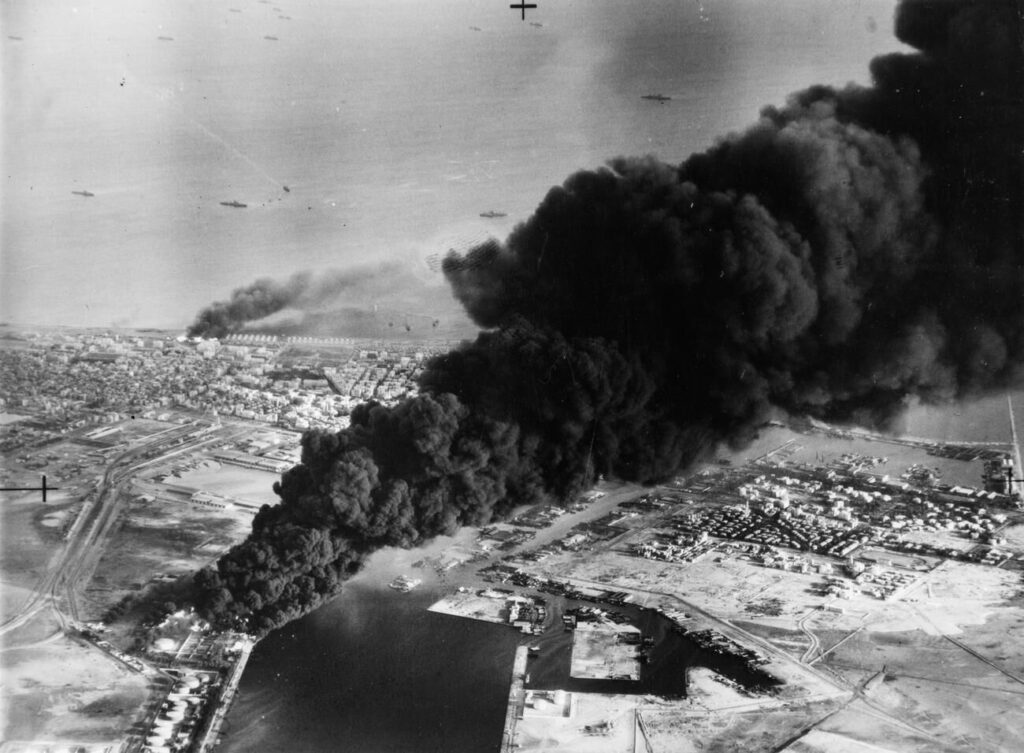
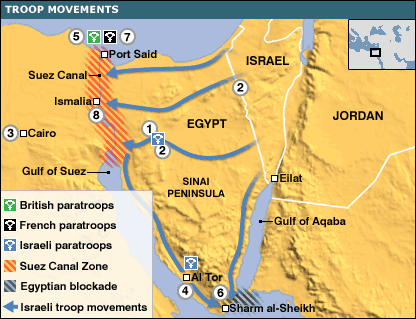
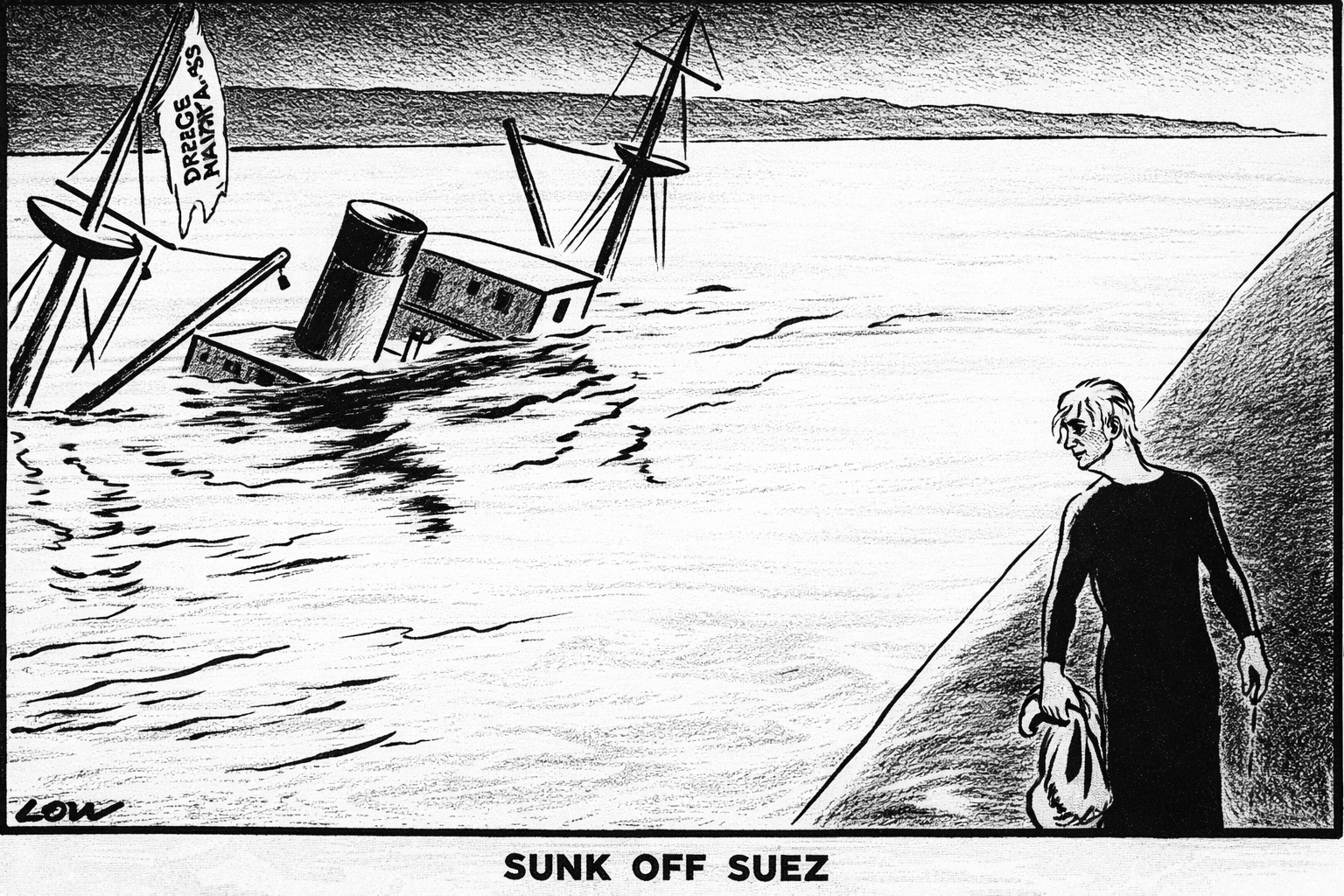
Eden concluded that Nasser had to be challenged by force if necessary, and hoped to use the crisis to overthrow his regime. The French also disliked Nasser because he was assisting the rebels fighting to end French colonial rule in Algeria. In late October and early November, the French and British in collusion with the Israelis, attacked Egypt. The Anglo-French invasion failed: Nasser responded to the invasion by sinking ships in the canal, preventing its use. President Eisenhower, who has not been consulted about the attack, insisted on the withdrawal of the invading forced. Humiliated by both Nasser and Eisenhower, Eden resigned in January 1957.
Analysis of British involvement
Around 45,000 British troops were involved in Operation Musketeer (codename for the November 1956 Anglo-French military operation). Sixteen were killed and 96 wounded at Suez. 900 Egyptian soldiers were killed and tens of thousands were taken prisoner. Nasser’s action was not illegal. Even the British Cabinet recognised that his action amounted to no more than a decision to buy out the shareholders who he promised to compensate. This highlighted Eden’s mistake which was further enforced by the USSR who condemned the invasion as imperialist.
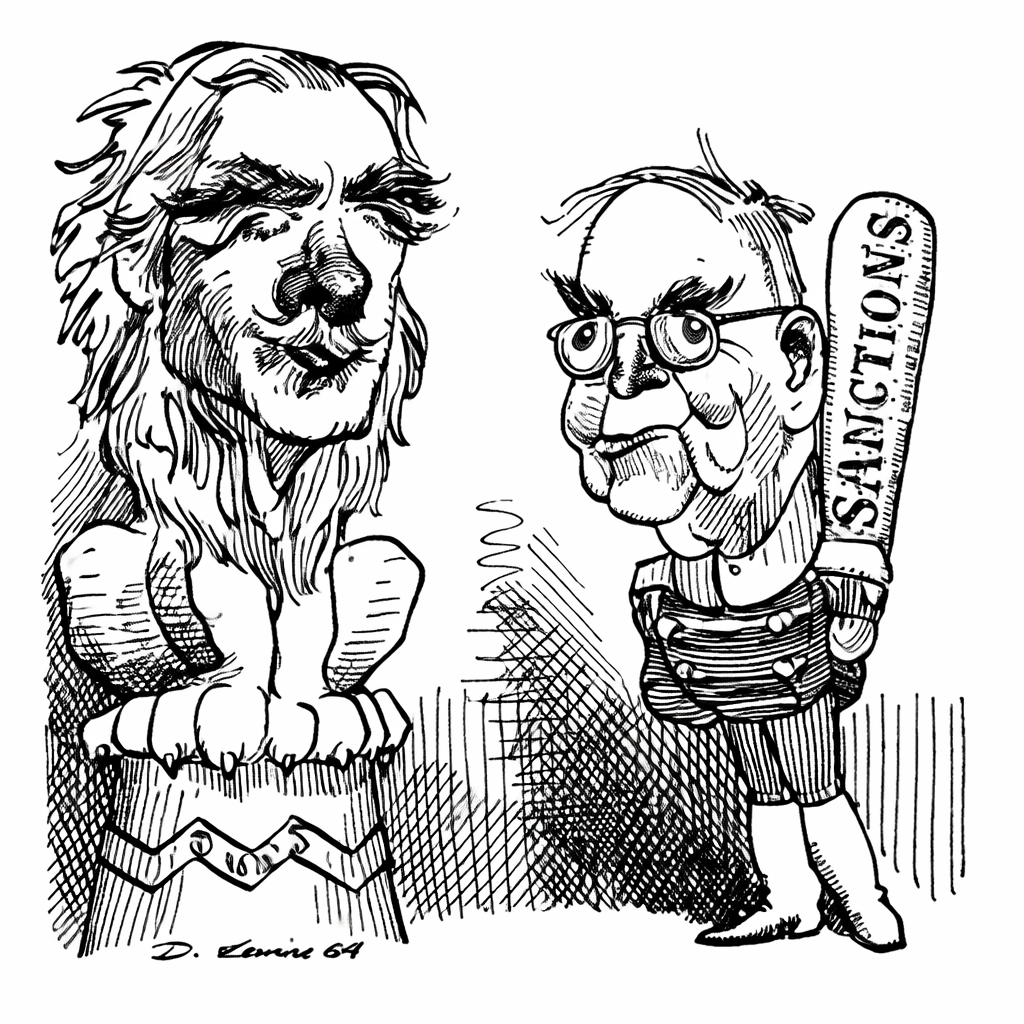
President Eisenhower was furious about the invasion because he had repeatedly made it clear to Eden that he opposed the use of force. He felt deceived by the collusion between Britain, France and Israel. The invasion coincided with the USSRs invasion of Hungary to crush efforts at reform there and the Suez invasion made it difficult for him to condemn the USSR. On 4 November the United Nations threatened Britain with sanctions if there were any civilian casualties from British aerial bombing of targets in Egypt. This led to economic panic in the first week of November 1956 and resulted in tens of millions of pounds being lost from the country’s reserves. Britain faced having to devalue its currency. Appalled that military operations had begun without his knowledge, US President Eisenhower put pressure on the IMF to deny Britain any financial assistance. With few options Eden reluctantly accepted a UN proposed ceasefire.
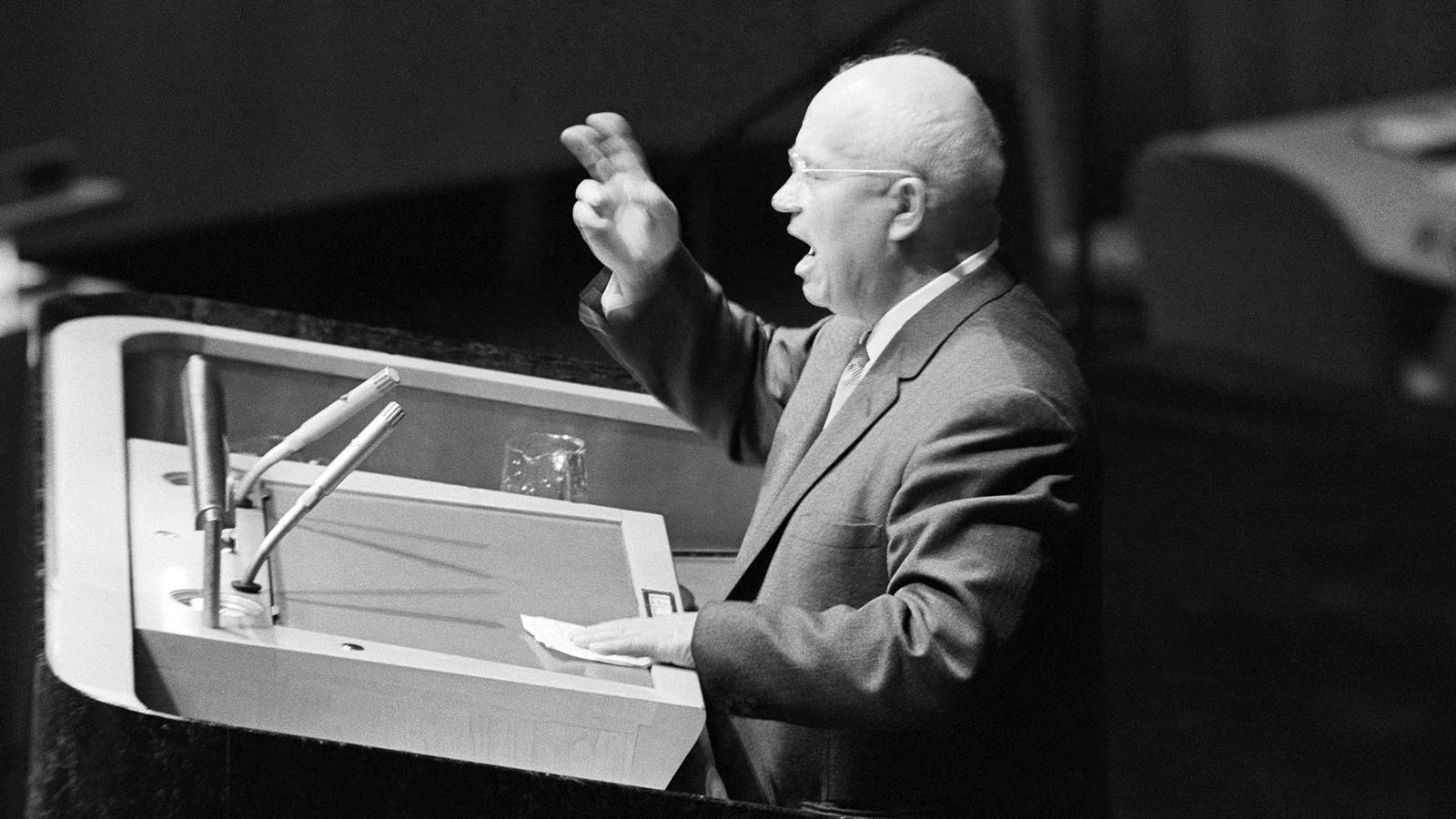
The crisis had a serious impact on Britain’s international relationships. Several recently independent former-British colonies were against the conflict. Only Australia supported Britain, while Pakistan threatened to leave the Commonwealth. Soviet leader Nikita Khrushchev attacked ‘British imperialism’, threatening to attack London with rockets, as well as sending troops to Egypt, potentially dragging NATO into the conflict. President Eisenhower believed that, as a result of the Suez conflict, a power vacuum had formed in the Middle East due to the loss of prestige of Great Britain and France. Eisenhower wanted this vacuum filled by the United States before the Soviets could step in to fill the void.
Within Britain, the conflict divided opinion. The Conservative government faced significant hostility from the Labour opposition and even experienced division in its own party. Intervention in Suez was initially popular with the British public, but following the humiliation caused by the conflict, the government rapidly lost the support of the country. Nationwide anti-war protests sprang up, and several civil servants resigned in protest.
The Falklands War
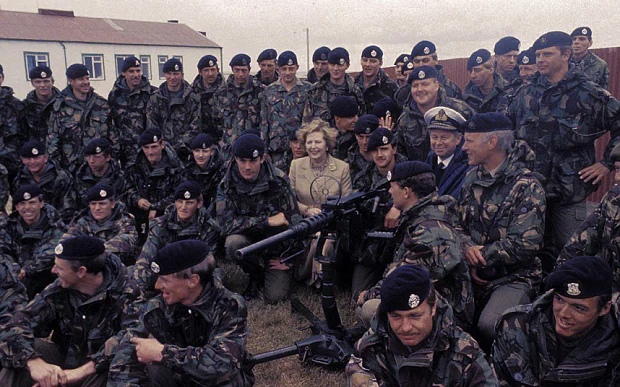
On 2nd April 1982 Argentine forces invaded and captured the Falkland Islands, a British colony in the South Atlantic approximately 400 miles from the Argentine coast and 8000 miles from Britain. Argentina’s brutal military dictatorship Believed that Britain would not have the will or means to retake the islands. The British government had to decide whether to risk military defeat by attempting to recapture the islands or suffer a loss of prestige by abandoning the islands British population to Argentine rule.
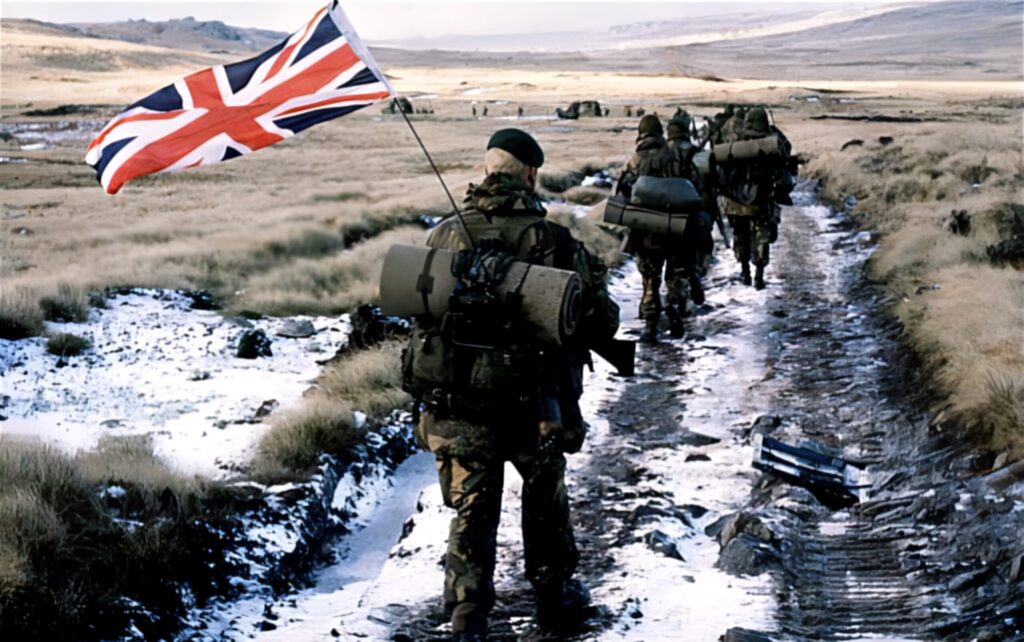
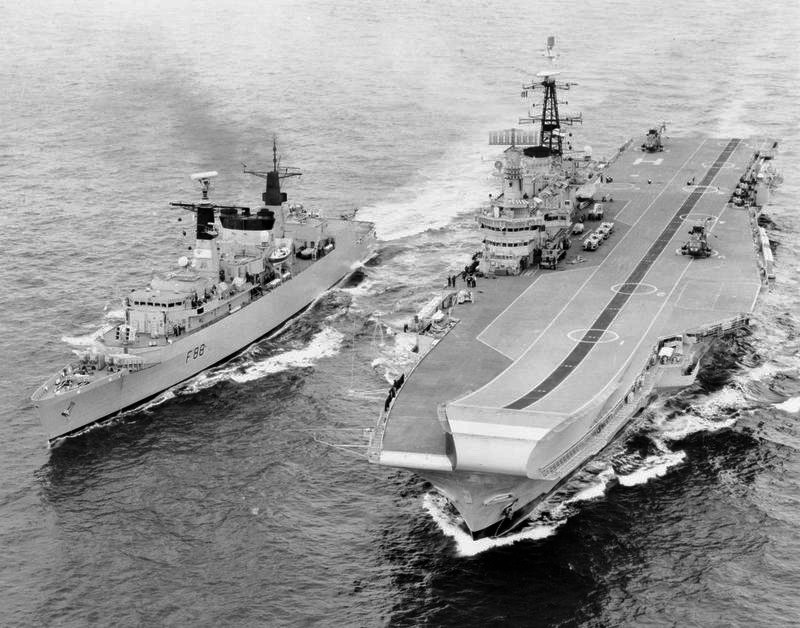
On 5th April Thatcher’s government dispatched a task force of ships and troops to retake the islands. On May 2nd a British submarine sank the General Belgrano and Argentine cruiser with the loss of 360 lives and a few days later, an Argentine missile destroyed HMS Sheffield a British warship, killing 20. On May21st British troops landed on East Falkland. As the troops advanced, the Argentine air force continued to attack British ships, sinking several, but losing planes in the process. On 14th June British forces entered the capital and the Argentine forces surrendered.
Analysis of British Involvement
Thatcher reacted swiftly to the invasion. A task force of 127 ships and 25,000 troops was assembled quickly and set sail three days after the invasion. The UN at Britain’s request demanded the withdrawal of Argentine forces ensuring that Britain’s actions were justified in law. It was clear that Thatcher had the backing of the UN and also other European nations who imposed sanctions on Argentina. The Argentine forces were not matched to the professionalism and the high-level training of the British army. This was true as the Argentine Navy played little part in the conflict, possibly cowed by the loss of the Belgrano. President Reagan, though a close friend of Thatcher did not think the islands were not worth a war. Although the US felt mediation was the best way forward, they provided a task force with weapons and intelligence to aid the British.
Thatcher’s personal political fortunes were transformed by the war and this contributed to her victory in 1983 election. She used the victory to boast of a restored British greatness and many admired her resolution and skill that made this happen. The war also enforced that the British could not go to war without active support of the USA. The war cost Britain around £2.8 billion equal to 5.3% of GDP. 907 lives were lost during the conflict: 649 Argentinian, 255 British and three Falkland Islanders.
Critics of the war regarded it as a costly enterprise of little real significance which also left Britain with the substantial costs of maintaining a military presence to continue to defend the islands. In the 1990s, the annual cost to maintain the defence of the Falklands Islands was estimated to be over £60 million.
The Gulf War
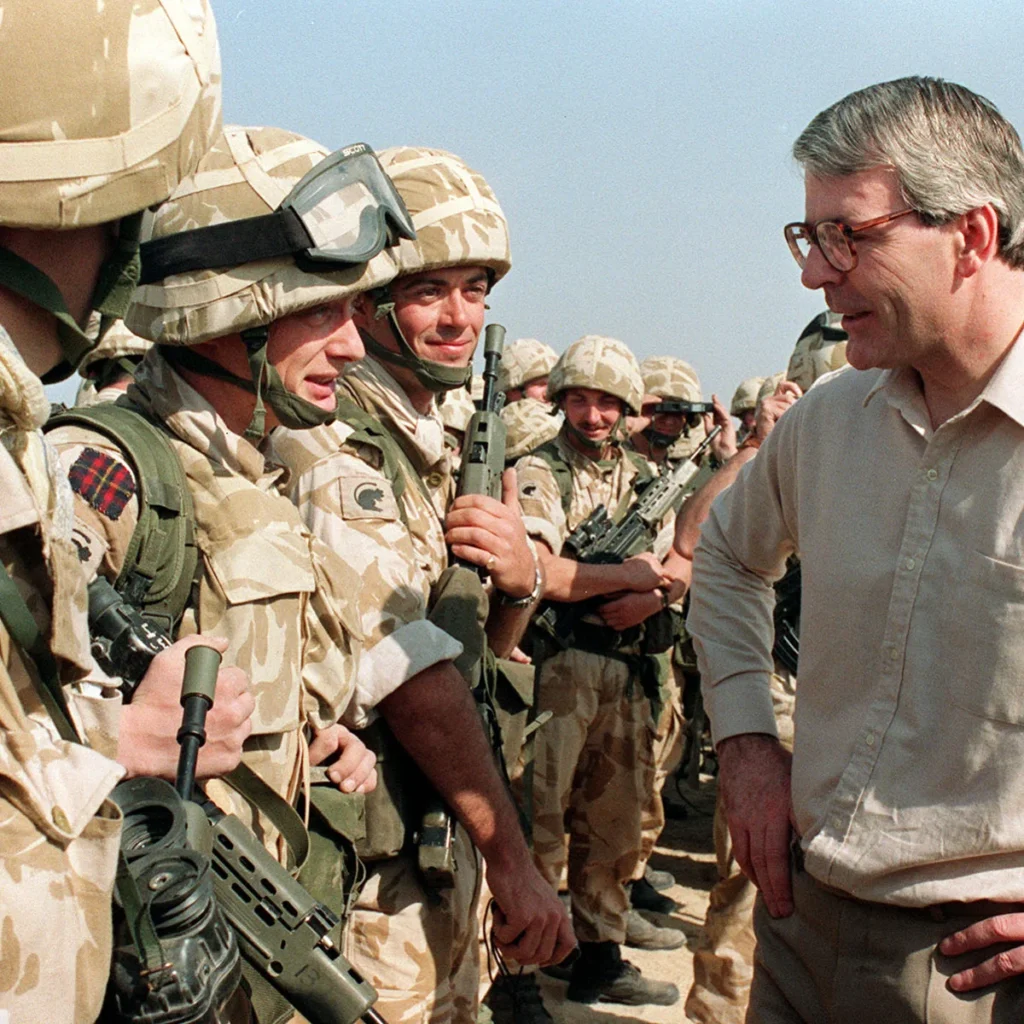
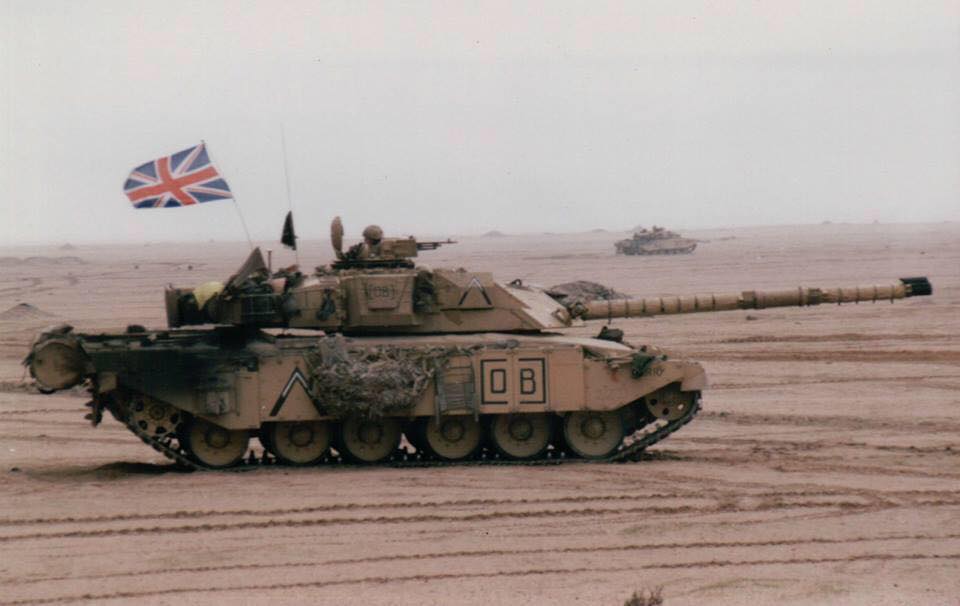
One of the major tests for Britain’s role in the post-Cold War world and for the new government of John Major was in January 1991 when it participated in the Gulf War. In accordance with an UN ultimatum for the withdrawal of Iraqi troops from Kuwait, on 15th January 1991 operation Desert Storm began against Iraq. Although under operational US command, it was carried out under the United Nations. Five weeks of air war were followed by a ground campaign until on 28th February 1991 Iraq accepted a cease fire. Britain deployed more than 53,000 servicemen to the allied coalition, the third largest military contribution after USA and Saudi Arabia. The was successfully liberated Kuwait and it strengthen US British relations.
Throughout the war, the RAF had played a prominent role on equal footing with the US Air Force and British forces had also been essential in the co-ordination of naval movements. Britain’s unequivocal support of the United States throughout the crisis did a lot of reinvigorate the “special relationship” for which there had been fears following the end of the Thatcher-Reagan era. However, the war did come at a cost. The total cost of Operation Granby, the British military operations during the Gulf war, was £2.4 billion. Primarily Kuwait and Saudi Arabia contributed to such expenses. Approximately £200 million of equipment was lost during the conflict.
One of the aims of the United States and Britain had been to eliminate Saddam, but to pursue that to the end meant continuing armed action of Iraqi territory leading to the seizure of the capital Baghdad. The US did not feel justified in carrying out such an undertaking. President Bush believed it would break up the coalition against Iraq which had been committed to liberating Kuwait only. In this Britain again followed the American lead. However, Iraq’s effective defeat had increased instability within Iraq. The Iraqi regime turned its full military potential against the Kurds and the Shi’ite Arabs of Southern Iraq following rebellions. With the humanitarian situation deteriorating steadily, the international community had to step in. Upon largely, British initiative, safe havens were created in Northern and Southern Iraq over which “non-fly zones” for the Iraqi air force were imposed.
International troops, including British forces were sent to monitor Iraqi observation of these rules. Britain was breaching its long-standing policy of non-intervention in other countries domestic affairs – however this was based purely on humanitarian reasons.
The operation was successful but there were problems:
- Saddam Hussein was allowed to maintain control of Iraq. He took revenge by persecuting his domestic enemies, especially the Iraqi Kurds, a minority who had risen in revolt against him
- The war was seen by many in the Middle East as British and American imperialism, despite the coalition with Arab states
- Iraq continued to be an issue for Britain and the USA and in 2003 much more controversial joint action was taken which resulted in the removal of Hussein
International Relations
Britain and the USA
1950s:
PM MACMILLAN (CONSERVATIVE) & PRESIDENT EISENHOWER (REPUBLICAN)
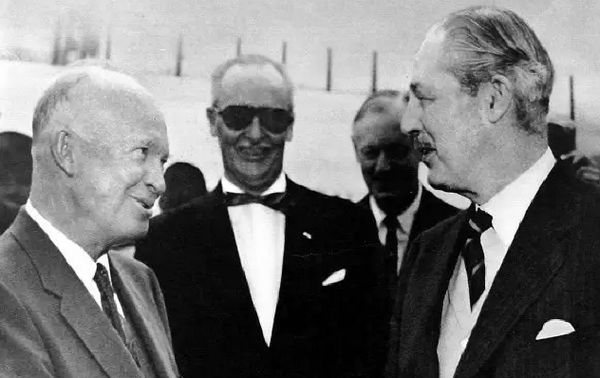
The Suez Crisis had led to the resignation of Prime Minister Anthony Eden, and the new Conservative leader, Harold Macmillan, was left to repair the relationship with the United States. The crisis had demonstrated that Britain could no longer act independently of, and certainly not in opposition to, the United States. Despite Eisenhower’s fury, the crisis did little permanent damage to Anglo-American relations because Macmillan exploited his wartime friendship with Eisenhower and made it clear that the US alliance was central to Britain’s foreign policy.
1960s:
PM MACMILLAN (CONSERVATIVE) & PRESIDENT KENNEDY (DEMOCRAT)
President Kennedy and Prime Minister Macmillan developed a genial relationship in which Kennedy regarded Macmillan as a political father figure. Kennedy sought Macmillan’s advice over the two great crises of their joint period of rule – the Berlin crisis of 1961 and the Cuban Missile Crisis of 1962. Despite the fact that during the latter Kennedy telephoned Macmillan late into several nights to discuss key issues, Britain’s role in both of these crises was small. However, Macmillan can be credited with getting both the USA and the USSR to sign up to the Nuclear Test-Ban Treaty in 1963 following the end of the Cuban Missile Crisis. He had continued to press for this to happen during the period 1959-63.
1960s: PM WILSON (LABOUR) & PRESIDENT JOHNSON (DEMOCRAT)
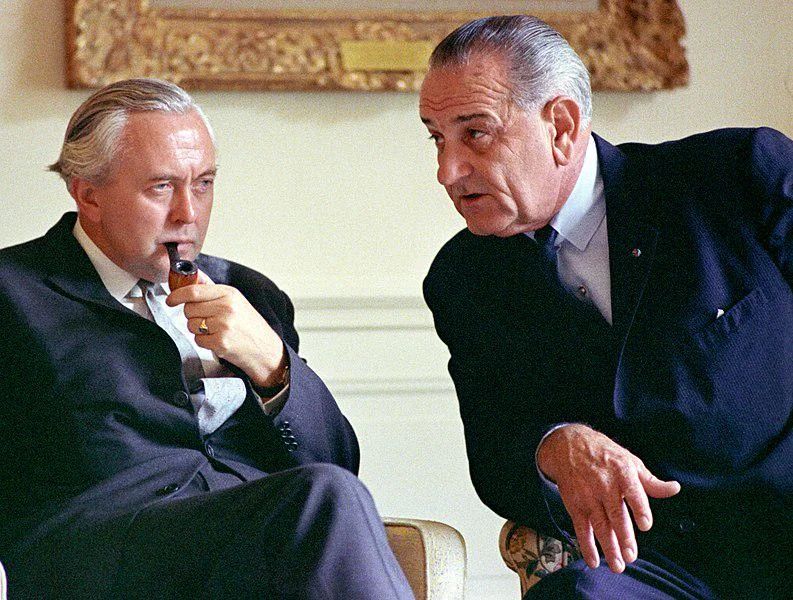
When Harold Wilson took office in 1964, he insisted that unless Britain remained a world power it would be “nothing”. Such a statement was rooted in the understanding that to be considered a “Great Power” Britain must continue to possess overseas territories and military bases. Wilson’s views were enhanced by those of the new US President Lyndon Johnson who was keen to maintain British military bases east of Suez so that the US could have access to them. In the summer of 1965 a secret Anglo-American deal was agreed in relation to this issue. However, in reality economic issues meant that Britain was not able to maintain control of all of its overseas bases. Defence Review’s in 1966 and 1967 called for reduction in defence spending and recognised that the core of Britain’s defence strategy lay with the collective security of NATO and the United Nations. In 1968 the government confirmed that British forces would withdraw completely from Singapore, Malaysia and the Gulf to the disappointment of the Americans.
The most serious issue dividing Britain and the United States was the war in Vietnam. In 1965 when the Americans looked to increase the deployment of US troops in Vietnam, Wilson requested an audience with Johnson to counsel against further US military involvement. His efforts were deeply resented. The US failed to understand the British government’s position. The anti-American feeling within the left of the Labour Party and its thin parliamentary majority following the 1964 election accounted for Wilson’s stubborn resistance to US pressure. As well as refusing to send British troops to Vietnam; in June 1966 he publicly criticised heavy US bombing of North Vietnam and in 1967 he attempted to broker a peace deal. These actions irritated Johnson.
1970s: PM HEATH (CONSERVATIVE) & PRESIDENT NIXON (REPUBLICAN)
During the premiership of Edward Heath relations with the USA were distinctly cool. Heath believed that Britain’s future lay with Europe and had campaigned in the 1970 election of securing Britain’s entry to the EEC. The Americans approved of Britain’s efforts to join the EEC viewing Britain as a potential useful mediator between Europe and the USA. However, it was exactly this point that had made the Europeans, especially France, suspicious of a Britain whose close Atlantic link might disturb the relative harmony of the EEC. Heath recognised these fears and was doubly careful to not appear to close to the American government. He demonstrated his European credentials in 1973 when Nixon called for a new Atlantic Charter. He stated that he was only willing to negotiate from a common position with the other European powers. Britain joined the EEC in 1973 and its foreign policy became more European.
1970s: PM CALLAGHAN (LABOUR) & PRESIDENT CARTER (DEMOCRAT)
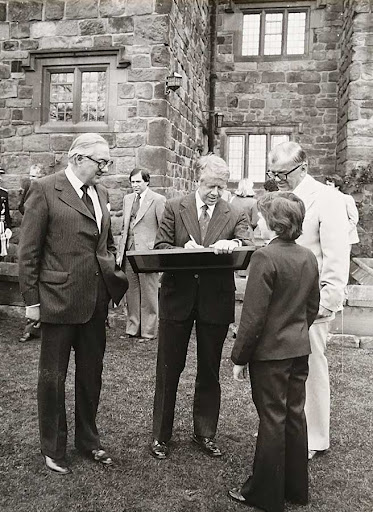
Warmer relations were restored by the personal chemistry between James Callaghan and Jimmy Carter. Both ex-sailors the two men developed a strong relationship. Carter visited Britain in 1977, including a special trip to Tyne and Wear, where they visited Washington Old Hall, the ancestral home of George Washington. Callaghan also coached him to shout “Howay the Lads” to the delight of Newcastle fans.
1980s:
PM THATCHER (CONSERVATIVE) & PRESIDENT REAGAN (REPUBLICAN)
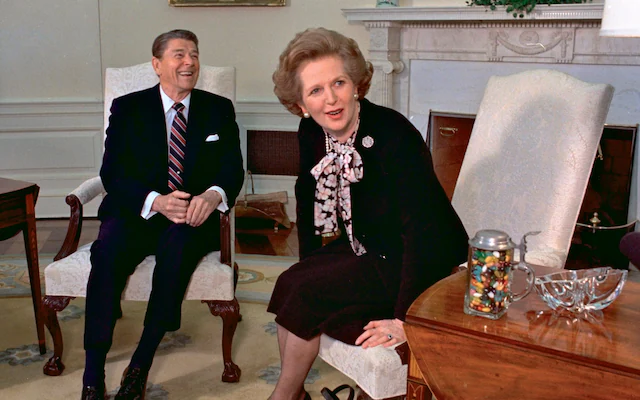
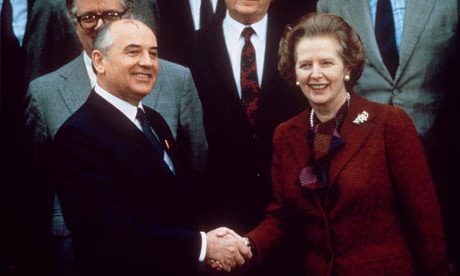
The “special relationship” was perhaps never stronger than during the Thatcher-Reagan era. Elected in 1981, Reagan’s wife Nancy described the pair as “political soulmates”. The pair shared similar economic philosophies, and both initially took a strong anti-Communist line; Thatcher succeeded in getting US backing for the Falklands War in 1982. The Ronald Reagan library identified Thatcher as Reagan’s most prolific correspondent among heads of state and notes that they exchanged hundreds of letters, messages and phone calls.
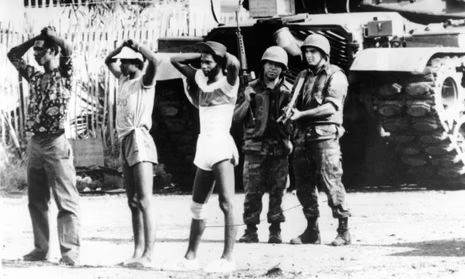
One area in which tensions did, however, emerge in the relationship was over Reagan’s Strategic Defence Initiative (SDI) launched in 1983. This ambitious plan aimed to create an anti-missile system on the ground and in space, which would act as a nuclear shield over the United States. Thatcher was unhappy that the “Star Wars” programme (as it became known) failed to consider the security of Western Europe, whom would now become, she argued, more vulnerable to an attack from the Soviet Union. Thatcher maintained a pro-nuclear deterrent line – believing that it had been vital in maintaining peace in Europe. Thatcher had a stormy meeting with the President at which she secured an agreement that any further implementation of SDI would have to be negotiated with America’s allies. 1983 continued to be a difficult year in the relationship between the two leaders when in October Reagan caused Thatcher huge political embarrassment due to an American attack on Grenada, a member of the Commonwealth, to overthrow a Marxist regime. Reagan did this without consulting Britain. Thatcher made her feelings clear in a furious telephone call. Once again though, the “special relationship” was patched up.
Friendship was once again demonstrated in 1986 when Thatcher allowed the US too use British bases for American F-111s to bomb Libya in retaliation for terrorist activities against American targets.
Another area in which the “special relationship” appeared strong was in the United Nations, where the two countries supported each other on several key issues. For example, both Thatcher and Reagan opposed attempts by the UN to impose sanctions on the apartheid regime in South Africa.
Thatcher’s ability to develop a good working relationship with the Soviet leader Mikhail Gorbachev had served as a useful tool for the Americans, who placed her in the position of mediator between the two states. In 1986, a proposed agreement was made in Reykjavik between the two states, which committed both sides to cutting their nuclear arsenals, whilst leaving in place the SDI. Thatcher expressed the concerns of Europe in her communications with Reagan, as Europe felt it would be left exposed in denuclearisation in a way that the US would not.
1990s:
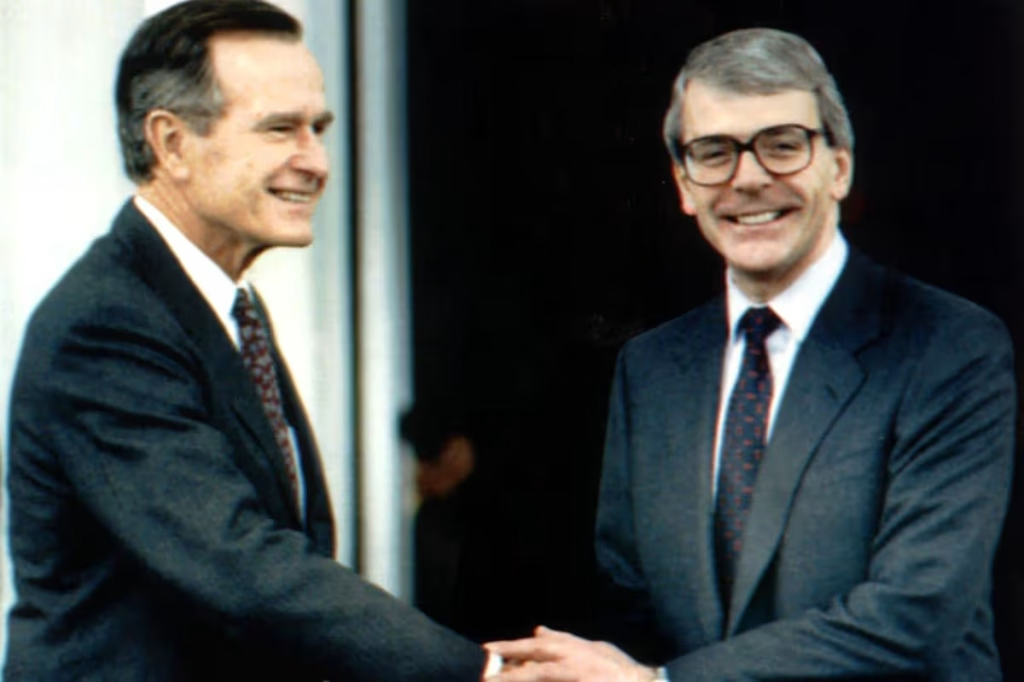
PM MAJOR (CONSERVATIVE) & PRESIDENT BUSH (REPUBLICAN) / PRESIDENT CLINTON (DEMOCRAT)
The relationship in the 1990s was one of cooperation between the two powers. Britain supported the USA in the Gulf War in 1991, both in the United Nations and in providing British forces to fight against Saddam Hussein’s Iraqi forces. After some initial disagreements, the European NATO powers, including Britain, agreed to cooperate with the USA in a bombing campaign against the Bosnian Serbs in retaliation for the 1995 massacre of Muslims in the Srebrenica refugee camp, and also cooperated in bringing about the Dayton Peace Accords, which ended the conflict.
Britain and the USSR
During the early years of the Cold War the Western powers, including Britain, had been fearful that the USSR wanted to invade, or at least destabilise, Western Europe and that a third world war was imminent. However, Stalin’s death in March 1953 raised hopes that relations with the USSR might improve.
Peaceful Coexistence
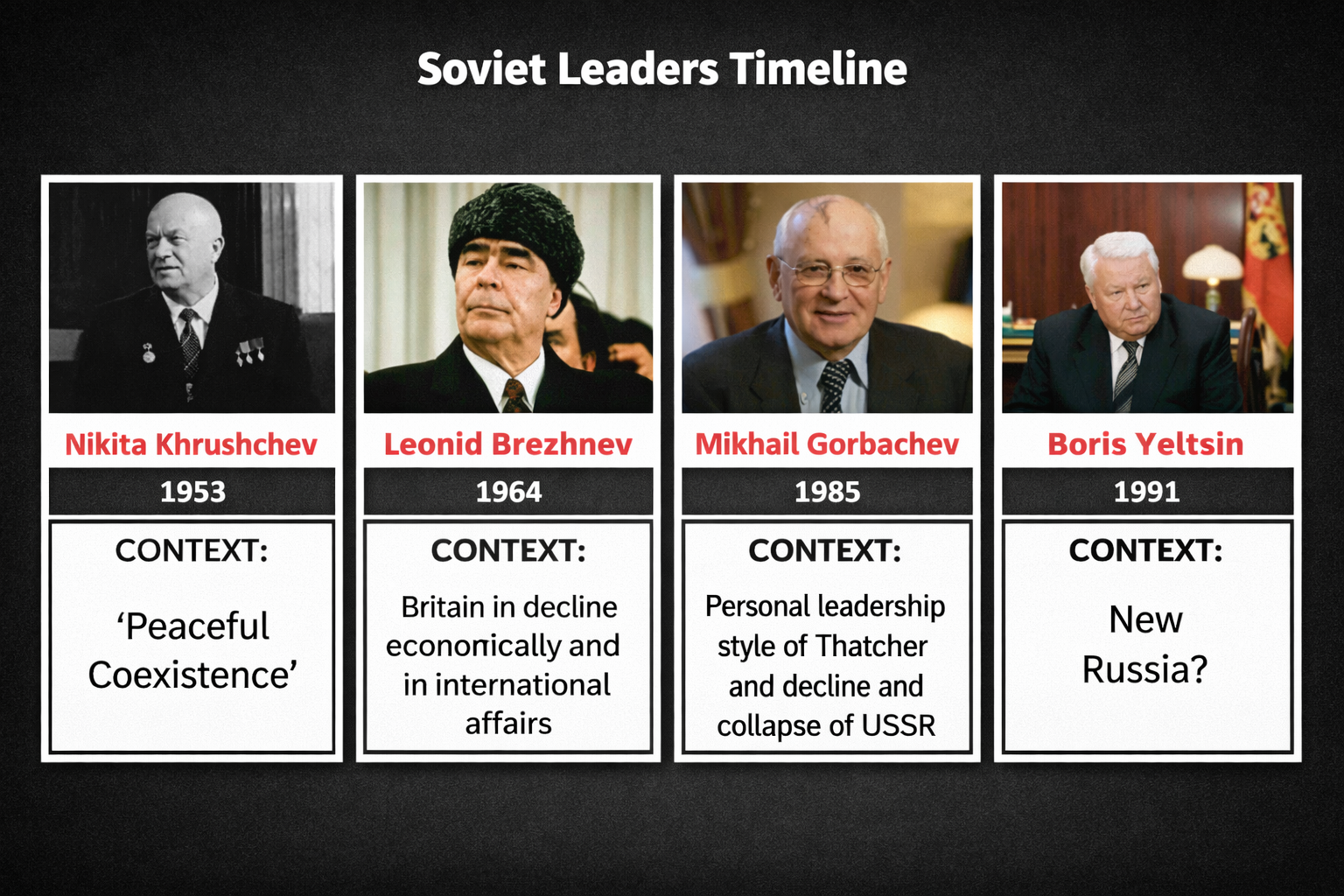
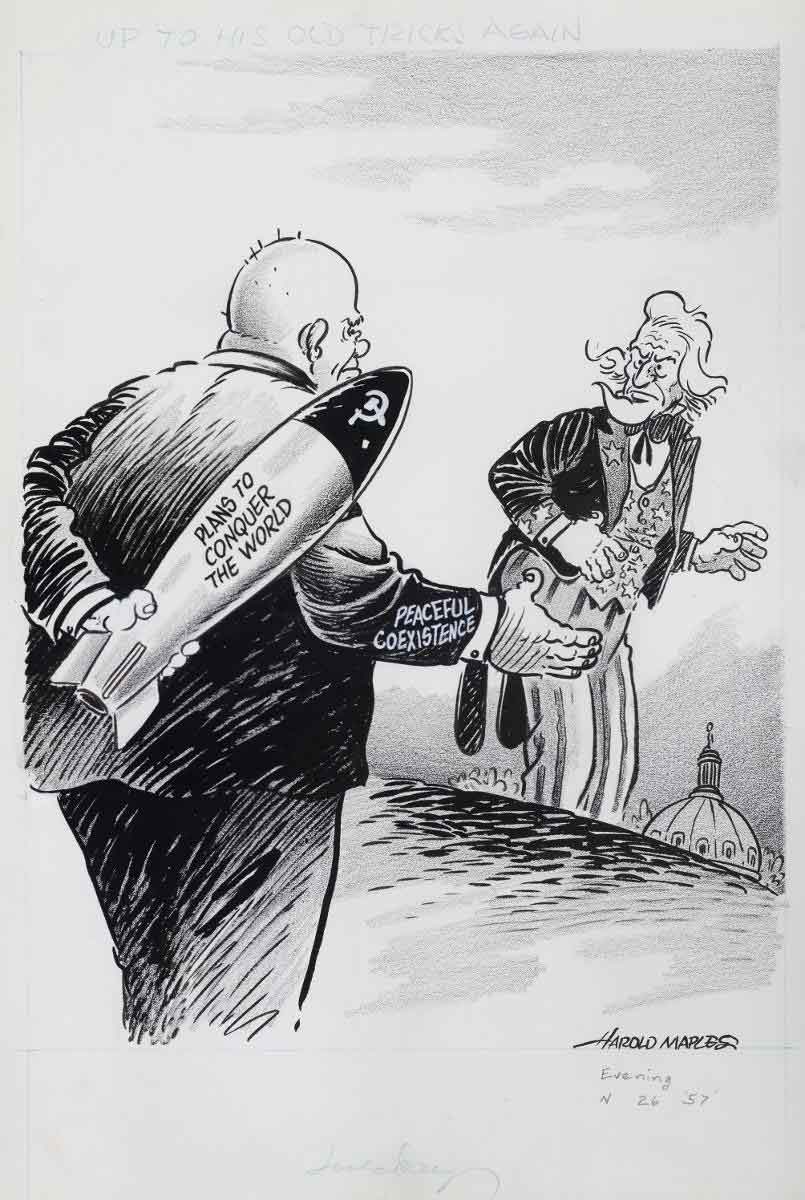
The new Soviet leader, Khrushchev, initiated a policy of ‘peaceful co-existence’ with the west. This meant he wanted, if possible, to avoid war but to continue competition with the West for influence around the world:
- In October 1955, the British and Russian navies exchanged goodwill visits
- Khrushchev visited Britain in April 1956
- Harold Macmillan went to Moscow in Feb 1959
But these signs of a thaw in relations did not fundamentally change the mutual hostility between Britain and the USSR. Throughout the Cold Warm the British and Russians accused each other of imperialism.
- From the mid 1950s the USSR started bidding for the support if the nations of the Asia and Africa as they emerged from European colonial rule
- The West regarded the communist states of eastern Europe as part of a Soviet empire
The 1960s and 1970s
As the British withdrew from their colonial empire, the Russians regarded them as less important and concentrated their attention on the USA. However, Britain continued to regard the USSR as its principal potential enemy:
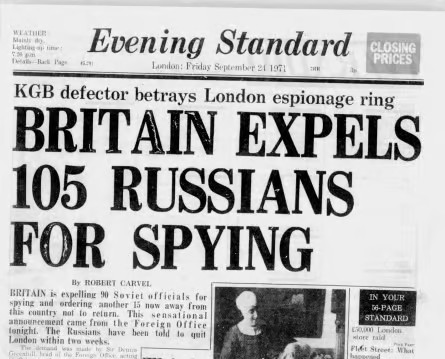
- Each side was involved in espionage – in September 1971 Britain expelled 105 Soviet diplomats accused of spying
- Britain and the rest of NATO were concerned about the build up on Soviet forces after the Cuban missile crisis
Thatcher and USSR
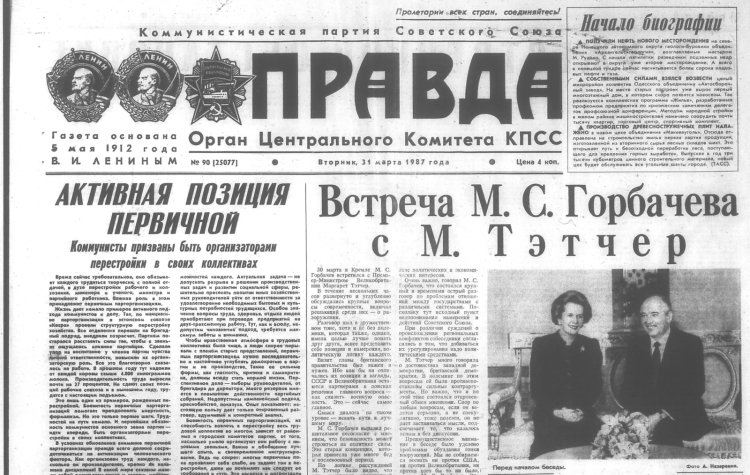
Margaret Thatcher, dubbed the iron lady by the Soviet media, made no secret of her anti-communism and was determined to retain Europe’s nuclear defences, but this did not prevent her from saying in December 1984 that she liked the reformist Soviet leader, Mikhail Gorbachev, visiting Moscow in 1984 and hosting a return visit, which did much to calm Russian concerns about America and the Star Wars (SDI) initiative.
The collapse of the USSR
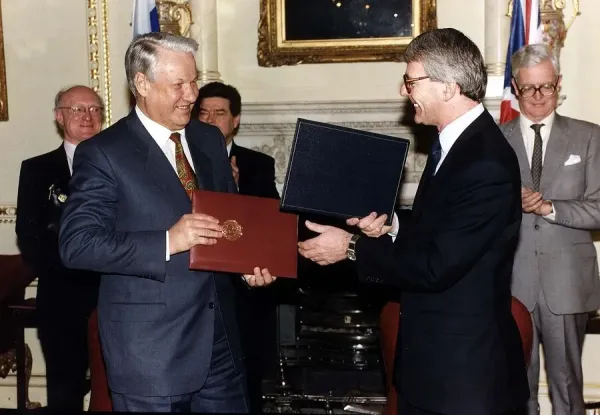
The collapse of the USSR in December 1991 brought about an entirely new Anglo Russian relationship. The new Russian president, Boris Yeltsin, was grateful for the immediate diplomatic support he had received from Britain when Soviet hardliners had tried to seize power in August 1991. And British efforts during the 1990s helped pave the way for Russia to join the exclusive club of the worlds leading industrialised nations, which, with Russia’s accession, became known as the G8. In November 1992 Yeltsin visited Britain to sign a set of wide ranging agreements on trade and military co-operation, He thanked John Major for him profound understanding of Russia and its reforms. The importance of London as a financial centre soon made it an attractive place for some Russian businessmen – who had become very rich by taking advantage of Yeltsin’s liberalisation of the economy – to live and invest in
Anglo-Russian relations during the period
Britain’s relations with the USSR during the Cold War varied from outright hostility short of war to cautious, lukewarm and limited cooperation. During the Soviet period there were trade links, British tourists could visit the USSR and the Russians occasionally allowed cultural or sporting groups to visit the West. But with Britain firmly aligned with the USA, the USSR was regarded as Britain’s principal potential enemy – an attitude reinforced by ideological hostility, propaganda and regular crises, although both sides were anxious to avoid a direct confrontation.
Organisations
How has Britain’s overseas policy been influenced by its role in the UN?
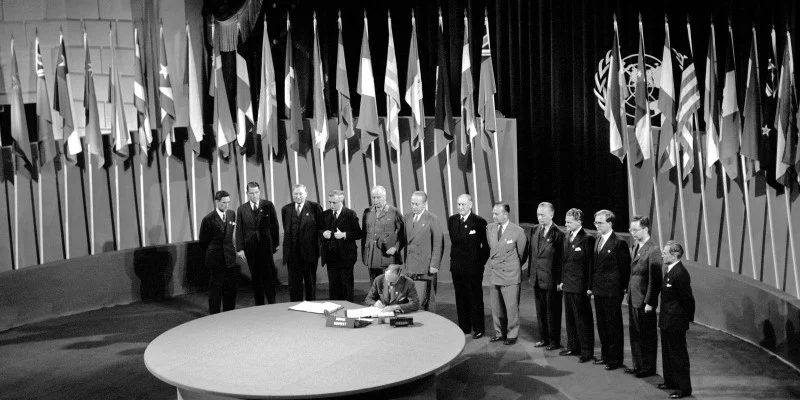
Britain, as one of the ‘Big Three’ victorious powers at the end of the Second World War, played a key role in establishing the United Nations in 1945.
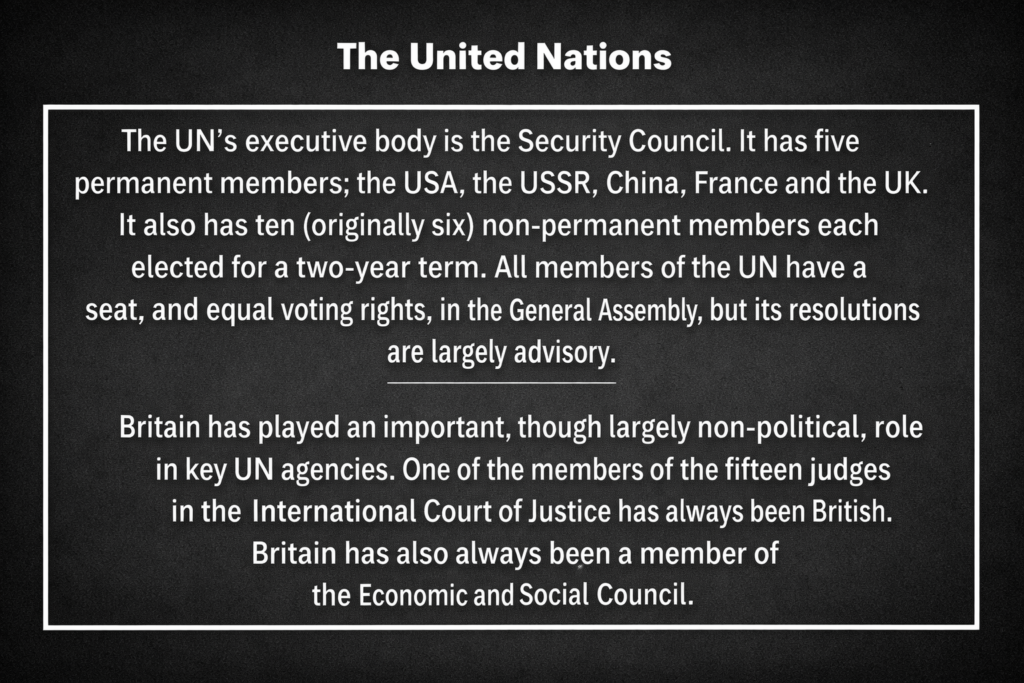
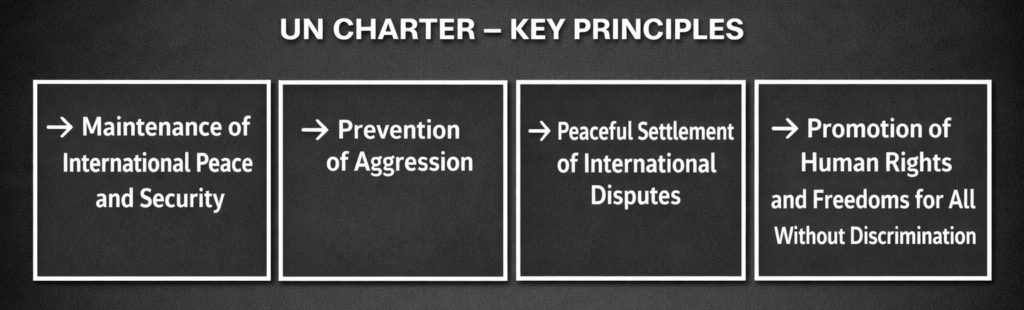
Along with China, the USSR and the USA, British diplomats were involved in drawing up the UN Charter. As a founding member, Britain also became one of the five permanent members of the Security Council, giving it considerable power and influence because each permanent member has a veto over Security Council decisions that are otherwise binding on all members.
The influence of UN membership on British policy
Membership of the United Nations has had a significant impact on British overseas policy because it has been important to British governments to present their actions as conforming to the principles of the UN. While Britain retained its colonial empire, its governments found themselves criticised, often by nations in Africa and Asia, as imperialist and in violation of the UN;s commitment to human rights and freedom for people of all races. The British have used their Security Council veto sparingly but almost always when their policy appeared to lay them open to the charge of imperialism. For instance, the British veto was first used, in conjunction with France, during the Suez crisis when the USA and USSR accused them of trying to re-establish colonial power over Egypt.
Southern Rhodesia
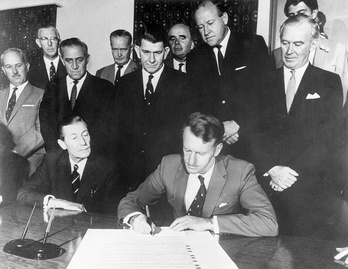
11th November 1965 – BBC news report The Rhodesian Government, led by Prime Minister Ian Smith, has illegally severed its links with the British Crown. Mr Smith made the Unilateral Declaration of Independence (UDI) after days of tense negotiations with British Prime Minister Harold Wilson. British authorities were only prepared to permit independence based on giving the black majority population a fair share of power. Under Mr Smith’s system, there will be white minority rule, where 220,000 white Rhodesians will enjoy privileges over nearly four million black Rhodesians. Harold Wilson told a packed and solemn House of Commons the Labour Government would not be sending troops to deal with the crisis. Instead, he announced a full range of sanctions, including ceasing all British aid to and preferential treatment for Rhodesia, banning the import of Rhodesian tobacco and recalling the British High Commissioner. The next day, the United Nations Security Council condemned Mr Smith’s regime in Rhodesia. The US immediately supported the British sanctions – with embargoes on arms exports and sugar imports – and the UN called for all its members to implement economic sanctions in 1966. France and the USSR abstained, but South Africa and Portugal – with its colony Mozambique – refused, and their continued trading with Rhodesia was instrumental in keeping the Smith government afloat. Joshua Nkomo’s Zapu and Robert Mugabe’s Zanu parties overcame their differences to form the Patriotic Front (PF) to confront Ian Smith.
Libya
In 1986 US planes bombed targets in the Libyan capital, Tripoli as President Reagan said he had irrefutable evidence that Libya was responsible for a bombing at a West Berlin nightclub which killed two American servicemen. British PM Margaret Thatcher justified Britain’s involvement in the campaign by supporting America’s right to self-defence under Article 51 of the United Nations Charter. However, the attack by the Americans generated criticism at the UN. Thatcher ordered that British representatives at the UN should veto the resolution condemning the Americans. Following this announcement of British backing, the extremist group Arab Revolutionary Cells murdered two British and one American hostage in Lebanon.
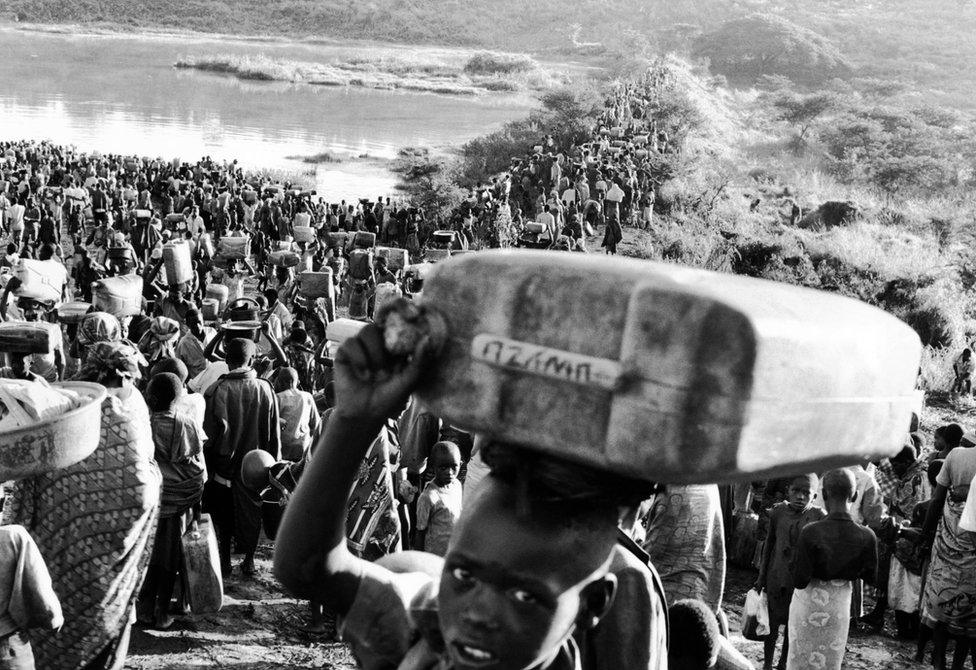
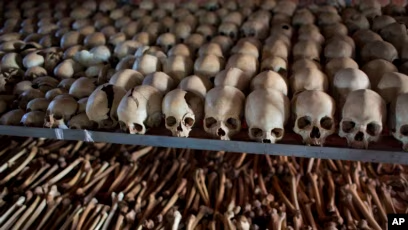
Rwanda
Over the course of 100 days in 1994, the central African nation of Rwanda witnessed a genocide that was shocking for both the sheer number of its victims and the brutality with which it was conducted. Occurring during the chaos of a civil war in the country – the Hutu political elite who dominated the Rwandan government set about eliminating the Tutsi population in the country. An estimated 800,000 men, women, and children (more than 1 million by some estimates) were hacked to death with machetes, had their skulls bashed in with blunt objects, or were burned alive — but their plight was largely ignored by the rest of the world.
The United Nations’ actions during the Rwandan Genocide remain controversial to this day, especially considering that they had received previous warnings from personnel on the ground that the risk of genocide was imminent. Although the UN had launched a peacekeeping mission in the fall of 1993, the troops were forbidden from using military force. Even when the violence kicked off in the spring of 1994 and 10 Belgians were killed in the initial attacks, the UN decided to withdraw its peacekeepers. Individual countries were also unwilling to intervene in the conflict. The U.S. was hesitant to contribute any soldiers after a failed 1993 joint peacekeeping mission with the UN in Somalia left 18 American soldiers and hundreds of civilians dead. John Major defended his decision not to send troops to Rwanda – he told MPs in July 1994 it was “simply not practicable” for the UN Security Council to become the “policeman of every part of the world“
The withdrawal of European troops only emboldened the extremists. A group of around 2,000 Tutsis who had taken shelter at a school guarded by UN troops in the capital of Kigali watched helplessly as their last line of defence abandoned them. One survivor recalled: “We knew the UN was abandoning us. We cried for them not to leave. Some people even begged for the Belgians to kill them because a bullet would be better than a machete.” The troops continued their withdrawal. Mere hours after the last of them had left, most of the 2,000 Rwandans seeking their protection were dead. Finally, France requested and received approval from the UN to send their own troops to Rwanda in June of 1994. The safe zones established by French soldiers saved thousands of Tutsi lives — but they also allowed Hutu perpetrators to slip over the border and escape once order had been re-established.
Why has Britain’s relationship with Europe proved controversial?
The nature of Britain’s relationship with Europe has divided opinion in the UK ever since the 1950s. However, in the immediate aftermath of the Second World War Britain’s relations with Europe caused little domestic controversy.
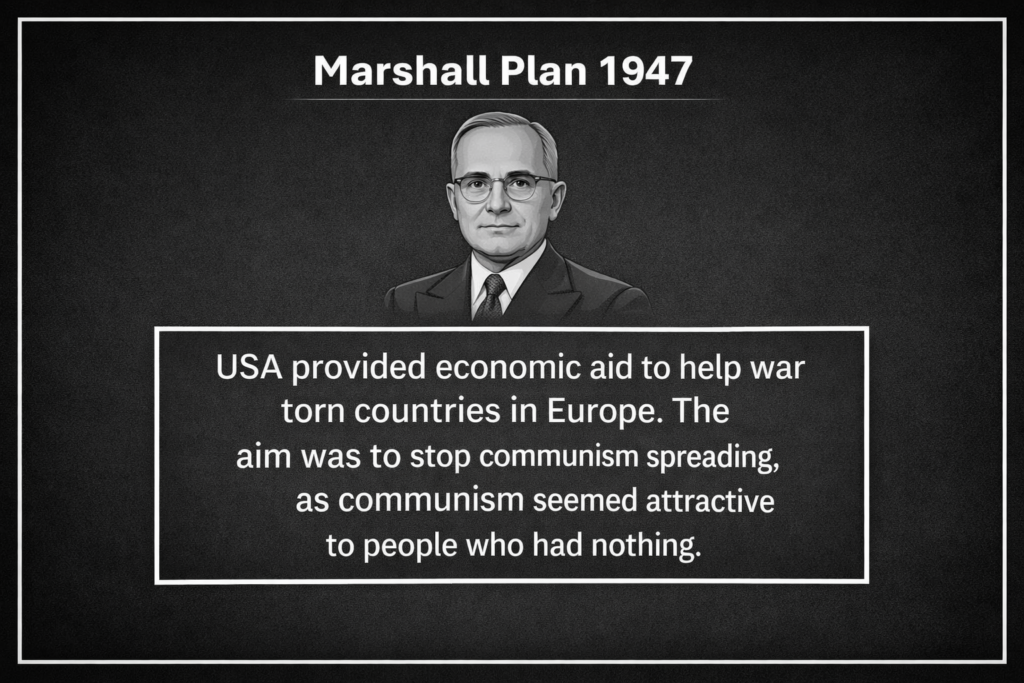
- Britain played a central role in creating the Organisation for European Economic Cooperation set up in 1948 to administer Marshall Aid, the huge American aid package to help rebuild war torn Europe
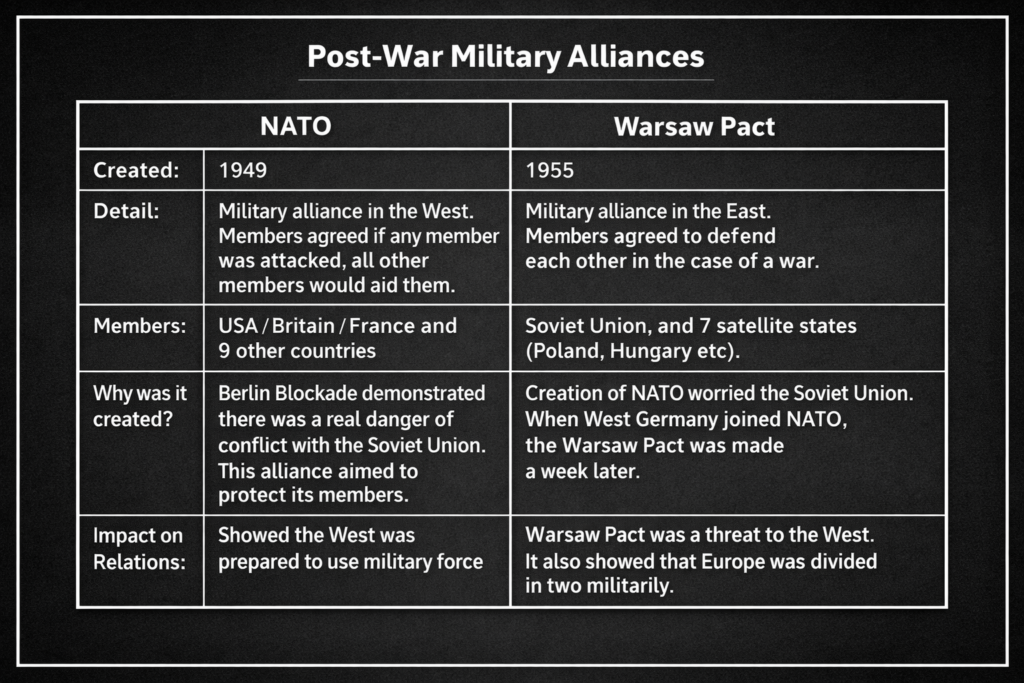
- Britain was also one of the original signatories of NATO in 1949
- They were a founder member of the Council of Europe to help promote unity and human rights
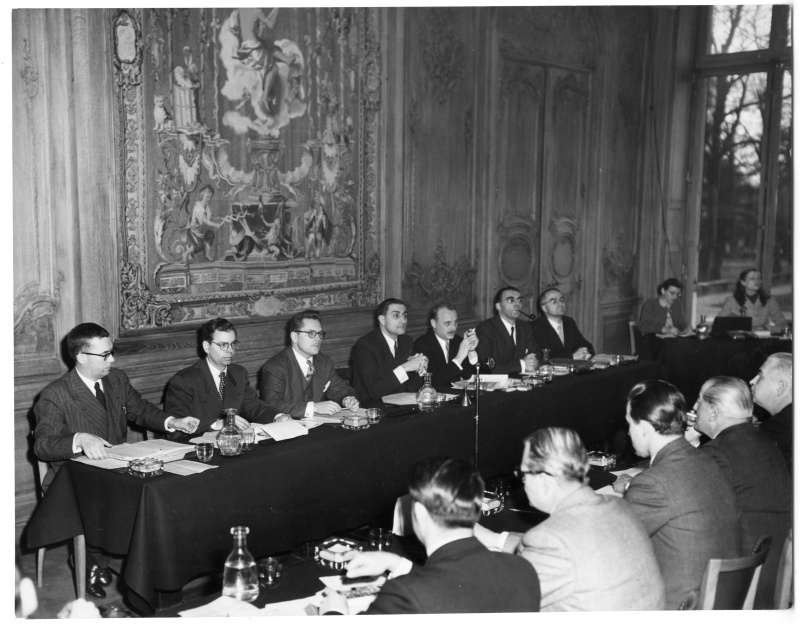
It was with the development of the European Economic Community in the 1950s that more controversy emerged as moves towards European unity appeared to threaten national sovereignty. British interest was limited. Britain played no part in:
- The European Coal and Steel Community
- The meeting at Messina that led to the Treaty of Rome 1957 which established the European Economic Community in 1958
The Conservative governments of the 1950s did not join the EEC because:
- They hoped to make the colonial Empire and the Commonwealth into a trading bloc that would be stronger than the EEC
- They disliked the commitment to closer union contained in the Treaty of Rome
- They did not believe that France and Germany could overcome centuries of hostility to make the EEC a success
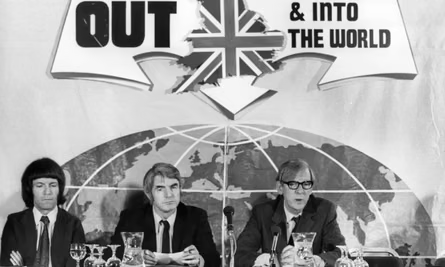
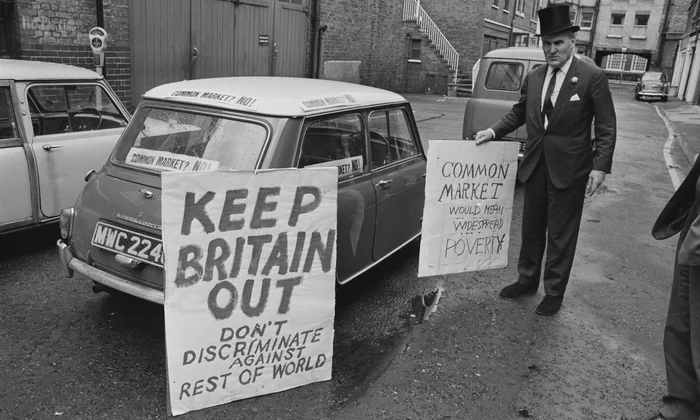
Domestic Division over Britain’s role in Europe
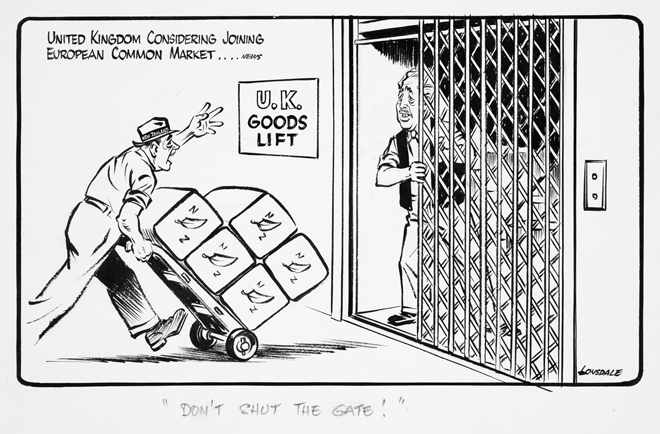
Britain’s relations with the EEC became a difficult issue in British domestic politics in the early 1960s. Harold Macmillan realised that Britain’s colonial empire had no future and tried to establish a new relationship with Europe. By 1961, the scale of Britain’s economic weakness convinced him and the pro Europeans in both major parties that Britain needed to join the Common Market.
Both major parties had influential groups opposed to Britain joining the Common Market because they believed the membership of the EEC would limit Britain’s freedom to make its own decisions.
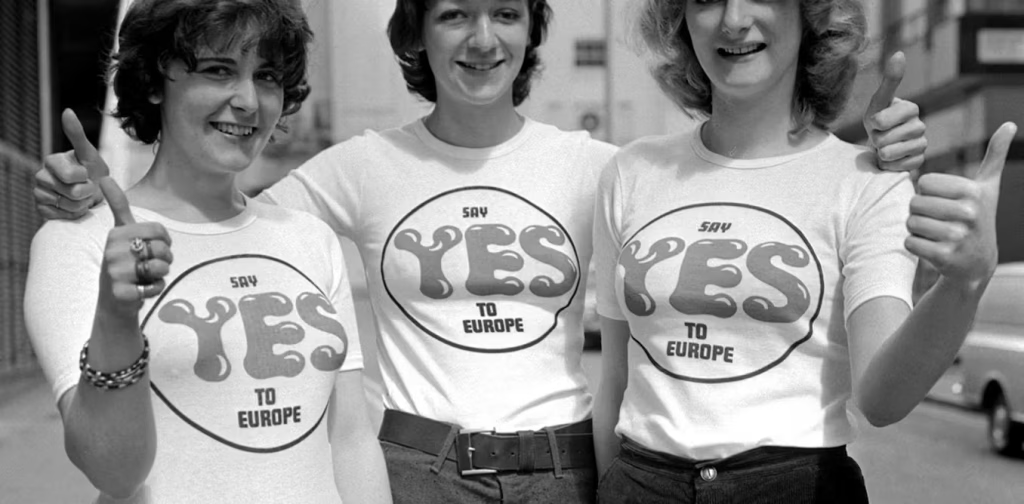
These divisions were starkly apparent when parliament debated the terms of British entry in 1973. Edward Heaths government could only secure a majority with the support of pro-European Labour MPs. When Labour returned to power in 1974, Wilson chose to tackle the divisions with in the party by holding a national referendum over membership in 1975. The 2:1 vote in favours demonstrated that the majority was vital to overcoming Britain’s economic difficulties.
Thatcher and Europe in 1980s
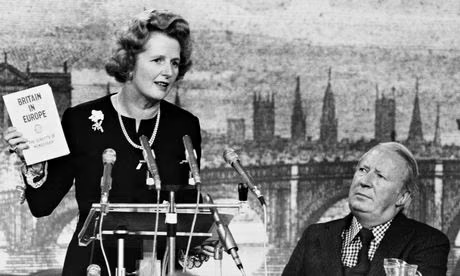
One of the politicians playing a key role in campaigns for a yes vote in the 1975 referendum was the newly elected leader of the Conservatives, Margaret Thatcher. But once she became PM in 1979, she began to have doubts about Britain’s role in Europe.
- In 1980, convinced that Britain was making a disproportionately large contribution to the EEC budget, she demanded a rebate. It took 4 years of negotiation before she succeeded
- Thatcher and her supported thought that economic policy brought about economic recovery rather than the EEC
- In September 1988 in a speech in Bruges she spoke for many on the right of the Tories who regarded closer European integration as a threat to British sovereignty when she denounced what she called a European super state
But there were also members of the Tories who believed that Britain should continue to play a major role in Europe.
- They believed that the benefits to Britain of closer integration with the economies of Europe outweighed the disadvantages
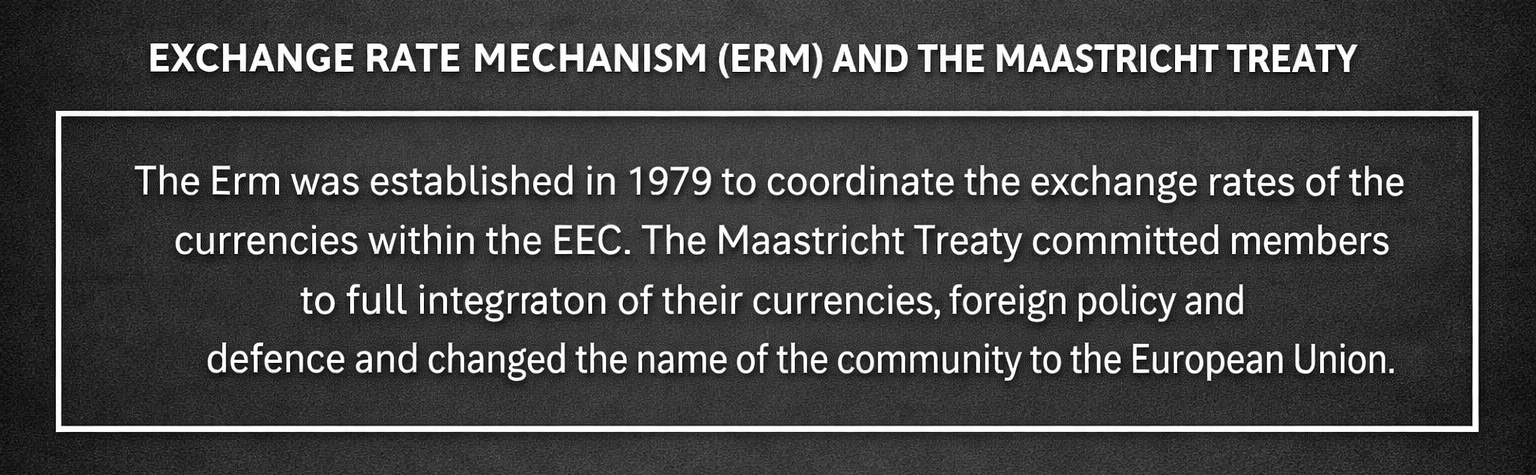
- By 1989 some of Thatcher’s senior ministers believed that inflation could be best tackled by Britain joining the Exchange Rate Mechanism – this led to her downfall
Major and the Maastricht Treaty
The Eurosceptic wing of the Conservative Party which grew during Major’s premiership, was emboldened by two issues:
- Britain’s humiliating withdrawal from the ERM in 1992 and subsequent economic recovery confirmed them in their view that Britain did not benefit from European Membership
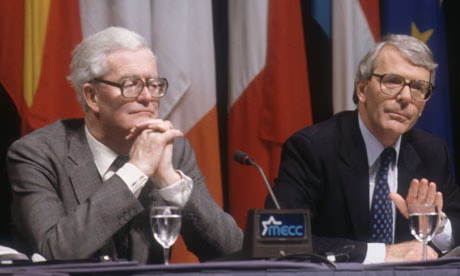
- The Maastricht Treaty brought together the Conservatives who wanted to leave the EEC with those who believed that the EEC should be no more than a trade partnership because of its implications for British sovereignty. They feared that the Treaty was another step towards making Europe into a federal state governed from Brussels
The pro-Europeans maintained that Eurosceptic fears were exaggerated and that:
- Britain benefited from being part of the world’s largest single market
- The free movement of goods, capital and labour removed obstacles to business
- Common regulations on goods, working conditions, the environment and crime benefited all member countries
- The European Union attracted more investment into Britain from outside Europe than Britain could achieved alone
Throughout the post war period and into the 21st Century the British people have been divided about how far the country should cooperate with Europe. The division cuts across the political and social spectrum.
Britain’s Nuclear Deterrent
1950s
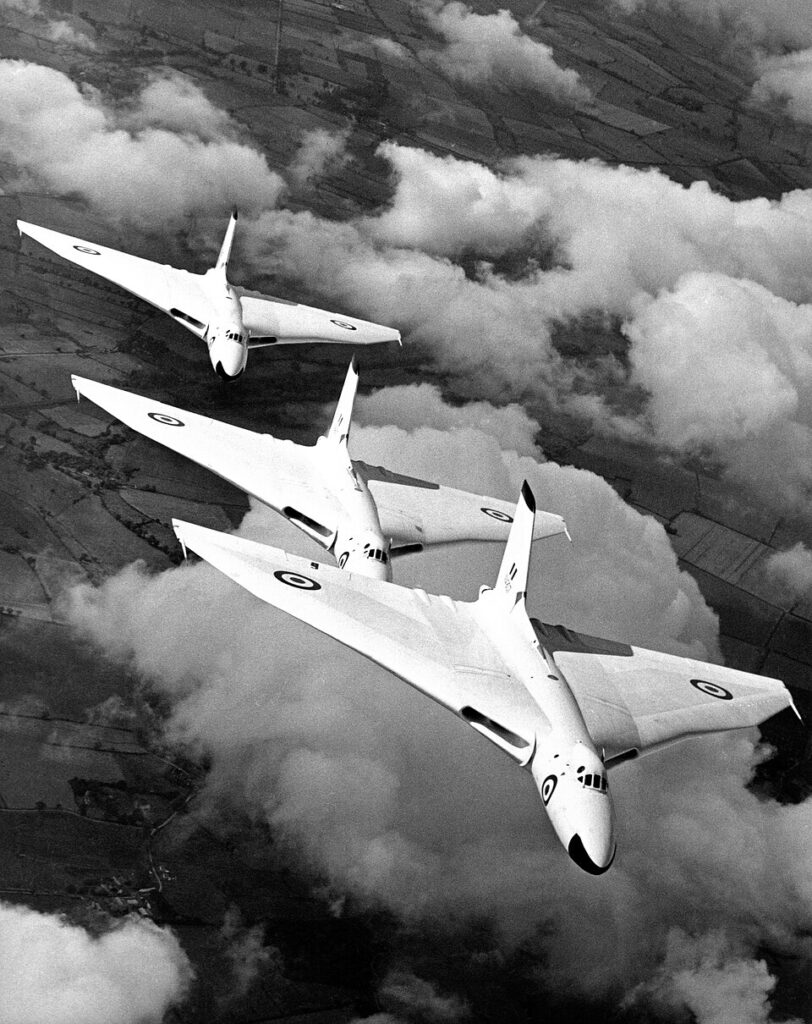
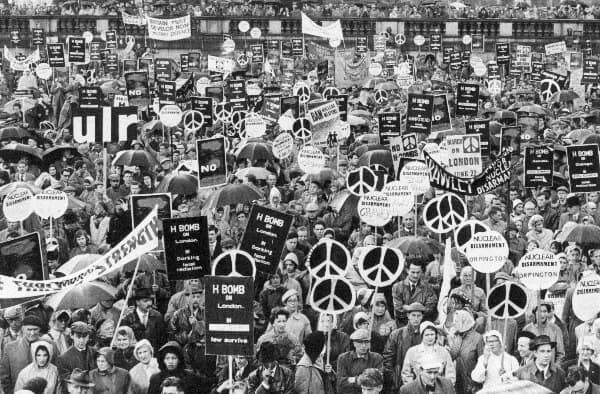
Pressure grew for nuclear weapons to be abandoned to make the world safer. In 1958 the Campaign for Nuclear Disarmament (CND) was founded and began a series of annual protest marches from the nuclear weapons plant at Aldermaston in Berkshire to Trafalgar Square in London. The march in 1960 attracted as many as 100,000 protestors. However, supporters of the nuclear deterrent maintained that Britain needed to be strong to prevent Soviet aggression, even though it was clear by the 1960s that Britain needed US missiles to deliver its bombs. The Labour party was more divided on the issue of nuclear weapons than were the Conservatives.
1960s
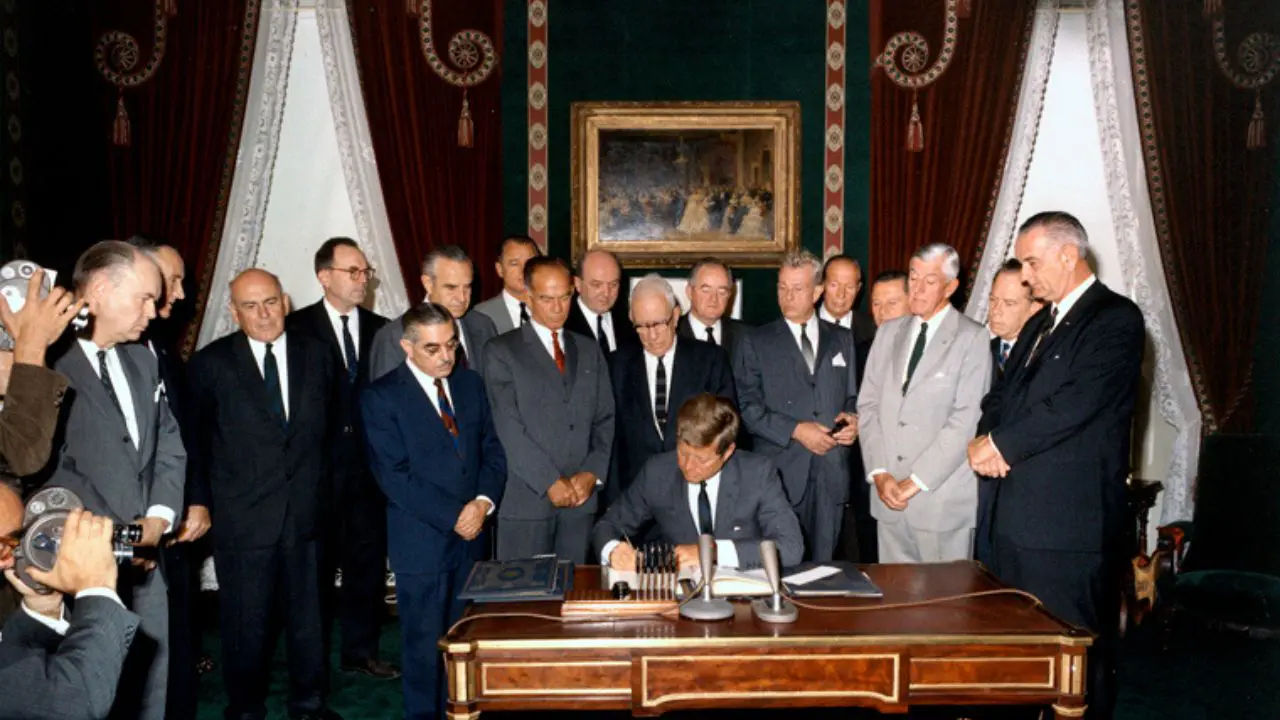
In 1963, Britain joined the USSR and the USA in banning nuclear testing in space (Test-Ban Treaty), under water and in the atmosphere. Britain also signed the 1968 Nuclear Non Proliferation Treaty by which signatories agreed not to share nuclear technology with other nations. The continued build up on nuclear-armed missiles by both the USA and the USSR during the 1960s rendered the much smaller British deterrent increasingly insignificant.
1970s
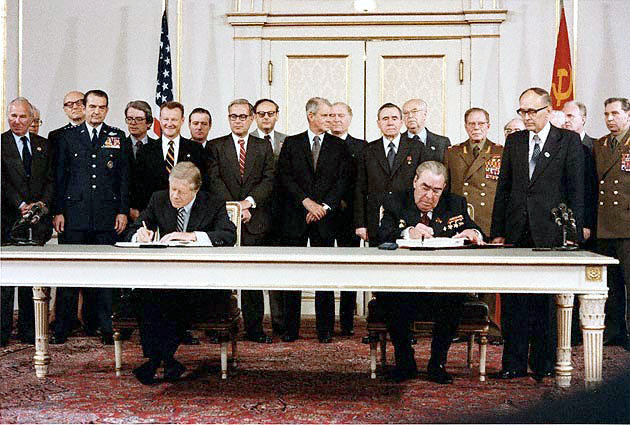
The British played little part when the two superpowers (USA and USSR) negotiated the two Strategic Arms Limitations Treaties (SALT) in 1972 and 1979. This began a period known as Détente – a period of peace between two nations (US and USSR) who were previously hostile or at war. SALT 1 (1972) aimed to limit the number of weapons each side had. This improved relations between Nixon and Brezhnev as it resulted in visits of the leaders to their respective countries. SALT 2 tried to improve on SALT 1 by putting more limitations on nuclear weapons. However, SALT 2 was never put into action as there was still a lack of trust between US and USSR and upon the Soviet invasion of Afghanistan in 1979, the US government refused to accept SALT 2 in response, meaning the period of Détente came to an end.
1980s
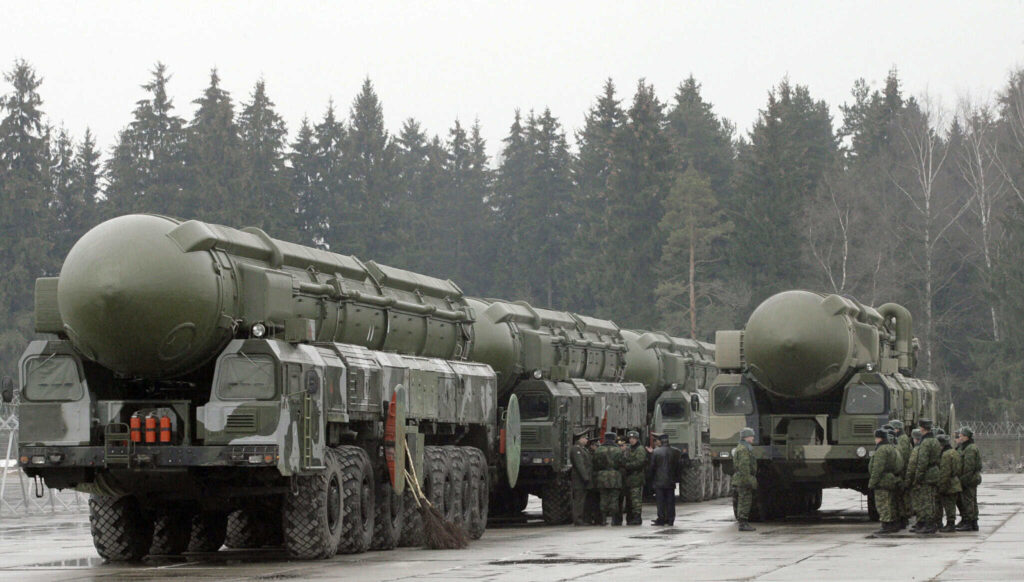
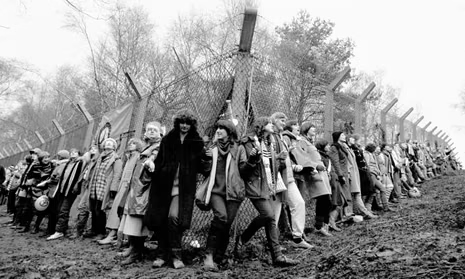
Britain’s role in the nuclear balance between East and West once again became controversial in the 1980s. In the mid-1970s the USSR had begun deploying SS-20 intermediate range missiles capable of hitting targets anywhere in Europe, and in 1979 the NATO powers agreed to deploy US intermediate range cruise missiles in response. This decision increased the likelihood of Europe becoming a nuclear battleground. It also prompted a group of women in 1981 to set up a protest camp at the RAF and USAF base at Greenham Common in Berkshire. The camp was for women only and was to demonstrate opposition to the siting of US nuclear weapons on British bases. The camp lasted for nineteen years and became a potent symbol of women’s rejection of war and violence.
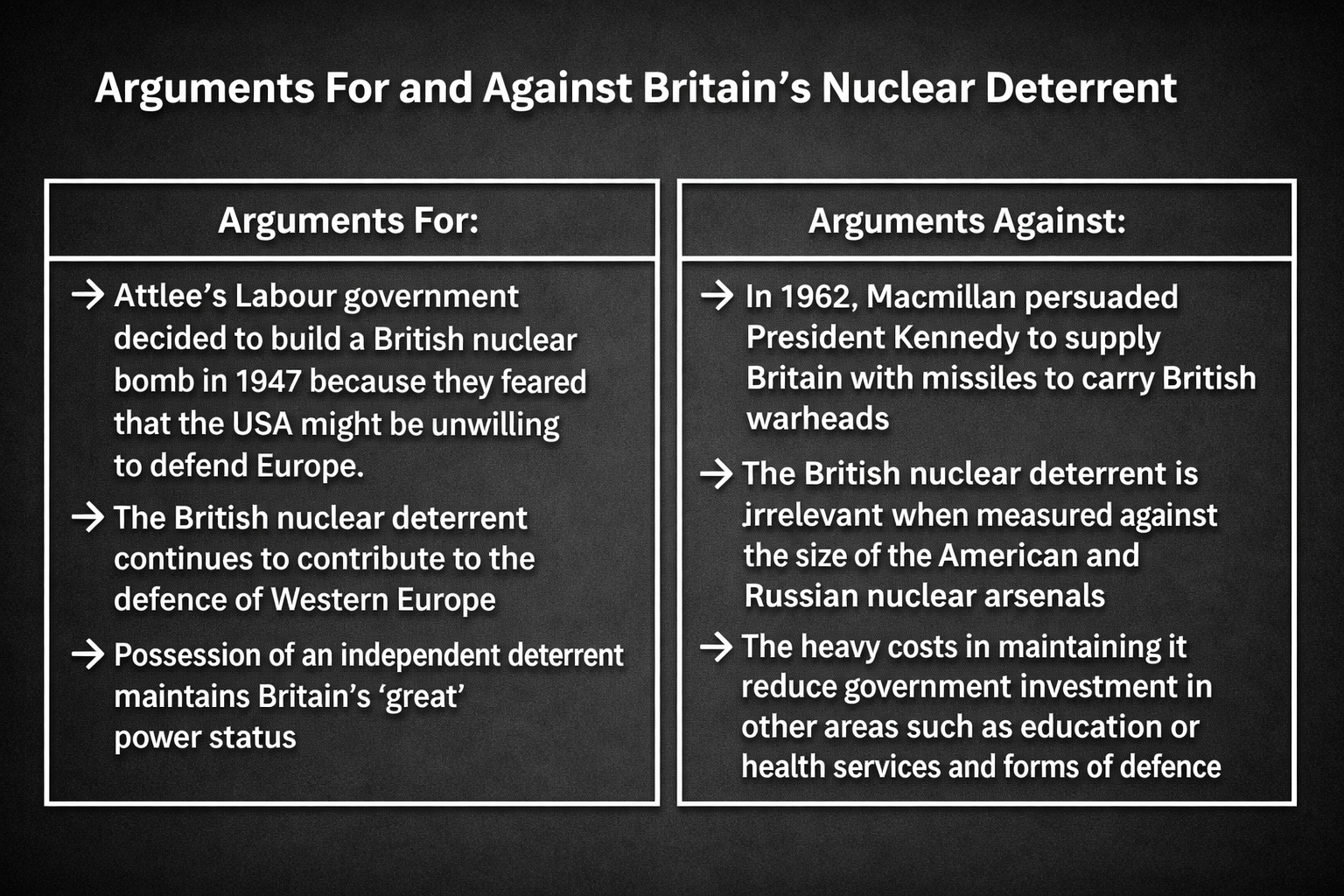
One woman who did not sympathise with the Greenham Common protest was Prime Minister Margaret Thatcher. She was alarmed by President Reagan’s willingness, in his discussions with the Soviet leader Mikhail Gorbachev, to embrace what became known as the zero option – the complete abolition of nuclear weapons on both sides. She also believed that the abolition of nuclear weapons would leave Europe exposed to the conventional forces of the USSR, which were much larger than those of NATO. Although the zero option was not adopted, the collapse of the USSR in 1991 did lead to agreements by which both the USA and Russia significantly reduced their nuclear arsenals. At the end of the century, Britain’s nuclear policy remained much like its foreign policy – nominally independent, but in reality dependent on the United States – as debate continued about the cost, ethical issues and viability of the nuclear option.
Impact of Britain’s Nuclear Deterrent Cost
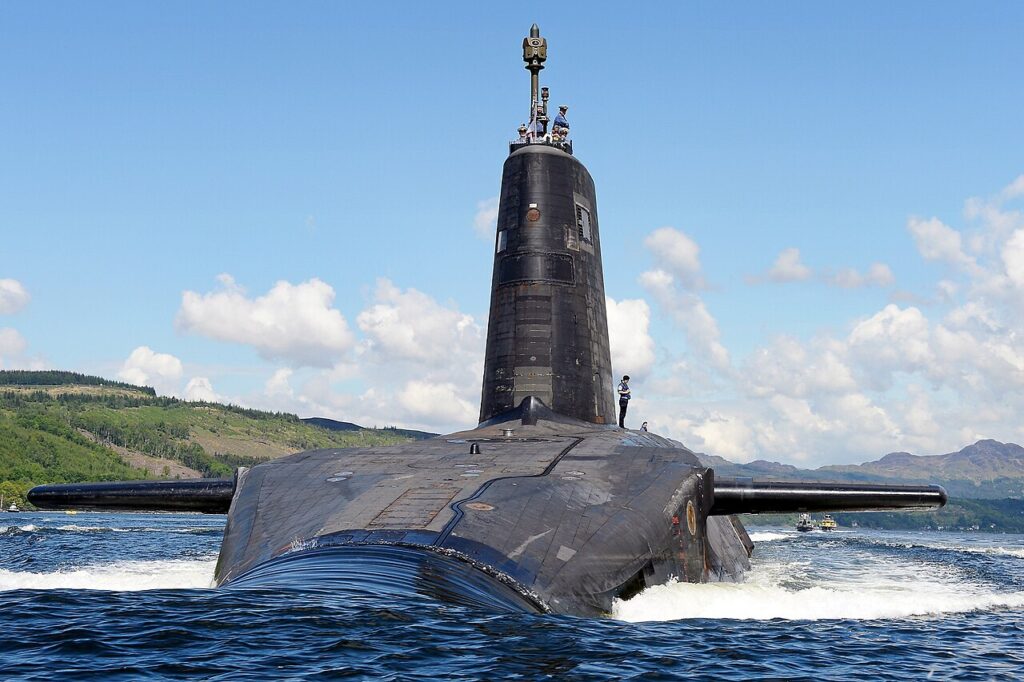
Britain’s spending on nuclear deterrence fluctuated significantly from 1950 to 1990, reflecting shifts in the Cold War and defence priorities. In the 1950s, following the successful testing of the first British nuclear bomb, defence spending rose significantly. By the late 1980s, it had decreased, with spending on defence remaining relatively high, between 4% and 5% of GDP, until 1988. The development and procurement of the Trident nuclear deterrent in the early 1980s, and the subsequent Strategic Defence Review, significantly impacted spending, leading to a total acquisition expenditure of £12.52 billion.
Political Divide
During the 1950s and 60s, the Labour party became increasingly divided regarding unilateral and multilateral nuclear disarmament, Additionally following the proposal of the Trident nuclear system, the Conservatives faced opposition. The maintenance of the strategic nuclear deterrent and decision to acquire Trident was achieved by 316 to 248 votes. In 1982, Labour presented an amendment which sought to ‘condemn the decision to purchase the Trident nuclear system’ which was defeated on division by 215 to 201 votes. The main motion was subsequently approves by 297 to 248 votes. Despite approval, the vote did demonstrate continued opposition and controversy regarding the acquisition of Trident.
Commonwealth
Why did Britain grant independence to the majority of its colonies in the period 1957-1964?
Second World War
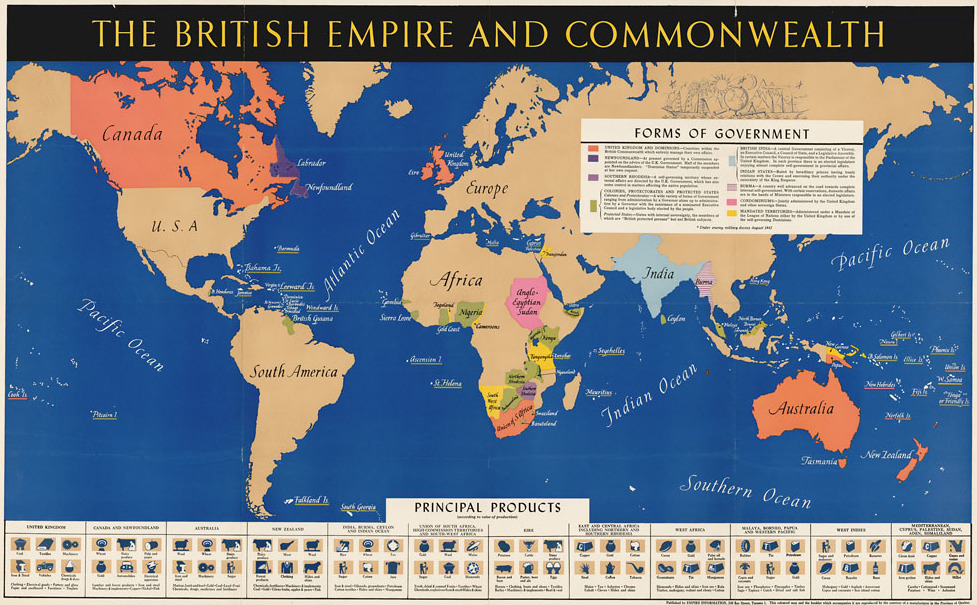
WW2 damaged European prestige. The nature of relationships between both Britain’s colonial people and themselves had changed.
- The fall of Singapore to the Japanese and the collapse of Dutch and French empires showed that European rule was no longer invincible.
- Administrators had to change their ruling style to help provide more raw materials and foodstuffs – farmers resented selling to the govt at a fixed price.
- The colonies couldn’t buy from Britain and were prevented from buying elsewhere – this led to the rise of nationalist movements
- The war saw greater unrest within the countries it ruled. India found itself wanting to withdraw quickly and so gained independence as well as Pakistan in 1947
Britain’s Economic Weakness
Britain’s economic weakness led to Britain exploiting the colonies even more.
- In 1948, the government set up the Colonial Development Corporation and established other projects e.g. the East African Groundnut Scheme – these helped to disrupt colonies even more, therefore hostility to British rule grew
- Britain could no longer supply capital and investment to its colonies.
The Growth of Colonial Nationalism
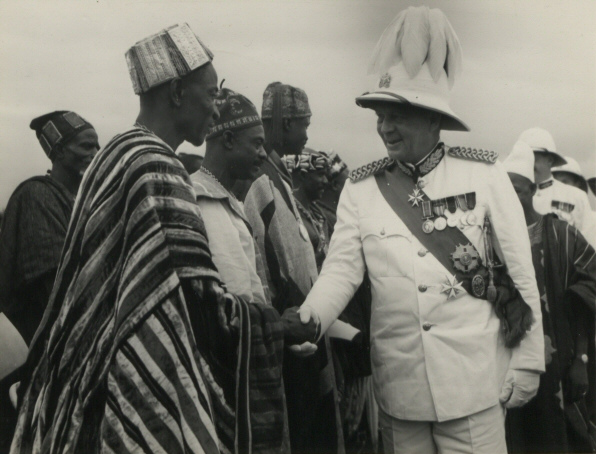
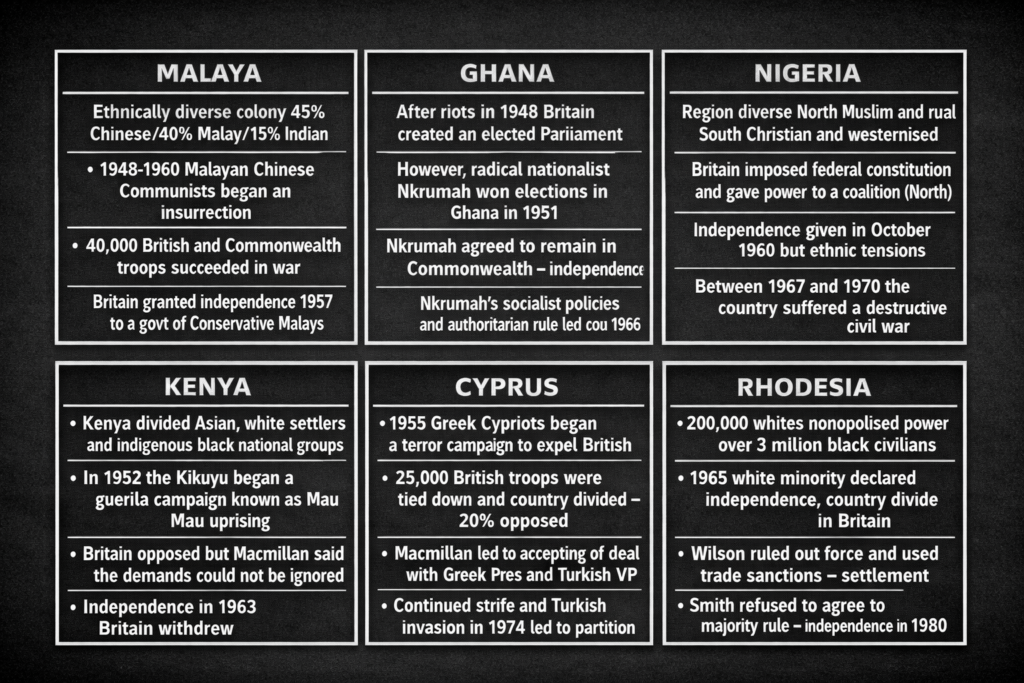
The growth of colonial nationalism was because many leaders started to emerge demanding immediate independence. They had often been educated in the West into ideals of freedom and democracy. They were encouraged by men such as Nasser and challenged ideas of white supremacy. When Macmillan toured Africa in 1960 he recognised that there were strong feelings of anti-colonial nationalism and spoke of ‘the wind of change is blowing through this continent’. This had already been seen in the Gold Coast (Ghana) where the independence movement had insisted government of the country must be African. In some area’s resistance was violent e.g. in Kenya a civil war was taking place between those who had and had not benefitted from colonialism. It resulted in a death toll of 14,000.
Impact of the Cold War
The Cold War was significant. The USA wanted Britain to maintain all of its colonies, especially African ones, to resist the influence of communism. However, as protests grew in the Empire, both the USA and USSR rushed to create anti-colonial propaganda, particularly as it was vital to persuade, as the size of the UN increased. The UN was becoming more ethnically diverse and criticising European empires, the USA feared them resorting to communism. The Non-Aligned Movement was formed in 1955 by many newly independent countries.
How successfully did Britain deal with the changing nature of the Commonwealth?
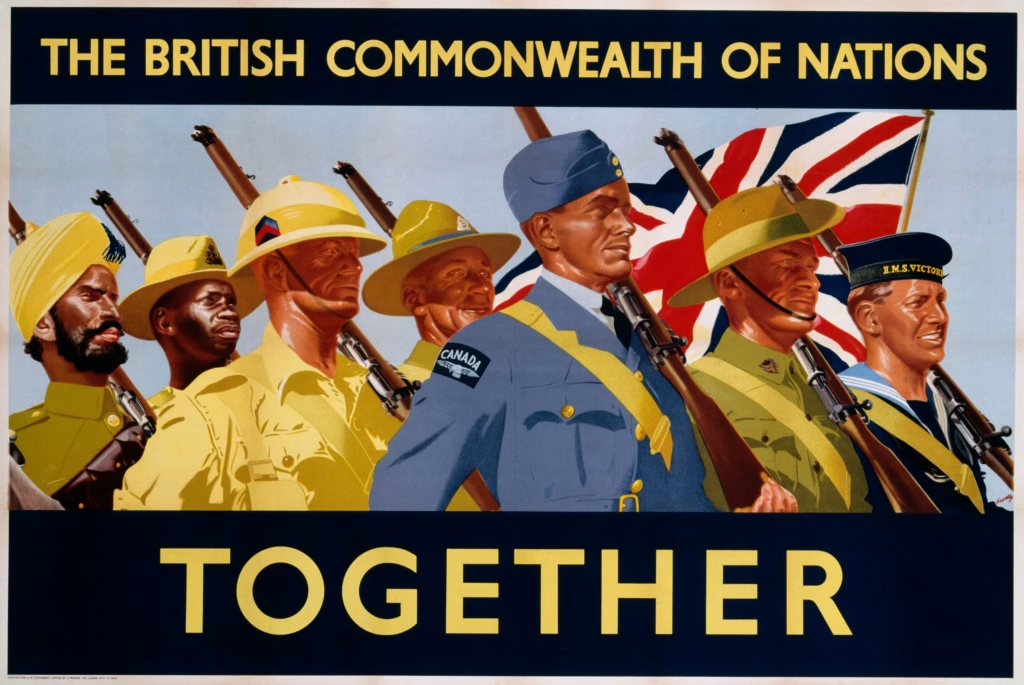
The Commonwealth had become a diverse and multi-racial association of nations united only by their history as territories formerly ruled by Britain:
→ The white ruled nations of South Africa, Canada, Australia and New Zealand had been granted complete legislative independence in 1931 but retained important economic and strategic tries to Britain
→ India, Pakistan and Ceylon (Sir Lanka) established a precedent by joining as republics and recognising the British monarch, not as head of state but merely as head of the Commonwealth
→ During the Korean War, Commonwealth troops fought alongside the British and Americans
There were various tensions within the Commonwealth during this period.
→ There 1956 Suez Crisis threatened Commonwealth unity because Canada, Australia, South Africa and New Zealand supported Britain but India and Pakistan sympathised with Egypt
→ The rapid dismantling of the British colonial empire in Asia and Africa between 1957 and 1964 considerably changed the nature of the Commonwealth ad the newly independent nations joined.
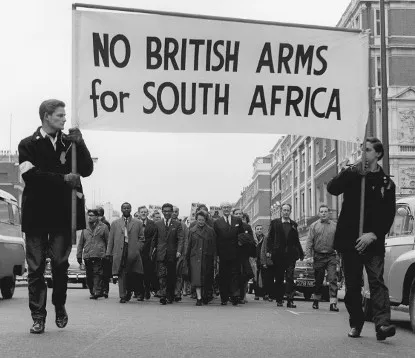
→ In 1961 South Africa left the Commonwealth rather than face the criticism of its apartheid policies from other members. During the 1970s and 1980s members of the Commonwealth repeatedly criticised Britain for its economic ties with South Africa, particularly the sale of armaments and Thatcher’s government found itself isolated for refusing to impose economic sanctions on the apartheid regime.
→ The 1962 Commonwealth Immigration Act was particularly resented by the black nations because it was clearly designed to limit black immigration into Britain
→Commonwealth unity was again seriously threatened by Britain’s handling of the Rhodesian crisis.
→ Britain itself sacrificed its preferential trade links with Commonwealth members such as New Zealand by joining the European Community in 1973
Despite the tensions and difficulties, the Commonwealth survived.
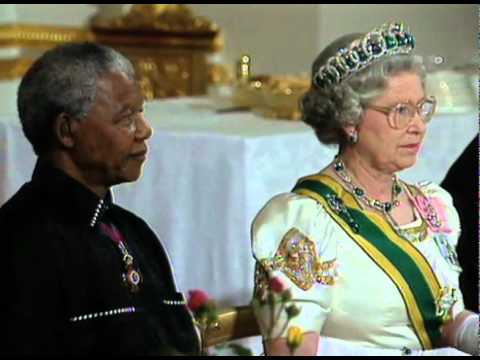
→ Nelson Mandela’s government in South Africa decided to re join the Commonwealth within a month of being elected in 1994. This suggested that the Commonwealth remained a viable institution
→ The 1995 Mozambique and Cameroon joined and became the first members of the Commonwealth with no historic ties to Britain
→ The 1971 Singapore Declaration condemned racial prejudice and emphasised members commitment to democratic values, international peace, equal rights and freedom of the individual. There principles were formally codified in the Commonwealth Charter adopted n 2012. Not all the Commonwealth nations could boast a spotless record adhering to these principles, and Nigeria membership was suspended between 1995 and 1999 for violating them
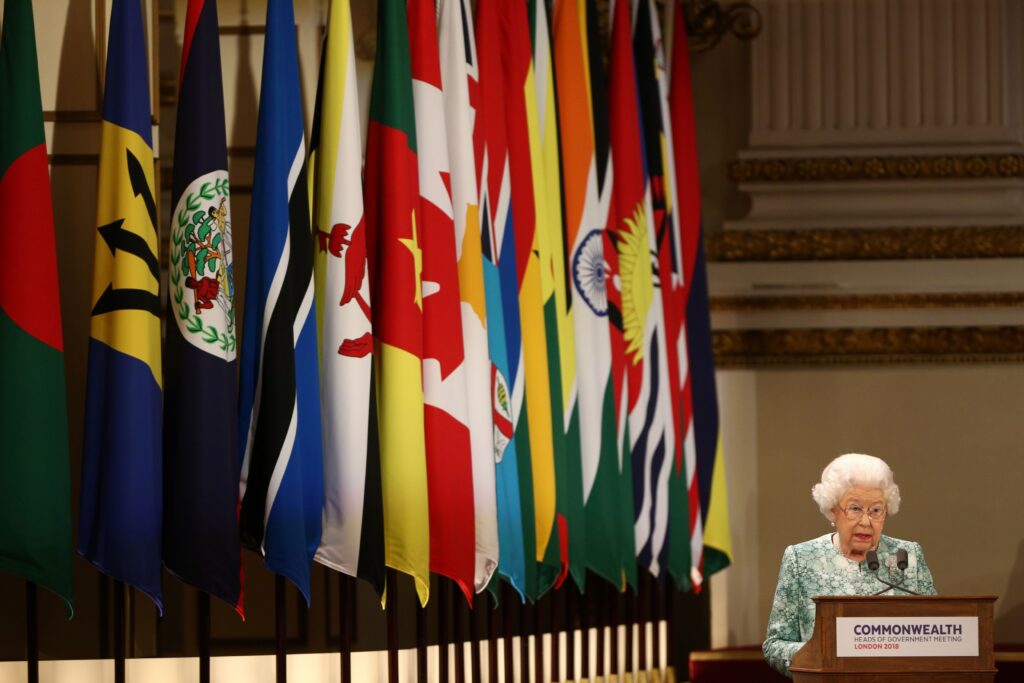
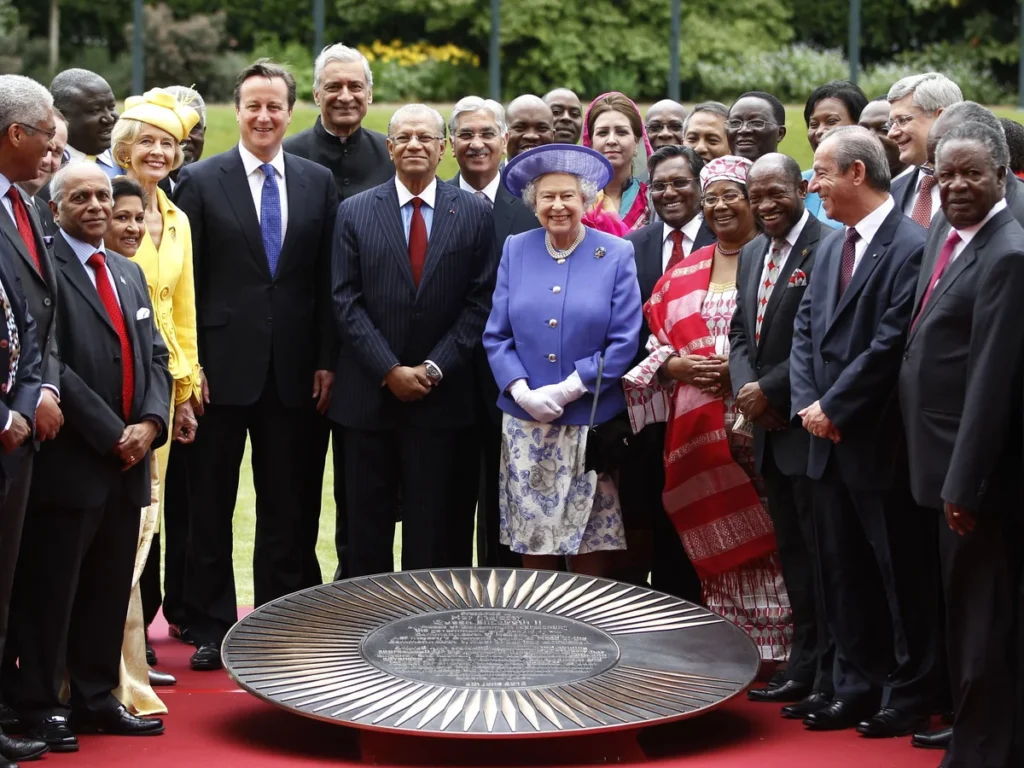
The Commonwealth has survived into the 21st century, in part because its head since 1952, Queen Elizabeth II is highly regarded by its members for her commitment to it, The Commonwealth despite its lack of obvious political power, remains a respected medium for cultural and economic exchange and for promoting important democratic values.
Why did Britain grant independence to the majority of its colonies in the period 1957-1964? Case Studies
Exam Zone
This section has been designed to help you build confidence, sharpen your skills, and achieve your best possible results. Whether you are preparing for mock exams, end-of-unit tests, or final assessments, the Exam Zone provides everything you need in one place.
The Exam Zone is not just about testing your knowledge. It is about developing the key historical skills required for success: critical thinking, evaluation, and clear written communication. By practising regularly and reflecting on feedback, you will strengthen both your understanding of the past and your performance in exams.