Explore the Significance of Churchill’s Wilderness Years
Churchill’s Wilderness Years (1929–1939) were a decade of political isolation in which his fierce warnings about Hitler clashed with his misjudgements on issues like India and the Abdication Crisis, leaving him marginalised until events in Europe proved him right.
Britain in the 1920s & 1930s
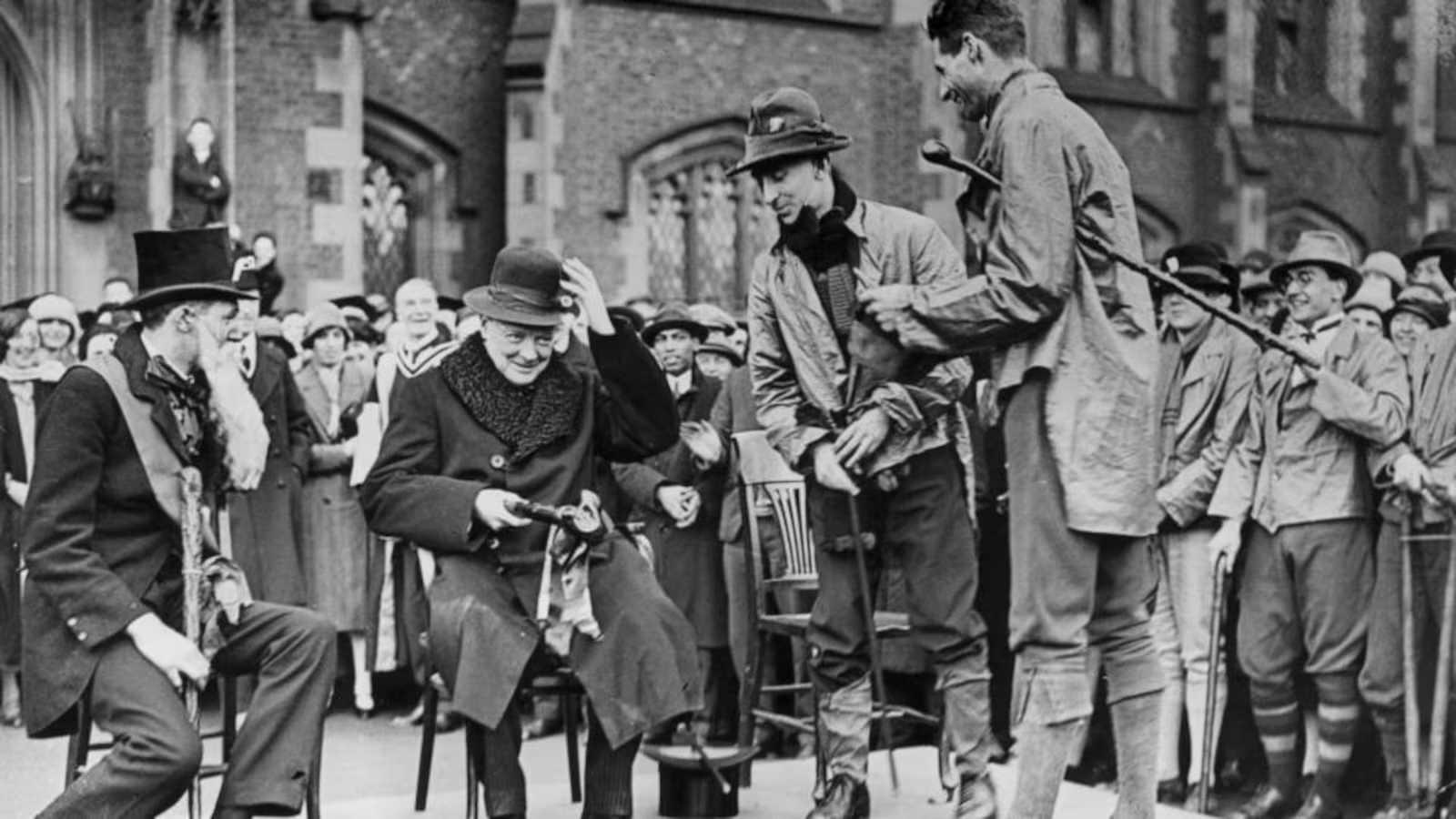
Britain in the 1920s
Churchill: Irish independence and Empire
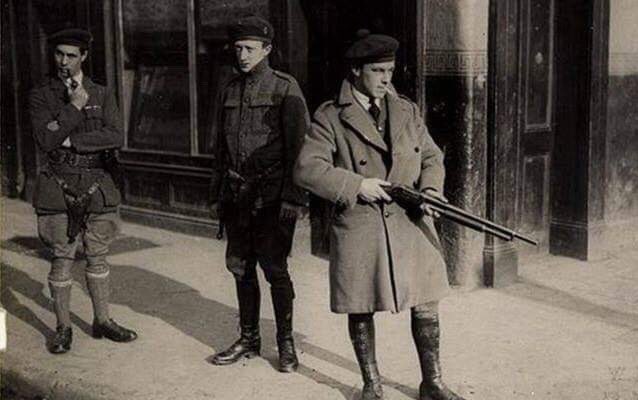
Churchill was an enthusiastic supporter of the British Empire and held a traditional view about the role of Britain in the nations under British control. His early military career had taken him to many differing parts of the Empire such as India in 1896, Sudan in 1898 and more famously as a war correspondent during the Boer War of 1899-1902. These experiences had led him to believe firmly in the continuation of the British Empire. As Colonial Minister during the post-WW1 Lloyd George coalition government, Churchill continued to focus on questions related to Empire. A growing problem facing the British government post-war was an intensification of Irish nationalist groups campaign for independence from British rule – a campaign that was growing increasingly violent. Churchill encouraged the use of British forces in Ireland known as the “blacks and tans” to control the nationalist forces. He remained opposed to the moves by the Lloyd George government to end the dispute by giving Ireland greater powers and the subsequent formal partition of Ireland into North and South. He feared that these concessions to Ireland would only encourage other parts of the Empire to push for their own independence and would lead to the break-up of the British Empire.
The Economy
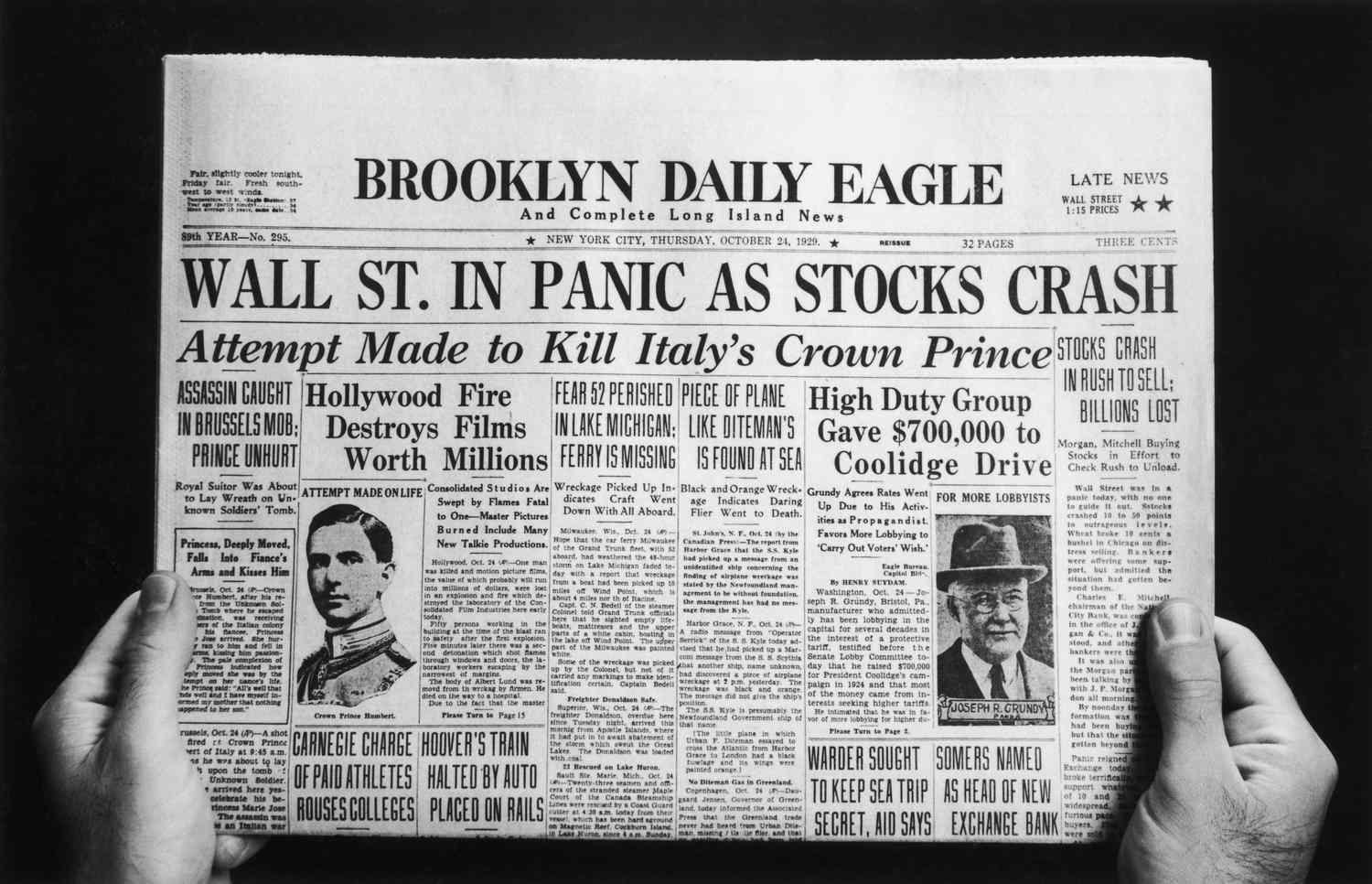
Britain had been a great industrial power in the nineteenth century with textiles, iron and steel, engineering, coal and chemical industries leading the world. However, by 1929 its older industries were in decline. There was much less demand for its heavy industry products. Unemployment had not fallen below a million in the 1920s and trade had been hindered by the high price of the pound after the return to the GOLD STANDARD. In October 1929 the collapse of the US stock market saw the beginning of the WALL STREET CRASH and a long period of world economic depression which lasted into the 1930s.
A number of financial experts warned that the American economy was slowing down and in September 1929 some investors started selling shares in large numbers. Many people started feeling nervous and investors went into panic and rushed to sell their shares. On 24 October, now referred to as Black Thursday, 12.8 million shares were sold. Thousands of people saw their fortune, or any money they had in the bank, disappear.
Society
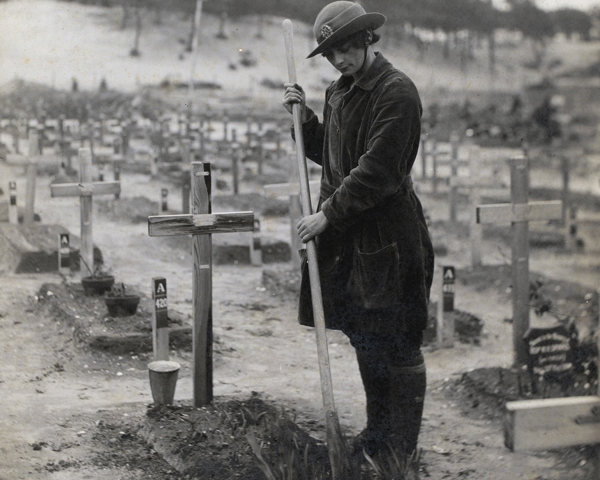
Britain had been deeply affected by the loss of over 750,000 men in the First World War. There was a loss of faith in old values of patriotism and deep reluctance to go to war again. There was a rise in the relative wealth and influence of the middle classes as the suburbs grew and the importance of banking and financial services to the economy began to outstrip that of industry. The war had confirmed social change with regard to the role of women who had the vote on equal terms with men after 1928 and had much more freedom of movement, dress and way of life than had been true in the previous century. The rise of radio, cinema, the popular press, the telephone and the use of motor transport increased awareness of the wider world and improved communications.
Political Life
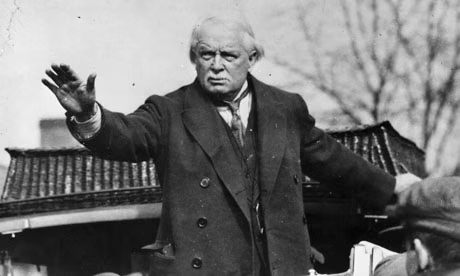
The two main parties of Britain were Conservative and Labour. The Liberals, who had been the major party of change before 1914, had declined to the third party. Labour was a relatively new party, representing working people, and had increased its support during and after the First World War to become a national party. It did not form a government until 1924, which lasted under a year, but it did win the election of 1929. The Conservatives had lost the 1906 election badly and were out of power until they joined a wartime coalition with Labour and the Liberals in 1915. They were the major party in the continuing coalition from 1916 to 1922 under the Liberal, Lloyd George, but ended the coalition agreement in 1922. They were in power 1922-1923 and 1924-1929. The Liberals had been the great party of reform since 1859 and introduced many important changes, including the beginnings of the modern welfare state. However, the party split during the First World War and were overtaken by Labour. They did not hold office in their own right after 1915.
The British Empire
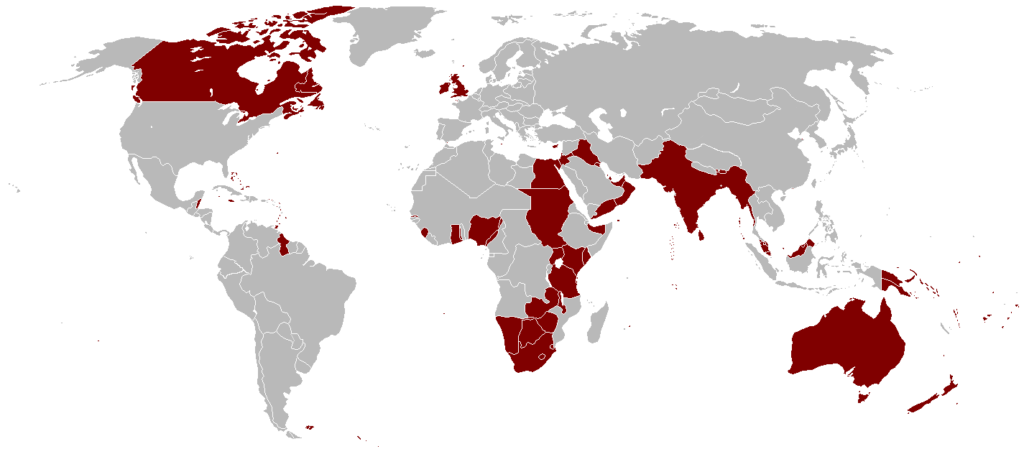
Britain was the head of an empire of 240 million people. The Empire was very important and many British people lived and worked in it either in administration, education or in farming, business or church activities. Some areas were self-governing such as Australia, New Zealand, Canada and South Africa. India however had limited self-government only which proved to be an issue for Britain during the 1930’s. Britain’s African possessions and its other colonies in Asia were ruled directly. Britain also controlled the Suez Canal, which also became a problem during the 1950’s, as well as being highly dominant in Egypt. The Empire helps Britain to win the First World War, but was very costly and difficult to defend.
Prices fell faster than wages, particularly food prices. Cost of living fell by more than a third between 1920 and 1938.
This led to historian A.J.P Taylor’s claim that “increased consumption by individuals pulled Britain out of the Depression”.Improvements in housing and sanitation helped to reduce the incidence of infectious diseases such as typhoid. A higher proportion of army volunteers were judged fit to fight in 1939 than in 1914.
Many of newer industries of the 1920s did experience unemployment during the slump but managed to recover from it easier than the old staples. E.g. insured unemployment in motor car industry ran at 20% in 1932 but fell to 4.8% by 1937. In shipbuilding, the corresponding figures were 62.2% and 23.8%.
Financial security of the salaried
middle-classes stimulated a suburban house building boom in the 1930s.A new steelworks opened in Jarrow in 1938 which led to increased employment in the town. This development largely arose as a result of increased rearmament in 1938-39.
There was a decline in the average family size in inter-war Britain. A woman who married in the 1880s was likely to have over 4 children, whereas by the 1920s the figure was on average 2 children.
A 1944 study found that 85% of all long-term unemployment in the inter-war period was found in North England, Scotland and Wales.
As well as regional differences in economic circumstances, there were also differences between towns within the same region. For example, Jarrow experienced around 80% male unemployment in 1935, but just down the road in Hebburn, there was a housing boom.
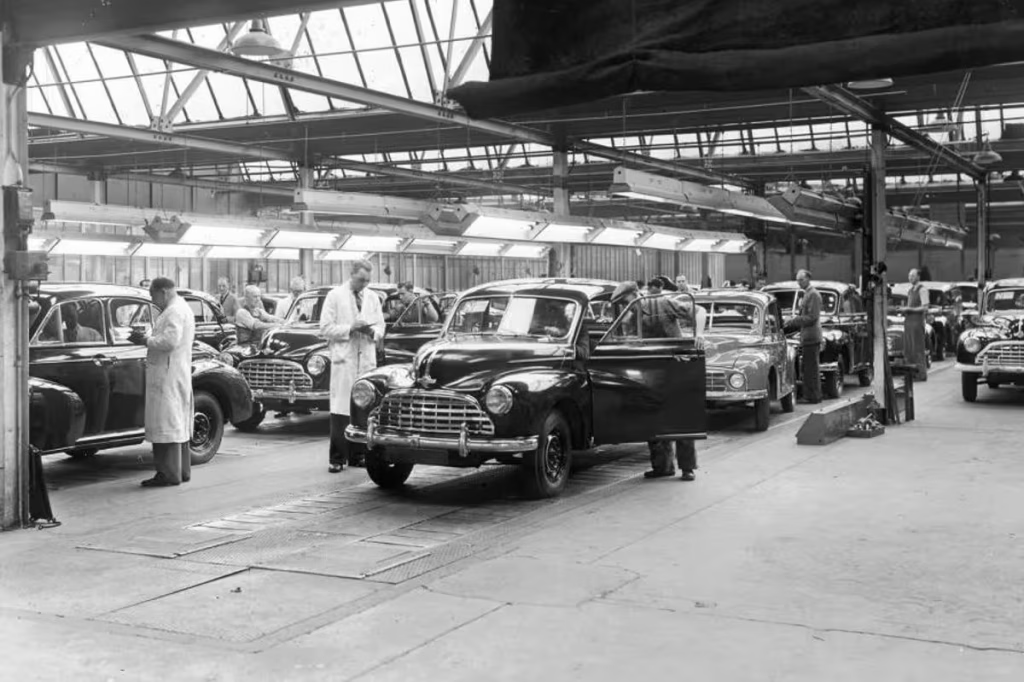
New industries such as motor vehicles, chemicals and aircraft enjoyed particular growth. Output of motor cars doubled between 1929 and 1939, making Britain the second largest car maker in the world. However many of these growing newer industries were
based in particular parts of the country such as the south and Midlands.In an attempt to control unemployment
benefits the government introduced the “means test”. This was an invasive
financial assessment that families went through before the level of their benefit was decided.
Britain in the 1930s
The Labour government elected in 1929 very quickly became blighted by the world economic crisis which had been caused by the Wall Street Crash of October 1929. Division within the Labour Party about what was the best way to deal with the Great Depression led to the collapse of the government in 1931. From 1931 until 1940, Britain was governed by a “national government” – a coalition government of all parties, formed on the request of the King. However, although the ex-Labour Prime Minister Ramsay MacDonald, was the Prime Minister, the National Government was not a true coalition of all the parties. The bulk of the Labour Party was bitterly opposed to MacDonald joining the national government. The Liberal Party made a small contribution. The power base of the national government was the massive majority that the Conservatives held in parliament. When MacDonald resigned in 1935, Conservative leader Stanley Baldwin became Prime Minister and Conservative dominance became even more obvious
The economic impact of the Wall Street Crash and Depression intensified a range of existing economic problems, especially the decline of the staple industries. From 1930, world trade shrank and with it the demand from British exports which hit British manufacturing hard. As a result, unemployment in the staple industries rose to frightening levels. By 1932 unemployment reached 2.5 million. This meant that 47% of steel workers were unemployed and 60% of shipbuilders were without work. Certain areas of the country were completely dependent on these industries and as a result many towns experienced particularly acute unemployment. For example, Merthyr Tydfil in South Wales had 62% male unemployment and Jarrow in the northeast had 70% male unemployment.
Jarrow became a town that came to symbolise the problems of industrial decline and the plight of the unemployed because of the Jarrow March of 1936, when 200 unemployed men from the South Tyneside shipbuilding town marched the 300 miles to London to deliver a petition to parliament calling for government intervention to help save the town. The Jarrow March was one of many so-called “hunger marches” that occurred during the 1930s to draw attention to the poor living conditions and desperate poverty many were facing.
As well as facing the responsibility of guiding Britain through the world Depression, the national government also faced the pressure of a growing political extremism which had swept across Europe (both from the communist left and the fascist right) and appeared to becoming more popular at home in Britain too. Following the economic crash of 1929, it gave weight to the argument that capitalism was on the verge of collapse and the early 1930s saw the membership of the Communist Party of Great Britain rise. The party newspaper had a daily circulation of 80,000 copies and the party even were successful in getting some MPs elected. In 1932, following a visit to Mussolini’s fascist Italy, former Labour MP Oswald Mosely formed the British Union of Fascists. The BUF gained support for the owner of the Daily Mail, which printed many pro-BUF articles and helped swell their membership to 50,000. However, overall both groups had limited success in fully gaining traction into the British political system. The BUF became associated with anti-Semitism and violent incidents such as the Battle of Cable Street which lost them the support of many. The CPGB were largely restricted by the fact that the moderate leadership of the Labour Party refused to work with the Communists and blocked its efforts to infiltrate the trade union movement.
Indian Independence
British Rule in India
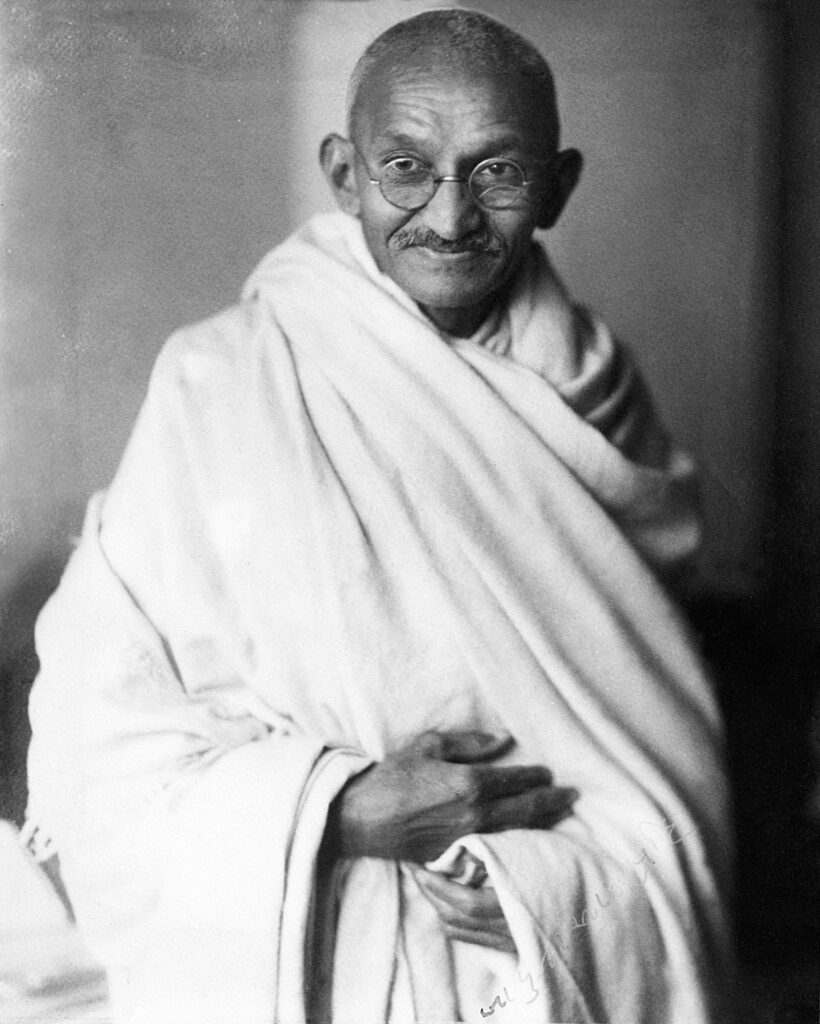
British rule in India was coming under increasing pressure in the late 1920s and 30s from an Indian population who wanted self-governance and representation. The pressure came from both the educated elite and the mass population, led by Gandhi. Dressing like a poor peasant, he developed a campaign in the pursuit of freedom by non-violent protest. Britain responded with a mix of repression and reform. In April 1919, Gandhi led a mass campaign against the extension of police powers and troops fired on a protesting crowd at Amritsar, killing 400 and wounding 1200. This brutality gave Indian nationalism huge numbers of new supporters.
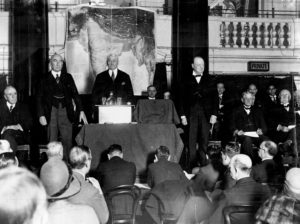
There followed a mass civil disobedience campaign, and in 1930 Gandhi led a mass march to the sea to protest the salt tax by gathering natural sea salt. Numerous arrests followed, including Gandhi, who was released from jail to attend conferences in London in 1930 and 1931 to get agreement on ending the conflict. He was arrested in his return to India. In 1933, Britain announced its intentions of allowing India greater self-government. This paved the way for the Government of India Act of 1935, which took effect in 1937.
How did Churchill’s views on India clash with those of his own party and the government?
Churchill had served in India as a young officer. He took the late-Victorian view that India was “the jewel in the crown” of the whole British Empire and that it had to be protected, no matter what, in order to maintain the empire. He took it for granted that Britain’s greatness was bound up with its imperial status. He also took the view, common among those who had served and worked in India, that British rule alone prevented the domination of the Hindu elites over the large numbers of Indian Muslims. British rule had ensured the end of what he saw as barbaric practices and meant economic and social progress. He thought that it had ensured good government, prevented endemic corruption and protected the weak. He also had a strong belief in the racial superiority of the Anglo-Saxons and in their destiny to rule over and develop “lesser” peoples.
Churchill’s attitude to proposals to introduce reforms into India led to a serious rift with Baldwin and the Conservative leadership. Churchill disliked a proposal from the Viceroy Lord Irwin (later Lord Halifax), suggesting that there should be a Round Table Conference to discuss giving India the status of a Dominion within the Empire, allowing it to govern itself along the lines of the self-governing “white” Dominions of Australia, Canada, South Africa and New Zealand. This suggestion came in the aftermath of reforms in 1909 and 1919, which had already introduced a measure of self-government in India.
Indian Independence
From September 1930 Churchill became the figurehead of a very determined opposition to change in India. In December 1930 Churchill spoke at a meeting of The Indian Empire Society, a reactionary imperialist organisation set up to oppose reform.
India – consensus politics
Some issues in British politics did not and do not become matters of party debate but political parties try to work together to get the best policy. India was one of these issues and Churchill, by not accepting this middle ground, made himself look out of touch with mainstream politics.
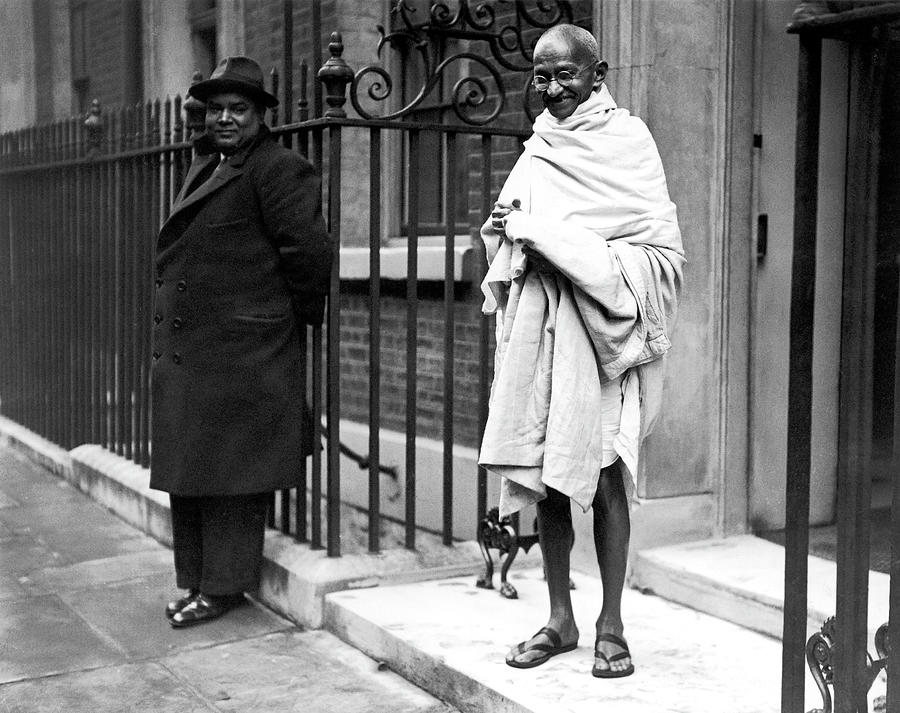
Baldwin, as Conservative leader, the Liberals and Labour members of the National Government had taken a joint stand in supporting discussions, so Churchill was taking on the entire British political establishment. Churchill was horrified by the release of Gandhi from prison to attend the London conferences in 1930 and 1931. Churchill refused to meet Gandhi and described him as “this malignant and subversive fanatic”. However, little progress was made at the meetings. While in the country Gandhi also met with the King at Buckingham Palace. When asked by a reporter if he thought wearing his traditional loin-cloth style dress was suitable attire to meet the King, Gandhi replied, “The King was wearing enough for both of us”. However, Churchill’s increasingly extreme public statements and his support of eccentric and racist organisations that were opposed to negotiations and change isolated him from the more moderate Conservatives. Stanley Baldwin undermined Churchill’s position through calm and moderate speeches and by mocking references to Churchill’s views.
In 1934 Churchill was bitter in his attacks on government ministers over India reform
proposals. Even his former supporter Leo Amery MP said that it was Churchill’s “unique achievement to stir up a hornets nest where there were no hornets”. In aiming to make Sir Samuel Hoare, the Secretary for India, resign he threatened to shatter the Conservative Party. This won him only ridicule from Conservative MPs and the deep distrust of the Conservative leadership. Yet when the Government of India Act was finally passed, Churchill stopped agitating, and even invited a close friend and political supporter of Gandhi to lunch, saying he wished India well.
Churchill and India – were his views further evidence of a racist attitude?
Views on Race
Historian John Charmley claims that Churchill believed in racial hierarchies and eugenics and that “Churchill saw himself and Britain as being the winners in a social Darwinian hierarchy.“
However, historian Richard Toye states, “The mitigation would be that he wasn’t particularly unique in having these views even though there were many who didn’t hold them”. He goes on to argue that any comparisons to Hitler’s murderous version of a racial hierarchy are unfair. However, Toye reflects that “Although Churchill did think that white people were superior, that doesn’t necessarily mean that it thought it was ok to treat non-white people in an inhumane way”.
Churchill’s grandson, Conservative MP Nicholas Soames thinks it is ludicrous to attack Churchill as Churchill was a “child of the Edwardian age and spoke the language of it.”
Poison Gas
Churchill has been criticised for promoting the use of poison gas – primarily against Afghans and Kurds. In a memo from 1919 whilst he was Minister of Air and War he wrote the following:
“I cannot understand this squeamishness about the use of gas. I am strongly in favour of using poisoned gas against uncivilised tribes. The moral effect should be so good that the loss of life should be reduced to a minimum. It is not necessary to only use the most deadly gasses: gasses can be used which cause the great inconvenience and would cause the spread of a lively terror and yet would leave no serious permanent effect on most of those affected.”
Bengal Famine
In 1943 in the Bengal region of India (still then a British possession) a horrendous famine broke out which killed an estimated 3 million people. Churchill has been criticised for his actions, or lack of action in relation to the famine. Historian Madhusree Mukerjee claims that Churchill prioritised the exportation of rice from India to feed the liberated peoples of Europe over the feeding of starving Indians. It has been claimed that Churchill blamed the Indians themselves for the famine claiming that they “bred like rabbits”.
Toye states that “its one of the worst blots on his record. Churchill viewed it as a distraction”, he explains. Preoccupied with defeating the Germans in Europe, Churchill did not want to be bothered by the issue when it was raised with him.
Abdication Crisis
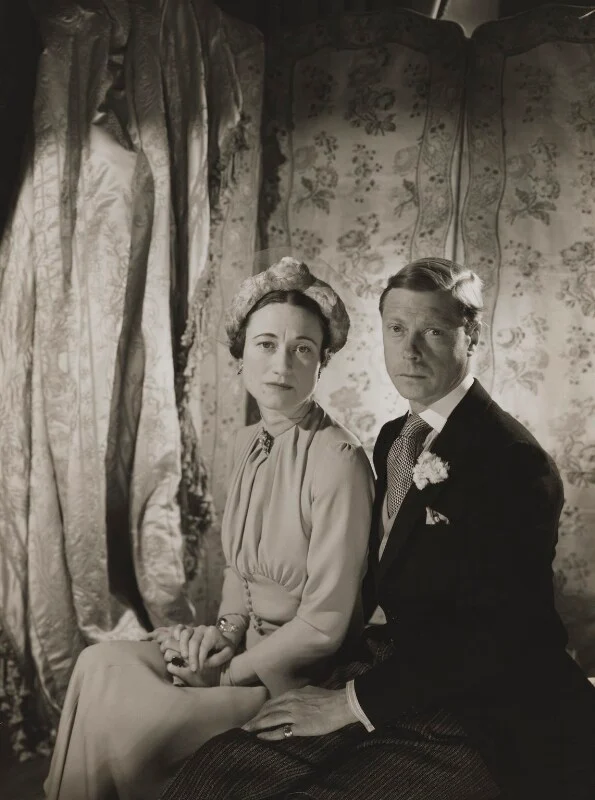
Despite the crises that Britain had faced since 1910 both at home and abroad the monarchy had been a stable element in British life. George V, who reigned from 1910 to 1936, was in many ways the first of the modern monarchs. His respectable lifestyle, in contrast to the mistresses and visits to Parisian houses of ill-repute of his father, was in accord with the desire for respectability of middle-class Britain. George V had been a solid supporter of the war effort. His bearing was dignified and suitably naval. He broadcast directly to the nation, but both he and Queen Mary kept an appropriate degree of reserve and aloofness. In many ways, he was a perfect constitutional monarch. David, his eldest son had been seen as neurotic and unstable. He had a reputation as a playboy and, despite doing his duty by serving in the armed forces during the First World War and by carrying out imperial tours and official openings, his private life was less respectable. He had a predilection for older women, regardless of whether they were already married, and for parties more typical of the “roaring twenties” than the more staid formal gatherings of his parents. He also had a tendency to make off-the-cuff remarks which could be seen as political interference. Some believed he was an admirer of Nazi Germany.
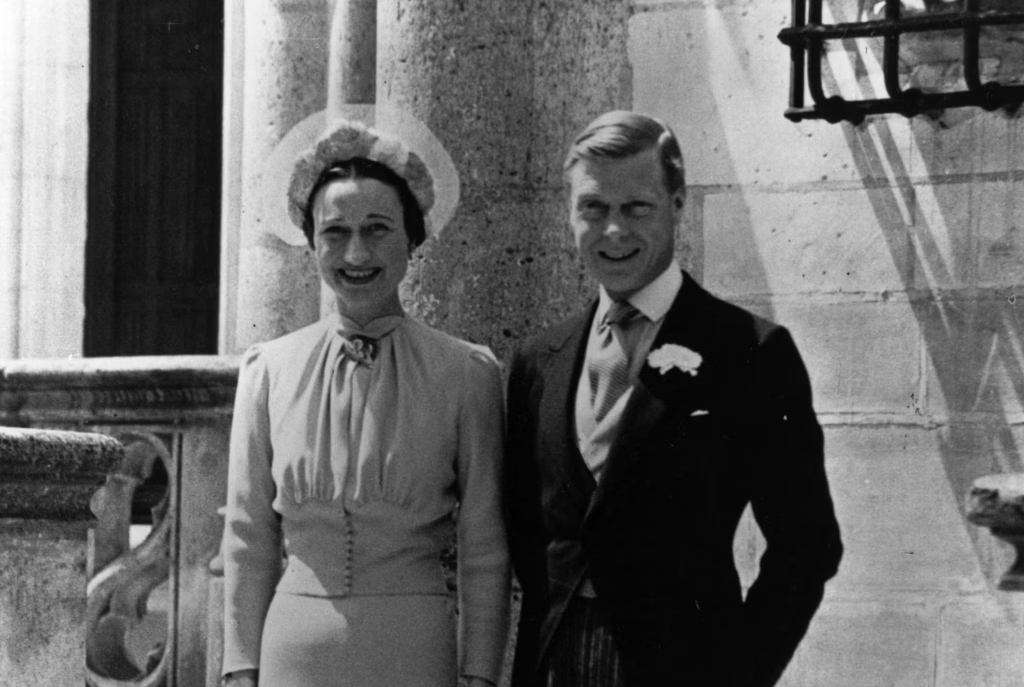
However, there had been erratic heirs in the past who had knuckled down to do their royal duties. The main problem was his attachment to Wallis Simpson, an American woman who had previously been divorced before marrying Mr Simpson. Following a second divorce from Mr Simpson in 1936, David, now King Edward VIII, was determined to marry her. This raised a considerable constitutional issue. The King was officially the head of the Church of England and, as such, was committed to defending its values, which included opposition to divorce. In November 1936, Prime Minister Stanley Baldwin told the King that public opinion would not accept Wallis Simpson as Queen. Edward proposed a morganatic marriage instead. However, this would have required parliament’s approval both in Britain and in the self-governing dominions. The cabinet did not give its approval. If the King married Wallis, then it would have meant the resignation of the government. Thus, there were very serious constitutional issues at stake at a time of dangers abroad and continuing economic difficulties.
In December 1936, Edward broadcast his speech of abdication.

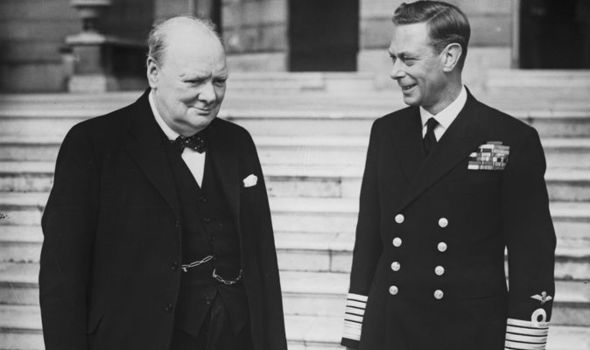
Question: What is the significance of the abdication crisis?
Churchill and the abdication
Churchill took up a minority position. He was a member of a limited and informal group called “The King’s Friends” who undertook to support the monarch for reasons of personal loyalty and chivalry. He was one of the biggest supporters of the idea of a potential morganatic marriage. However, the bulk of parliament, despite any personal sympathy, did not take that view. Churchill’s views brought him once again into direct conflict with leader of the Conservative Party and Prime Minister Stanley Baldwin. Baldwin was furious with Churchill’s ongoing meddling and support for the King. In early December Churchill experienced one of the worst days of his career as he misjudged the mood in the House of Commons and made a speech in favour of the King that was shouted down. Baldwin had “whipped” Conservative MPs into backing his moves to force the King to abdicate and Churchill was left humiliated. This marked the beginning of the end for the King, who came to realise that there was no parliamentary support for him continuing as King.
Appeasement
Nazi Germany
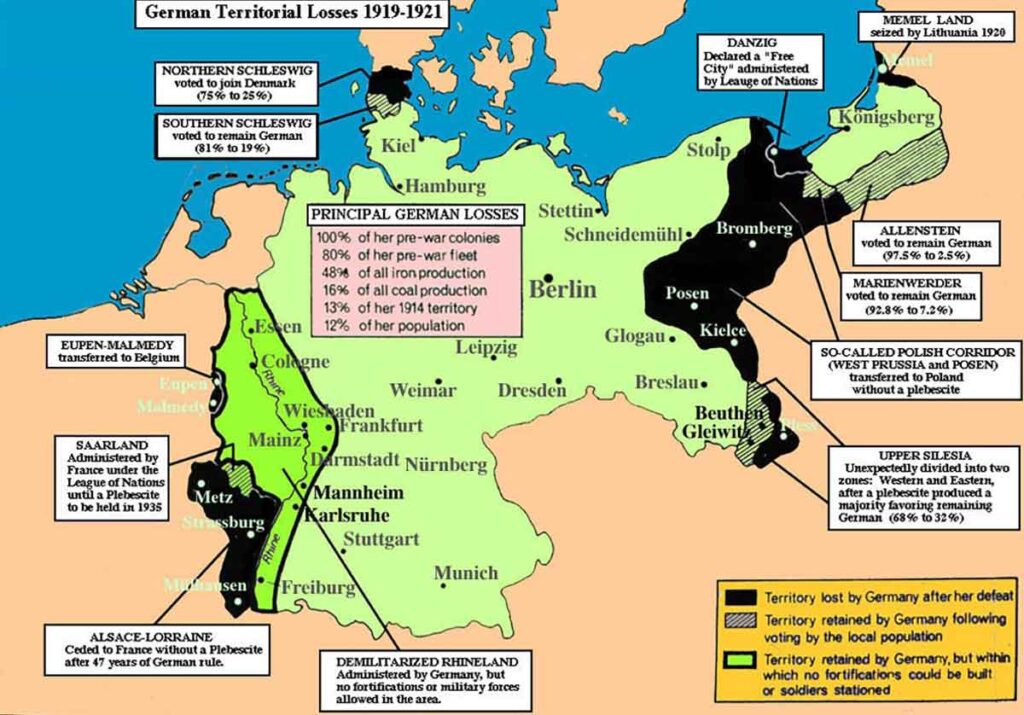
In January 1933, Adolf Hitler became Chancellor of Germany. By the summer of 1934 he had consolidated his power and became dictator of the newly labelled Third Reich. Hitler managed to achieve mass popular support in Germany through arguing for a programme of economic measures to ease unemployment, and vigorously arguing for the reversal of the despised ‘diktat’, the Treaty of Versailles.
Hitler’s Key foreign policy aims:
→ Uniting German speaking peoples
→ Recovery of lost territories
→ Rearmament
→ Lebensraum (expansion into the East
→ Union with Austria
Hitler’s earliest foreign policy actions:
→ Withdrew the League of Nations in 1933 .
→ Announces that Germany had reintroduced conscription and began rearmament in 1935.
Question: How did Hitler’s foreign policy increase international tension in the 1930s?
Rearmament in Britain
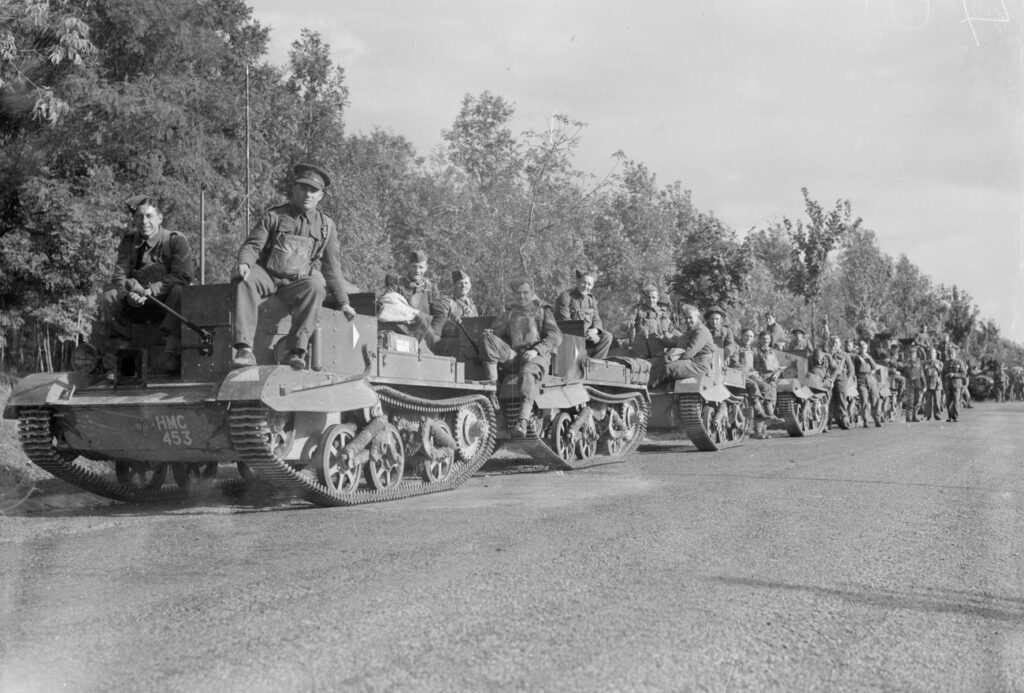
The debt that Britain had generated during the First World War meant that difficult decisions had to be made regarding cuts to government spending in the 1920s. The British adopted a belief in the “Ten-Year Rule” – which suggested that there would be no prospect of war for the next ten years, and therefore the government could make cuts to military spending without risking British interests. By 1920 the British armed forces had been reduced to 370,000 men. At the same time the German army had been reduced to 100,000 by the Treaty of Versailles. Churchill had been supportive of these cuts during the 1920s.
Was Churchill right to be concerned about the strength of the British armed forces in the 1930s?
→ The impact of the Great Depression in Britain from 1929, also did not encourage British politicians to prioritise military spending. By 1930 defence spending was below the amount spent in 1910.
→ During the 1920s Britain put its faith in international organisations and agreements such as the League of Nations and the Locarno Pact.
→ There appears to be a slight shift in policy in 1932 in the aftermath of the Manchurian crisis, with the British abandoning the “Ten-Year Rule”, however there was still no large scale move to re-arm with only £100 million spent on defence in 1933.
→ British defence spending had grown to £700 million but still lagged behind the spending of the Germans.
→ British politicians remain reluctant to make a public commitment to rearmament due to the anti-war feeling among the British public. Stanley Baldwin stated that announcing a programme of re-armament would have lost him the 1935 election.
→ In 1935 the British agree to the Anglo-German Naval Treaty which allowed the growth of the German navy to 35% the size of the British navy. Churchill was horrified.
→ Between 1932 and 1936 the number of German soldiers from 100,000 to 1 million. The British armed forces on the outbreak of war in 1939 only numbered 897,000 men.
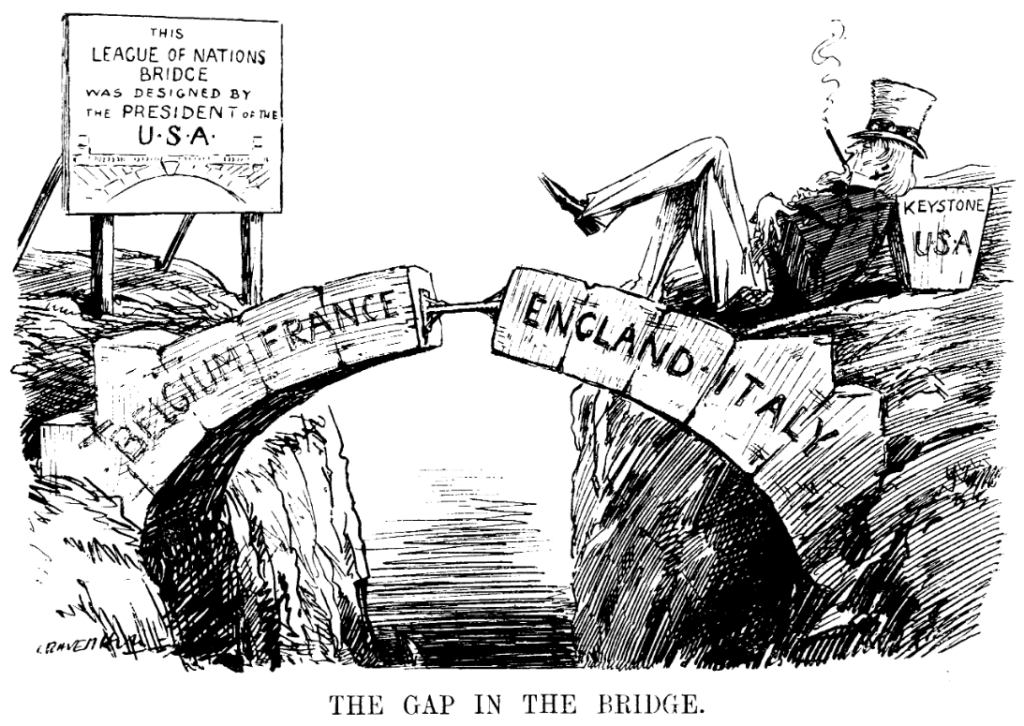
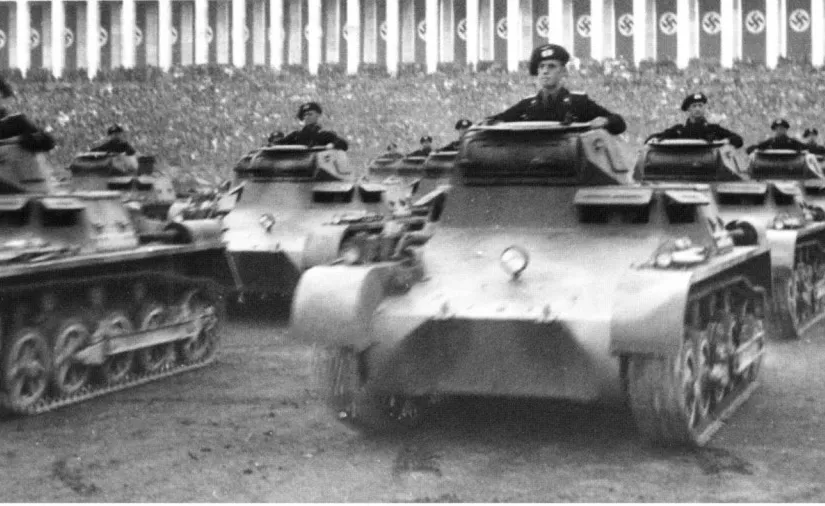
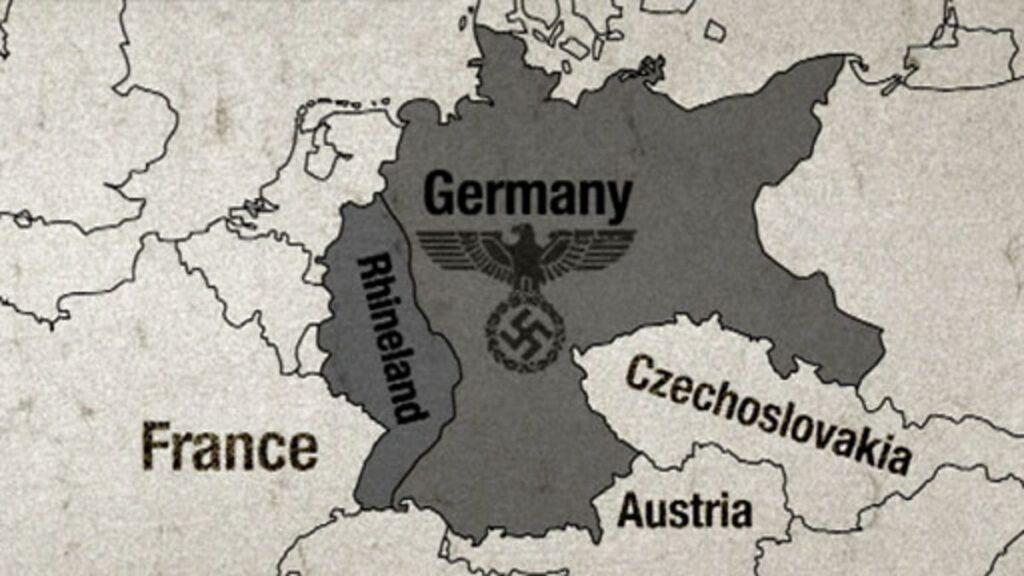
Question: How did Hitler’s foreign policy in the 1930s increase international tension?
Remilitarisation of the Rhineland
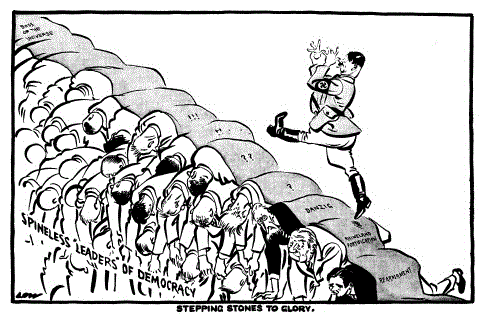
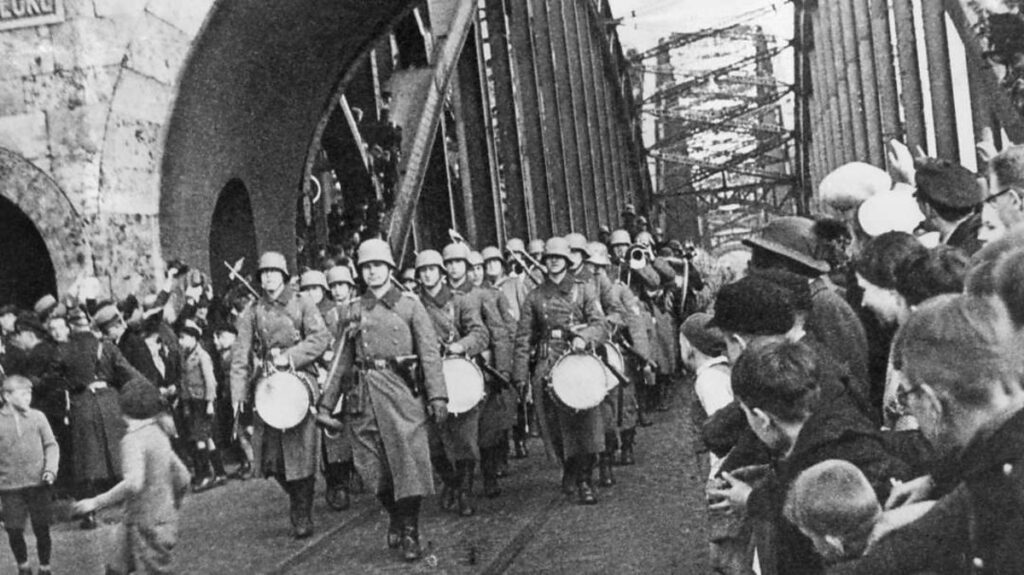
In March 1936, the Germans remilitarised the Rhineland; an area between themselves and France that was, according to the Versailles treaty, to remain demilitarised and act as a buffer zone between the two former warring nations. Since this was another breach of Versailles, Hitler gave his troops orders to withdraw at the first sign of French opposition. No resistance was offered beyond the usual protests. Hitler, well aware of the mood of pacifism among his opponents, soothed them by offering a peace treaty for 25 years. Baldwin and Eden (the new Foreign Secretary) judged that British public opinion would not have supported military action, since the Rhineland was part of Germany. Indeed, Lord Londonderry (a Conservative who was Secretary of Air from 1931 to 1935) was reported to have sent Hitler a telegram congratulating him on his success, while Lord Lothian remarked that the German troops had merely entered their own “back garden”. The Olympic Games held in Berlin in 1936, after the remilitarisation of the Rhineland, were a sign that Germany was still regarded as a “normal” European country.
Anschluss with Austria
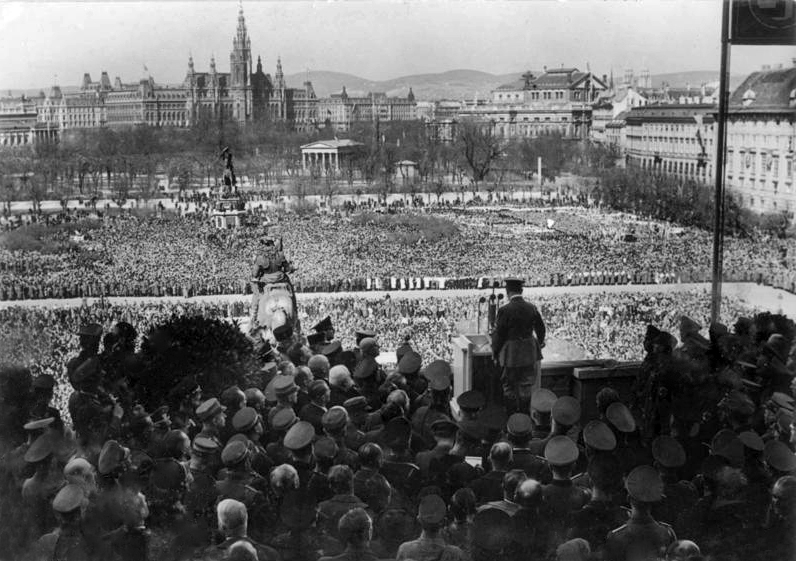
The abdication crisis also proved a distraction in 1936, and it was not until March 1938, when Neville Chamberlain was prime minister,, that the next European crisis – the annexation by Germany of Austria took place. This was Hitler’s greatest success to date. Having first reached an understanding with Mussolini (the Rome-Berlin Axis of 1936) and signed the Anti-Comintern Pact with Japan, Hitler carried out the Anschluss with Austria, a further breach of Versailles. It was a triumph for Germany: it revealed the weaknesses of Britain and France, who again did no more than protest; it demonstrated a new understanding with Italy, and it dealt a severe strategic blow to Czechoslovakia, which could now be attacked from the south as well as the west and north.
After the movement of German troops into Austria Churchill made a very dramatic speech in the Commons in which he called for a Grand Alliance and increased military commitment to France. However, at no point did Churchill suggest military action to reverse the seizure. The Grand Alliance was only a means to deter future aggression. Churchill’s response to Chamberlain’s rejection of this idea was muted. Instead he welcomed an increase in rearmament and did not resign from the Conservative Party over the issue or attempt to establish a strong opposition group to Chamberlain within the government
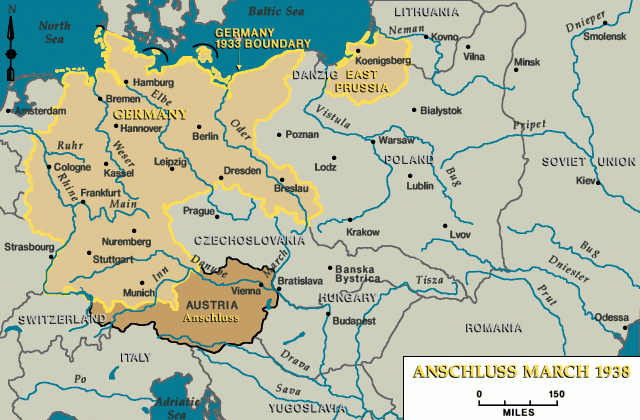
Sudetenland and the Munich Conference
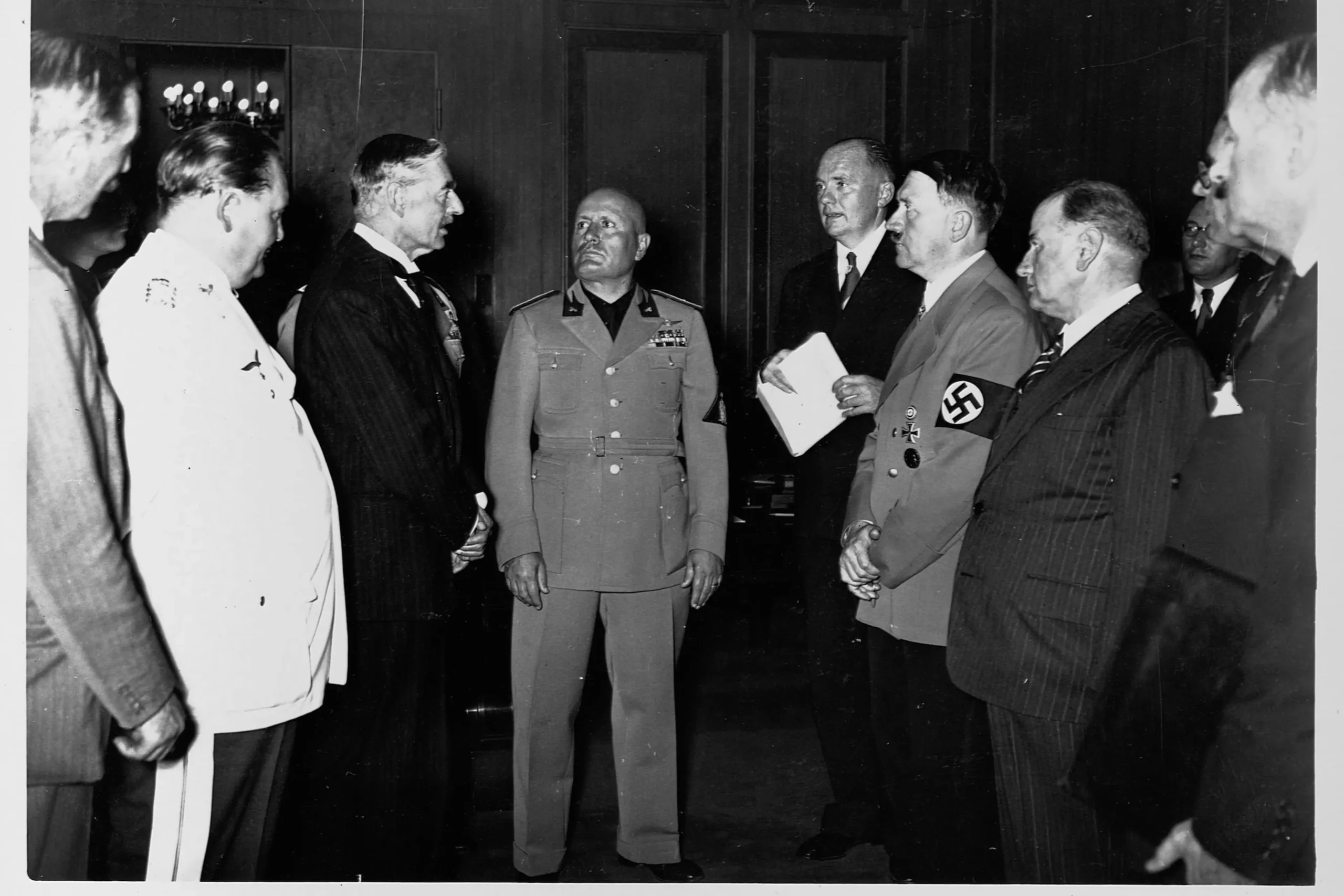
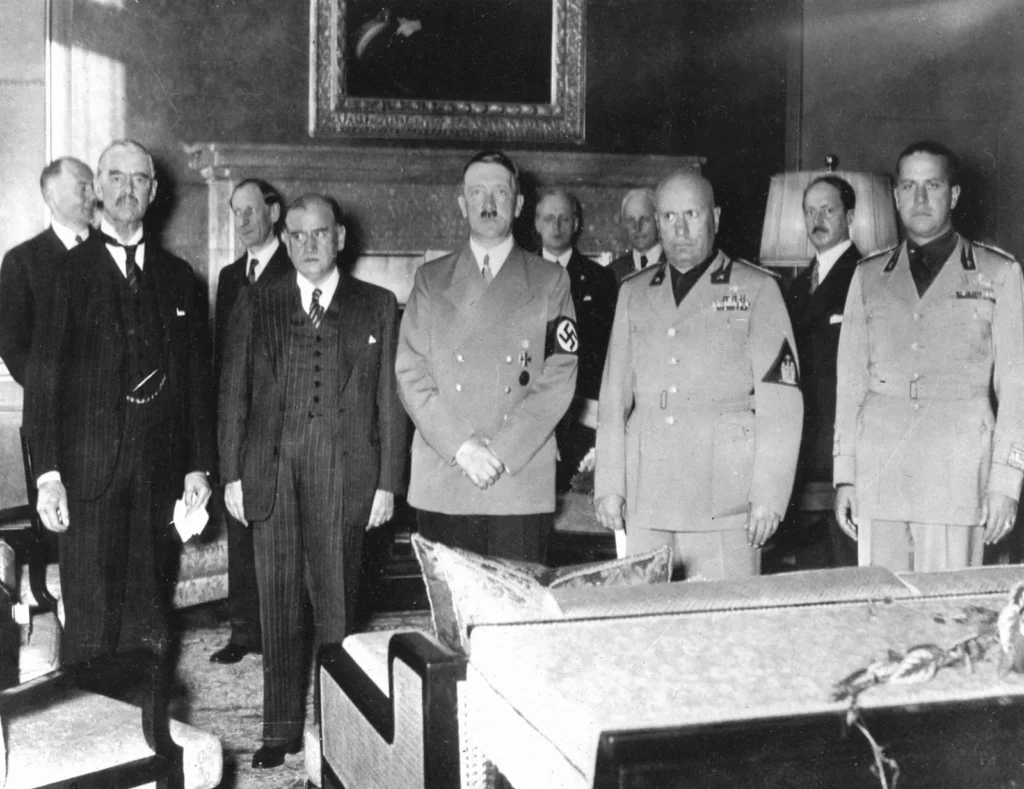
All was ready for the beginning of Hitler’s campaign to acquire the German-speaking Sudetenland, a campaign which ended in further triumph at the Munich conference in September 1938. The so-called “Sudetenland” had never been part of Germany. Czechoslovakia was a democracy, albeit one which had substantial ethnic minorities. It had alliances with both the Soviet Union and France. It seems likely that Hitler had decided to destroy Czechoslovakia as part of his lebensraum policy; he hated the Czechs for their democracy and for the fact that their state had been created by the Versailles settlement. His excuse for the opening propaganda campaign was that the 3.6 million Germans under their leader Konrad Henlein, were being discriminated against by the Czech government. The Nazis organised huge protest demonstrations in the Sudetenland, and clashes occurred between Czechs and Germans. The Czech president, Benes, feared that Hitler was deliberately stirring up trouble so that German troops could march in “to restore order”. Chamberlain and Daladier, the French Prime Minister, both feared that war between Germany and Czechoslovakia was imminent. Britain was not obliged to act, but the French were. If France supported the Czechs, who had a large army of 35 divisions, then there would be a European war which Britain could not have ignored. Chamberlain’s government put pressure on the Czechs to make concessions and, as agitation grew among the German speakers in Czechoslovakia, and Hitler’s speeches became more war-like, Chamberlain took a bold decision in flying to see Hitler to negotiate an agreement.
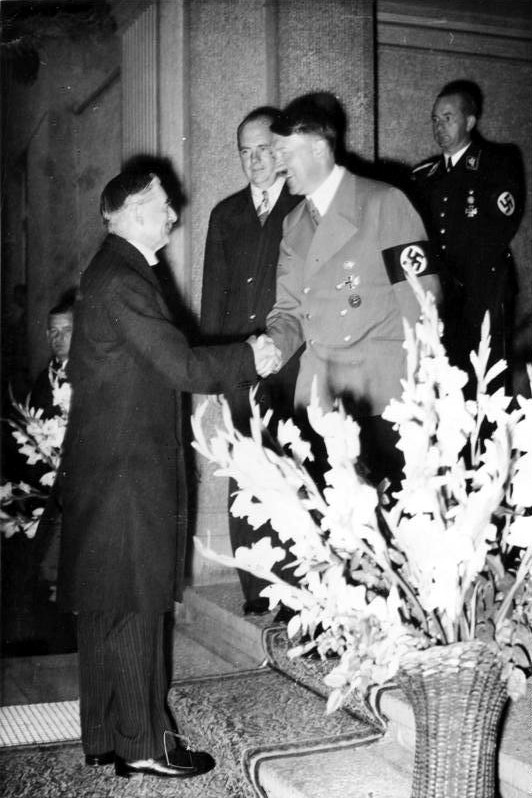
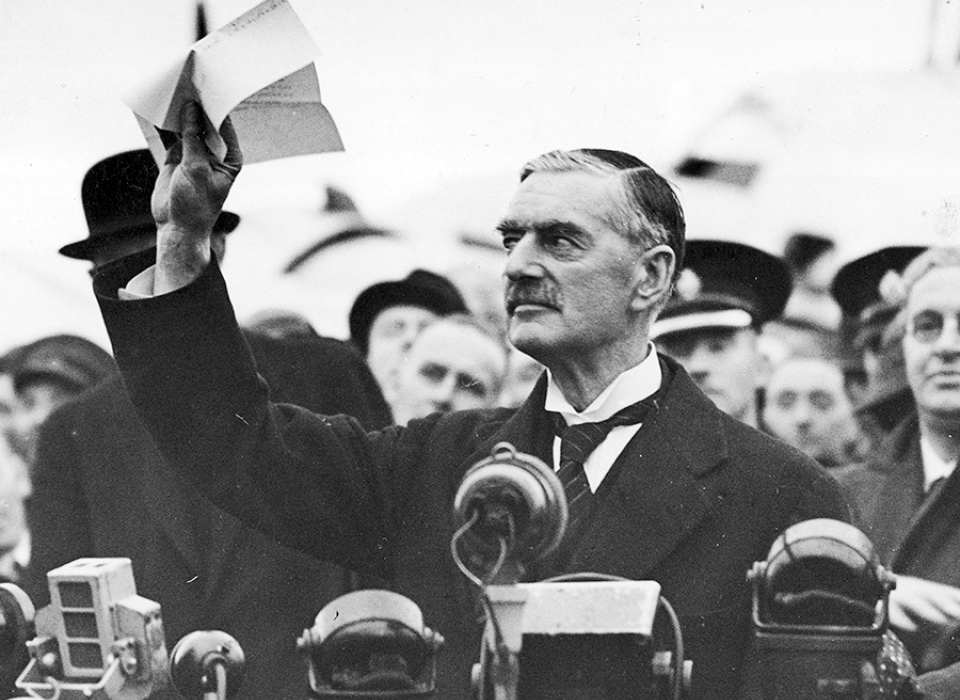
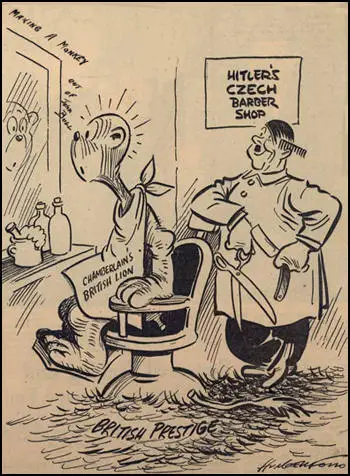
There was no attempt to involve the League of Nations and very little discussion with what would now be called the international community. Chamberlain acted virtually alone in an attempt to avoid having to take a decision about whether to join a war. However, this meeting ended in failure. There was much relief when Mussolini offered mediation and a four-power conference met at Munich in September 1938. There was little attempt to resist Hitler’s demands. The conference had been suggested by Hitler’s fellow dictator with whom he was allied in the grand-sounding, but not very binding, Pact of Steel. The French Government was anxious not to fulfil its obligations to the Czechs. Chamberlain pursued personal diplomacy and, without consultation, asked Hitler to sign a pact guaranteeing future consultation. He regarded this as somehow a diplomatic triumph. He waved it to cheering crowds on his return and claimed that he had gained “peace for our time”. There was tremendous admiration for Chamberlain’s efforts to keep peace, and leading military figures were relieved. Chamberlain was given large numbers of gifts by admiring members of the public and songs were composed in his honour. However, when the immediate relief had subsided there was growing concern. Churchill memorably expressed it when he said in a debate on Munich that Britain had suffered a defeat.
Annexation of Czechoslovakia
On his return from the Munich Conference, Chamberlain told the cabinet that he had established some influence over Hitler, a man who would be “rather better than his word”. It is open to debate as to whether Chamberlain really understood the sort of man Hitler was; he persisted in treating him as a responsible statesman and ignored his ill-treatment of the Jews and the mass of evidence (for example, the way he increased his demands when he realised that Chamberlain was committed to maintaining peace at all costs), suggesting Hitler was not reliable. Critics of the Munich settlement, such as Churchill, were right; Czechoslovakia was crippled by the loss of 70% of its heavy industry, and almost all its fortifications so that it looked as though the country was about to fall apart. Hitler pressurised President Hacha into requesting German help “to restore order”. Consequently, in March 1939, German troops occupied the rest of Czechoslovakia. Britain and France protested but took no action: according to Chamberlain, the guarantee of Czech frontiers did not apply because technically Czechoslovakia had not been invaded: German troops had entered by invitation. However, the German action caused a great outburst of criticism: for the first time, the appeasers were unable to justify what Hitler had done – he had broken his promise and seized non-German territory. Even Chamberlain and Halifax felt this was going too far, and their attitude hardened. Public and political opinion in Britain changed after 1938 and especially after the events of March 1939. If Munich was repeated, then European democracy had no real future and neither did Britain’s position as a great power.
Declaration of war
Neville Chamberlain announces war with Germany, broadcast by the BBC Home Service at 11.15 am BST on 3 September 1939.
Invasion of Poland
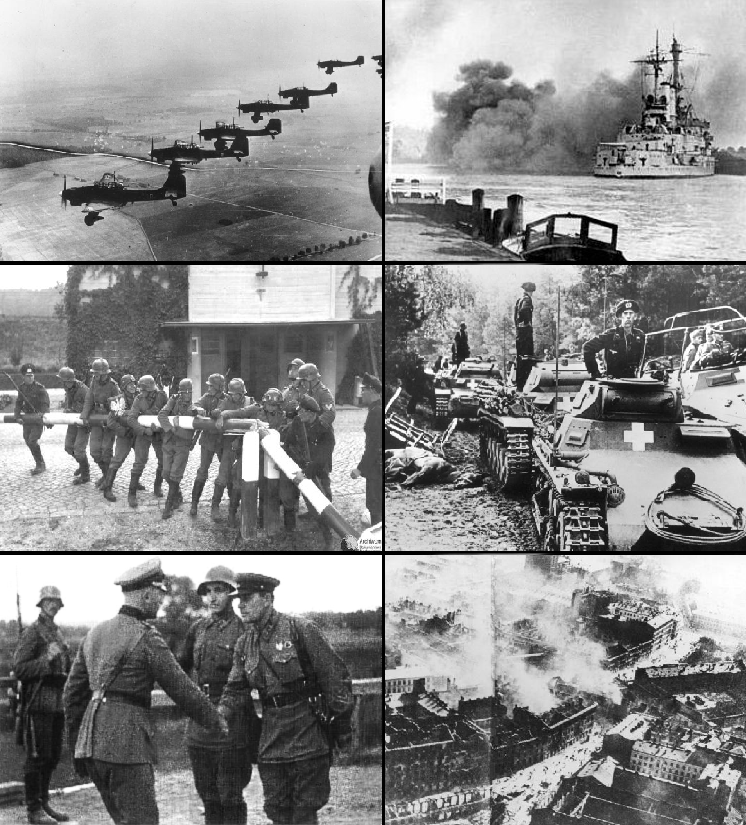
Hitler soon turned his attention to Poland. The Germans resented the loss of Danzig and the Polish Corridor at Versailles, and now that Czechoslovakia was safely out of the way, Polish neutrality was no longer necessary. At the end of March 1939, Chamberlain still outraged at the German occupation of Prague, wrote to the Polish government promising them that if their independence was threatened, Britain and France “would at once lend them all the support in their power”. In April Hitler demanded the return of Danzig and a road and railway across the Corridor. This demand was, in fact, not unreasonable since Danzig was largely German speaking; but coming so soon after the seizure of Czechoslovakia, the Poles were convinced, probably rightly, that the German demands were only a prelude to invasion. Chamberlain now began to have second thoughts as the threat of war increased again. Britain urged the Poles to surrender Danzig, but the Poles stood firm.
Meanwhile, there was pressure from certain quarters in Britain for some sort of alliance with the USSR. The Labour Party, Lloyd George and Churchill all pointed out that the promise of British help to Poland was meaningless without military help from the Russians, who could threaten Germany’s eastern frontier. However, both Chamberlain and Halifax detested Communism and were sceptical of Russia’s military strength. The negotiations dragged on without any result, and in the end, the Russians grew tired of British stalling and signed a non-aggression pact with Hitler in August. Hitler was now convinced that with Russia neutral, Britain and France would not risk intervention; when the British ratified their guarantee to Poland, Hitler took it as a bluff. When the Poles still refused to negotiate, a full-scale German invasion began early on 1st September 1939. Chamberlain had not completely thrown off appeasement and still shrank back from committing Britain to war. He suggested that if German troops were withdrawn, a conference could be held – there was no response from the Germans. Only when pressure mounted in parliament and in the country did Chamberlain send an ultimatum to Germany. When this expired at 11 am on 3rd September, Britain was at war with Germany. Soon afterwards France also declared war.
German Aggression 1938-1939 – Churchill’s Response
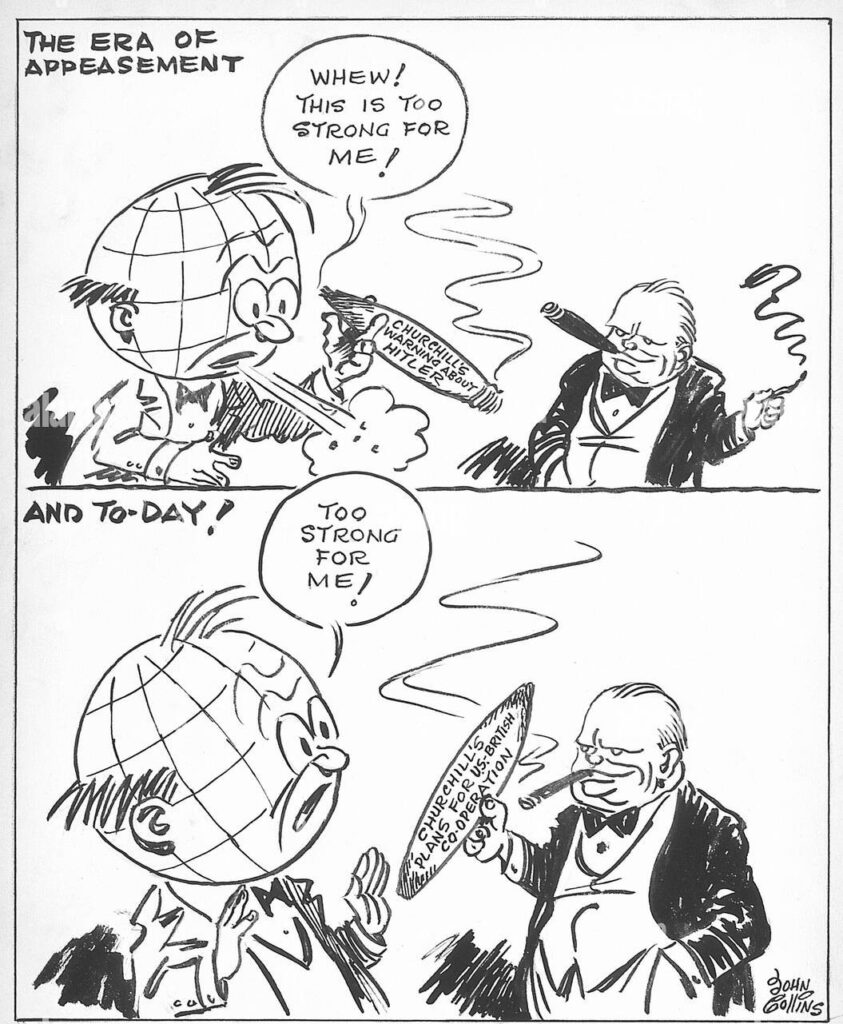
When Hitler began backing the demands of Germans in the Sudetenland there was the danger of a major European crisis. Churchill, unlike some Conservative MPs, did not favour staying out of European affairs. But he rejected the second option – of taking steps to prevent war by persuading the Czechs to make concessions and to persuade Hitler to accept those concessions which were short of outright annexation. There were considerable objections to this. It assumed that it was possible to negotiate meaningfully with Hitler; that what was at stake was really revision of the Treaty of Versailles with Hitler’s pronouncements about dominating Europe and the destruction of communism and European Jewry dismissed as crowd-pleasing rhetoric. It ruled out collective security and indicated that Britain now thought the League of Nations was now irrelevant. It also ruled out joint action with France and the Soviet Union and a possible Grand Alliance of countries ready to stop German aggression. The morality of handing over virtual control of part of another country’s territory, endangering the anti-Hitler Germans who lived in Czechoslovakia and giving in to obvious aggressive agitation was also a problem.
It was the later points that moved Churchill. His view was that it was moral cowardice to give in to aggression; that a firm stand with both the League and a widespread alliance of other nations was necessary; and that Britain had shown weakness which would encourage further German expansion. Oddly, the idea that Poland might be next on the list was not discussed as Churchill did not foresee an end to the friendly relations established between Germany and Poland in 1934. The implication in Churchill’s view was that, if necessary, Britain should have gone to war, thought this was not very clearly and directly stated. At the very least he thought there should have been a forceful response which opposed Germany, made in conjunction with an alliance of other nations.
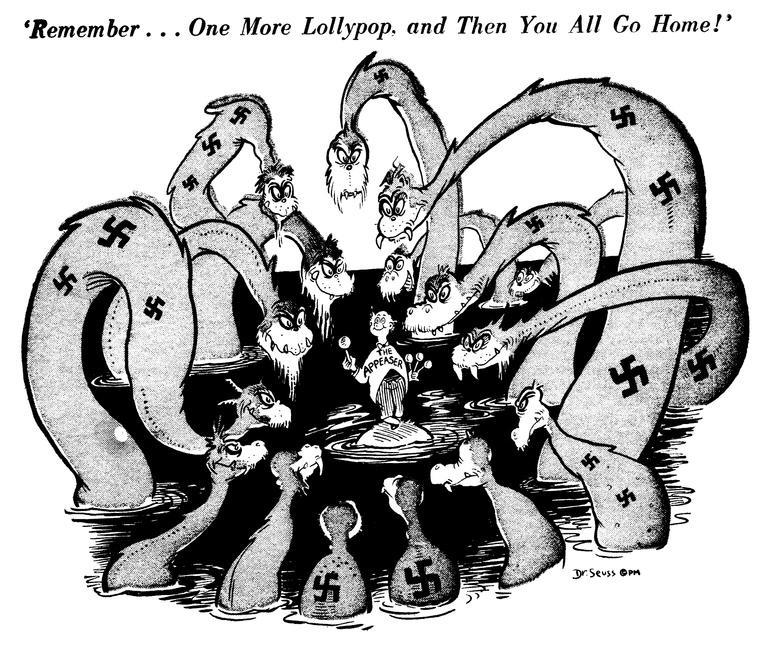
Question: What was the policy of appeasement?
Arguments against Churchill’s view
The idea that Britain should have gone to war in 1938 is where Churchill’s analysis began to break down.
→ If opposition to Hitler had led to war, who would Britain’s allies be? There had been no discussions with France or any other country of any joint action in case of war.
→ The British did not have an expeditionary force ready for war. Its troops were tied down in peace-keeping activities in the Empire, particularly in Palestine.
→ Any move to war had to take into account that either or both of Italy and Japan would take advantage of war in Europe to threaten Britain’s vital interests – Egypt and the Suez Canal and India, South East Asia and even Australia – which could not be easily defended. Churchill had very little understanding of the vulnerability of Britain in the Far East and his speeches and writings barely considered that in 1938 Japan was fighting bitter expansionist war in China and needed the raw materials of western colonies in South East Asia – rubber, ores and oil.
→Churchill had been relentlessly hostile to the communist Soviet Union which was undergoing massive internal change in the 1930s. It was unlikely that any meaningful alliance could be made with Stalin, given the concerns about Russian activities in the Spanish Civil War and the distrust in France of communism, let alone the hostility of conservative opinion in Britain.
→ France had looked consistently to Britain to provide excuses for not acting. There were no plans for a 1914-style French attack on Germany and little hope of linking up with Czech resistance. Opinion in France was profoundly opposed to any action which risked a repeat of the heavy losses of 1914-18 and the vast defensive Maginot Line was a defensive measure, not a means of attacking Germany and saving the Czechs.
→ The smaller nations of eastern Europe would not have been militarily effective, even if they had decided to join Britain in war against Germany; many of them were more concerned about the threat from the Soviet Union.
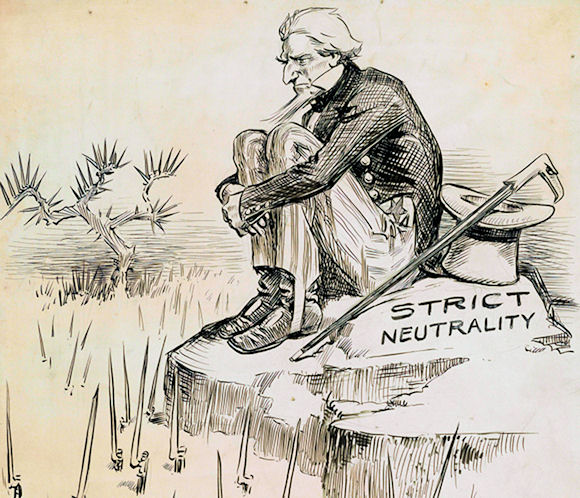
→ The majority of public opinion in the USA favoured isolationism; the Neutrality Acts passed by Congress prevented even supplying other countries engaged in war, let alone joining them. US concern was focused not on Europe but on the Pacific where the threat of Japan was more pressing.
→Churchill expressed enthusiasm for the League of Nations, but that had proved consistently ineffective in preventing aggression since 1931.
In many ways Churchill could propose no real alternative to appeasement. His critics in the House of Commons were quick to point out the flaws in his logic, but really that was to miss the point. His rhetoric hit the mark when he spoke of moral defeat as it summed up a lot of the concerns about the future that critics of Chamberlain felt.
Question: To what extent was the policy of
appeasement successful?
Exam Zone
This section has been designed to help you build confidence, sharpen your skills, and achieve your best possible results. Whether you are preparing for mock exams, end-of-unit tests, or final assessments, the Exam Zone provides everything you need in one place.
The Exam Zone is not just about testing your knowledge. It is about developing the key historical skills required for success: critical thinking, evaluation, and clear written communication. By practising regularly and reflecting on feedback, you will strengthen both your understanding of the past and your performance in exams.